

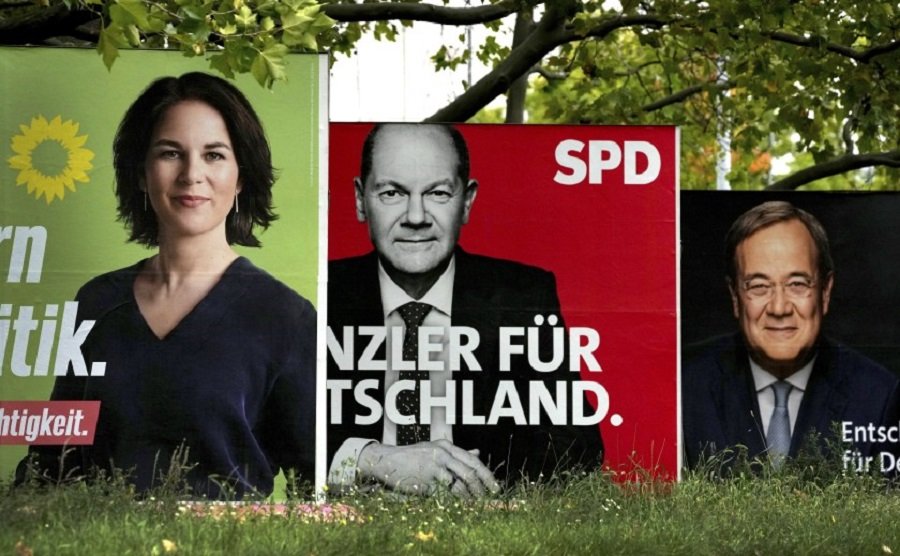

Germany’s centre-left Social Democrats (SPD) have secured a narrow win over outgoing Chancellor Angela Merkel’s conservatives in national elections with party leader Olaf Scholz claiming a “clear mandate” to form the government for the first time since 2005.
Preliminary results on Monday morning showed the SPD on track for 26.0 percent of the vote, ahead of 24.1 percent for Merkel’s CDU-CSU conservatives, the worst by the CDU in 70 years.
Figures on the election commission’s website showed the Green party came third with 14.8 percent. An official announcement from the Federal Returning Officer is expected shortly.
With neither main group commanding a majority, and both reluctant to repeat their awkward “grand coalition” of the past four years, the most likely outcome of the vote is a three-way coalition with the environmentalist Greens and the business-friendly Free Democrats.
Negotiations could take months, and the SPD is likely to be given the first chance to form a government.
“We are ahead in all the surveys now,” Scholz, the SDP’s chancellor candidate and the outgoing vice-chancellor and finance minister, said in a roundtable discussion with other candidates after the vote.
“It is an encouraging message and a clear mandate to make sure that we get a good, pragmatic government for Germany,” he added after earlier addressing jubilant SPD supporters.


The Greens, who made their first bid for the chancellery with co-leader Annalena Baerbock, improved on their performance in 2017.
Baerbock insisted that “the climate crisis … is the leading issue of the next government, and that is for us the basis for any talks … even if we aren’t totally satisfied with our result.”
Two parties were not in contention to join the next government.
The Left Party was projected to win less than five percent of the vote and risked being kicked out of parliament entirely while the far-right Alternative for Germany, which no one else wants to work with, saw its vote share declining to about 10.6 percent – about 2 percentage points less than in 2017 when it first entered parliament.
Lacklustre showing
The election is the first since Germany was reunified in 1990 that Merkel was not a candidate.
Armin Laschet, who outmanoeuvred a more popular rival to secure the nomination of Merkel’s conservatives, had struggled to motivate the party’s base.
“Of course, this is a loss of votes that isn’t pretty,” Laschet admitted.
The results looked set to be worse than the 31 percent recorded in 1949, but Laschet added that with Merkel stepping down after 16 years in power, “no one had an incumbent bonus in this election.”
Berlin-based political analyst Olaf Boehnke said the results were a “very serious defeat” for the conservative bloc, describing Laschet as a “weak” candidate.
The party will meet later on Monday to decide who will lead the party in the Bundestag, the German parliament.
“That will be the first indicator for us to see if Armin Laschet will be in any important position in the CDU or not,” he said. Courtesy: Al-Jazeera

