

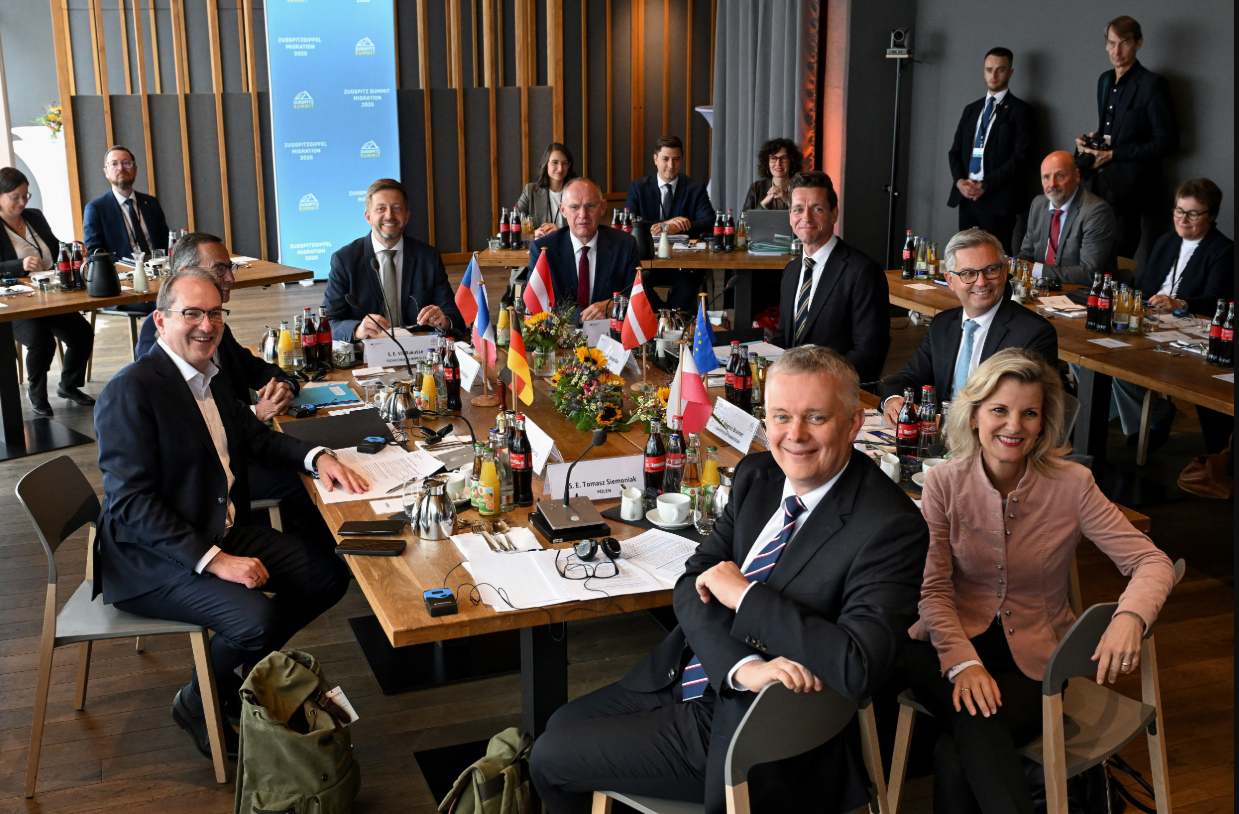

Germany and five European Union allies have agreed to a tougher asylum crackdown policy aimed at curbing illegal migration and expediting deportations. Led by Germany’s Interior Minister Alexander Dobrindt, the meeting brought together officials from France, Poland, Austria, the Czech Republic, and Denmark, along with EU Home Affairs Commissioner Magnus Brunner. The gathering, held at Germany’s Zugspitze peak, focused on creating a unified framework for a comprehensive asylum crackdown across Europe.
The proposed measures under the asylum crackdown include restoring deportations to conflict zones like Afghanistan and Syria, transferring rejected asylum seekers to secure facilities outside the EU, and carrying out asylum procedures in third countries. While these recommendations require approval from Brussels, the participating countries stressed urgency in tackling illegal migration and the rising strain on their asylum systems.
The asylum crackdown initiative follows Germany’s controversial move in May to reject asylum seekers at its borders, a policy reportedly coordinated with neighboring nations but widely criticized for bypassing broader EU consensus. The decision echoes tensions within the bloc that have persisted since former Chancellor Angela Merkel opened Germany’s borders to refugees nearly a decade ago.
During the meeting, Germany’s Interior Minister highlighted how illegal migration contributes to social polarization across Europe. He underscored the need to reduce public backlash by tightening control over migration through a robust asylum crackdown. As part of this policy, Germany recently deported 81 Afghan nationals.
The joint declaration also linked cooperation on deportations to diplomatic consequences. Countries that do not accept deported citizens could face visa sanctions, while development aid and trade benefits may be reassessed. The asylum crackdown also seeks increased funding for border personnel and infrastructure, as well as broader deployment of surveillance technologies like drones.
Combatting human smuggling and dismantling trafficking networks were also central to the asylum crackdown discussion. Officials agreed that asylum seekers granted protection in one EU country should not be allowed to reapply in another—a policy designed to close loopholes that burden national systems.
Polish Interior Minister Tomasz Siemoniak noted that once external EU borders are sealed, internal border controls could be lifted. He expressed willingness to remove controls at Poland’s border if Germany reciprocates, illustrating how the asylum crackdown could also influence broader EU mobility policies.
With migration remaining a politically sensitive issue across Europe, the proposed asylum crackdown is expected to face both domestic and EU-level debate in the weeks ahead.

1 Comment
Wonderful beat I wish to apprentice while you amend your web site how could i subscribe for a blog web site The account aided me a acceptable deal I had been a little bit acquainted of this your broadcast provided bright clear idea