

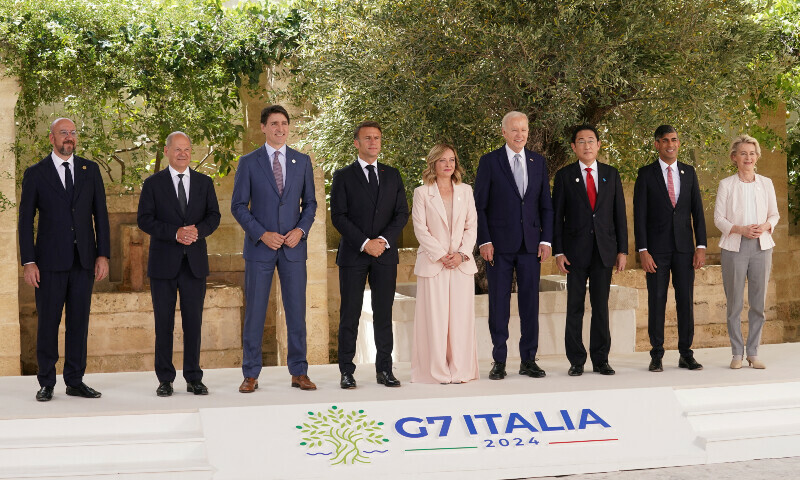

Leaders of the Group of Seven (G7) major democracies have agreed on a preliminary deal to provide $50 billion in loans to Ukraine using interest from Russian sovereign assets frozen after Moscow’s 2022 invasion of its neighbor. This political agreement was a highlight of the opening day of the annual G7 summit in southern Italy, attended for the second consecutive year by Ukraine’s President Volodymyr Zelenskiy.
President Zelenskiy is set to sign a new long-term security accord with U.S. President Joe Biden, as well as a similar agreement with Japan, another G7 member. Many G7 leaders are facing domestic challenges but are committed to making a global impact and countering China’s economic ambitions.
“There is a lot of work to be done, but I am sure that in these two days, we will be able to have discussions that will lead to concrete and measurable results,” said Italian Prime Minister Giorgia Meloni, welcoming her G7 counterparts at a luxury hotel resort in Puglia.
The G7’s plan for Ukraine involves a multi-year loan leveraging profits from approximately $300 billion in impounded Russian funds. The technical specifics are expected to be finalized in the coming weeks, with additional funding to be delivered by the end of the year. A senior U.S. official noted that the U.S. has agreed to provide up to $50 billion, though this figure could decrease as other countries contribute.
The aim is to ensure the deal’s longevity, regardless of changes in leadership within the G7, addressing concerns that U.S. Republican presidential candidate Donald Trump might be less supportive of Kyiv if he defeats Biden in November.
While Meloni is enjoying political success following recent European elections, leaders of the other six nations— the United States, Japan, France, Germany, Britain, and Canada—are dealing with significant domestic issues that could undermine their leadership.
Middle East Concerns
The G7 leaders also expressed concerns about the Israel-Lebanon border situation and endorsed U.S. efforts to secure a ceasefire in the Gaza Strip. They urged Israel to avoid a full-scale offensive in Rafah, in line with international law.
Western nations voiced unanimous concern over China’s industrial overcapacity, which is distorting global markets, and showed determination to support economic development in African states.
Summit Dynamics
The G7 may look different next year as Biden faces a tough re-election battle, and British Prime Minister Rishi Sunak is likely to lose power in an upcoming national poll. French President Emmanuel Macron dissolved his parliament following his party’s defeat in the European vote.
All leaders greeted Meloni warmly at the Borgo Egnazia resort, where they will spend two days in sessions. The summit will later be opened to other leaders, including Pope Francis, who will give a keynote speech on Friday about the risks and potential of Artificial Intelligence.
Invited guests also include leaders from major regional powers such as India, Brazil, Argentina, Turkey, Algeria, and Kenya. Although the summit is scheduled to run until Saturday, many G7 leaders, including Biden, will depart on Friday night. The final day will be dedicated to bilateral meetings and a closing news conference by Meloni.
