

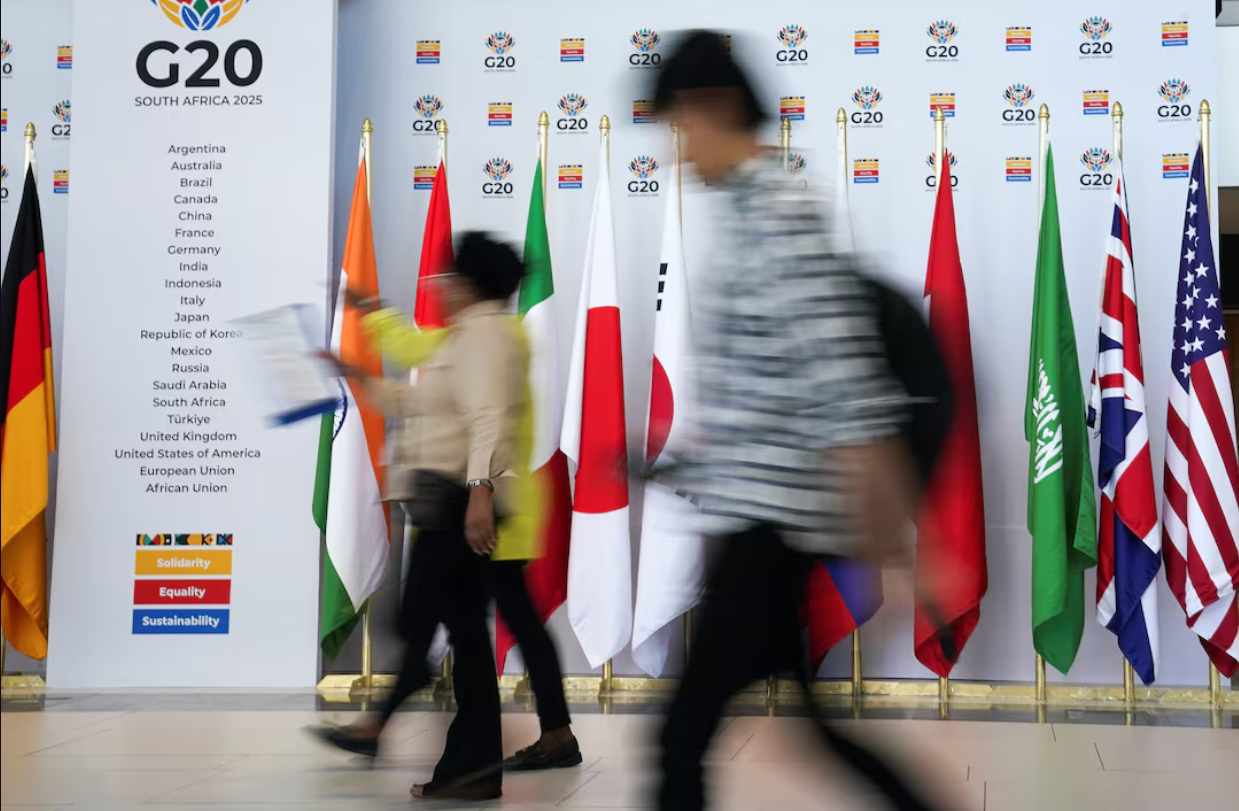

Finance ministers and central bank governors from the world’s top 20 economies are meeting in South Africa on Wednesday and Thursday, but the gathering is overshadowed by the absence of key officials and ongoing disputes over critical issues such as climate finance, debt relief, and economic inequality.
Reaching a consensus has always been a challenge for a group that includes geopolitical rivals like China, Russia, the European Union, and the United States. However, divisions are more pronounced than ever, with some finance ministers skipping the event due to domestic priorities.
Japan’s Finance Minister Katsunobu Kato is absent due to a parliamentary debate, while U.S. Treasury Secretary Scott Bessent and EU Economy Commissioner Valdis Dombrovskis have also opted not to attend.
Hopes for agreement on the key concerns highlighted by host President Cyril Ramaphosa—namely the lack of sufficient climate funding from wealthy nations, the reform of a financial system that disadvantages poorer countries, and widening global inequalities—appear slim.
“These global priorities are under threat,” said Alex van den Heever, a political scientist at the University of Witwatersrand in Johannesburg. He noted that debt relief for struggling nations is not a primary concern for the United States or other developed economies.
Climate Finance Challenges
South Africa aimed to use the G20 platform to push for greater commitments from wealthier nations in addressing climate change and assisting poorer countries in transitioning to sustainable energy and adapting to extreme weather conditions.
“Those most responsible for climate change have an obligation to support those least responsible,” Ramaphosa emphasized last week.
Energy Minister Kgosientsho Ramokgopa warned that shifting priorities, particularly under the U.S. administration, could reshape the discussions. “The American presidency has a way of revisiting settled matters, altering the discourse,” he told Reuters on the sidelines of a G20 briefing. He also suggested that some nations might reconsider the scale and timeline of their transition from fossil fuels to renewable energy.
Some analysts argue that the absence of the world’s largest economy raises questions about the G20’s relevance. Others, however, see an opportunity for progress without U.S. influence.
“This situation could create new synergies among the remaining members, allowing them to advance on specific issues,” said Daniel Silke, director of the Political Futures Consultancy. “It also presents an opportunity for South Africa to assert its leadership role.”
