

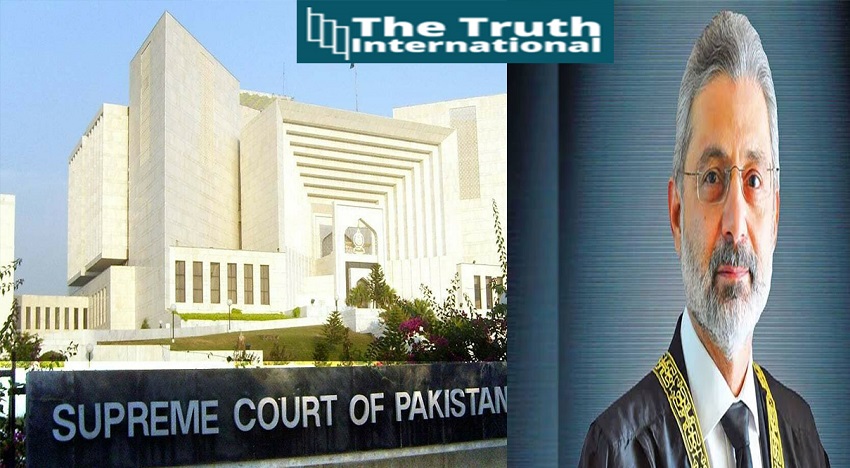

ISLAMABAD: Chief Justice of Pakistan Justice Qazi Faez Isa said that a full-court could be formed for the hearing of the suo motu on the IHC judges’ complaint about the interference by the executives in the judicial matters.
CJP stated this on Wednesday during the hearing of the suo motu case.
Qazi Isa said that the full court will conduct the next hearing of the suo motu case.
A seven-member bench of the Supreme Court, led by Chief Justice Qazi Faez Isa and including Justices Syed Mansoor Ali Shah, Yahya Afridi, Jamal Khan Mandokhel, Athar Minallah, Musarrat Hilali, and Naeem Akhtar Afghan, presided over the hearing on Wednesday.
The proceedings are being broadcast live by the Supreme Court.
Chief Justice Isa emphasized the importance of judges’ safety during the hearing, stating that they must ensure they are not endangered. He clarified that he cannot exercise contempt power on behalf of another court, as the court in contempt must wield that authority itself. The chief justice asserted a zero-tolerance policy towards any threats to judicial independence.
In response to demands for a suo motu notice, Chief Justice Isa questioned the absence of full-court meetings over the past four years, emphasizing that the full court primarily handles administrative, not judicial, functions.
He reaffirmed his commitment, along with his colleagues, to defending judicial independence, yet expressed disdain for interference in judicial affairs, urging those with agendas to pursue the role of chief justice if they seek to exert pressure.
During the hearing, the Attorney General of Pakistan outlined the sequence of events following the letter from Islamabad High Court judges, including meetings between Chief Justice Isa and the concerned judges.
Regarding the appointment of former Chief Justice Tasadduq Hussain Jillani to head the inquiry commission, Chief Justice Isa clarified that the meeting was administrative and conducted transparently, without secrecy.
Addressing discussions on social media about Justice (retd) Jilani, the chief justice underscored the court’s lack of constitutional authority to establish a commission, emphasizing that the government holds that prerogative.
The Attorney General assured the court of the federal government’s commitment to preserving judicial independence, emphasizing legal constraints on government interference in the inquiry commission.
Chief Justice Isa criticized the influence of social media, lamenting the pressure stemming from the letter and subsequent events.
He noted changes in case decision-making processes, stating that a three-member committee now holds authority, reducing the significance of the chief justice’s individual influence.
Expressing frustration over premature media publication of petitions and lawyer pressure for suo motu notices, Chief Justice Isa asserted his independence from external pressures, suggesting that lawyers seeking such notices should reconsider their legal practice.
The Attorney General reaffirmed the government’s support for judicial independence before concluding his arguments.
