


Wardah Rafique
For decades, debates over Pakistan’s provincial boundaries have centered on political wins and losses. But for ordinary citizens, the question is simple: will services actually reach them? Will doctors make it to remote villages on time? Will teachers show up in classrooms? Will land disputes be resolved without endless trips to Lahore, Karachi, Quetta, or Peshawar?
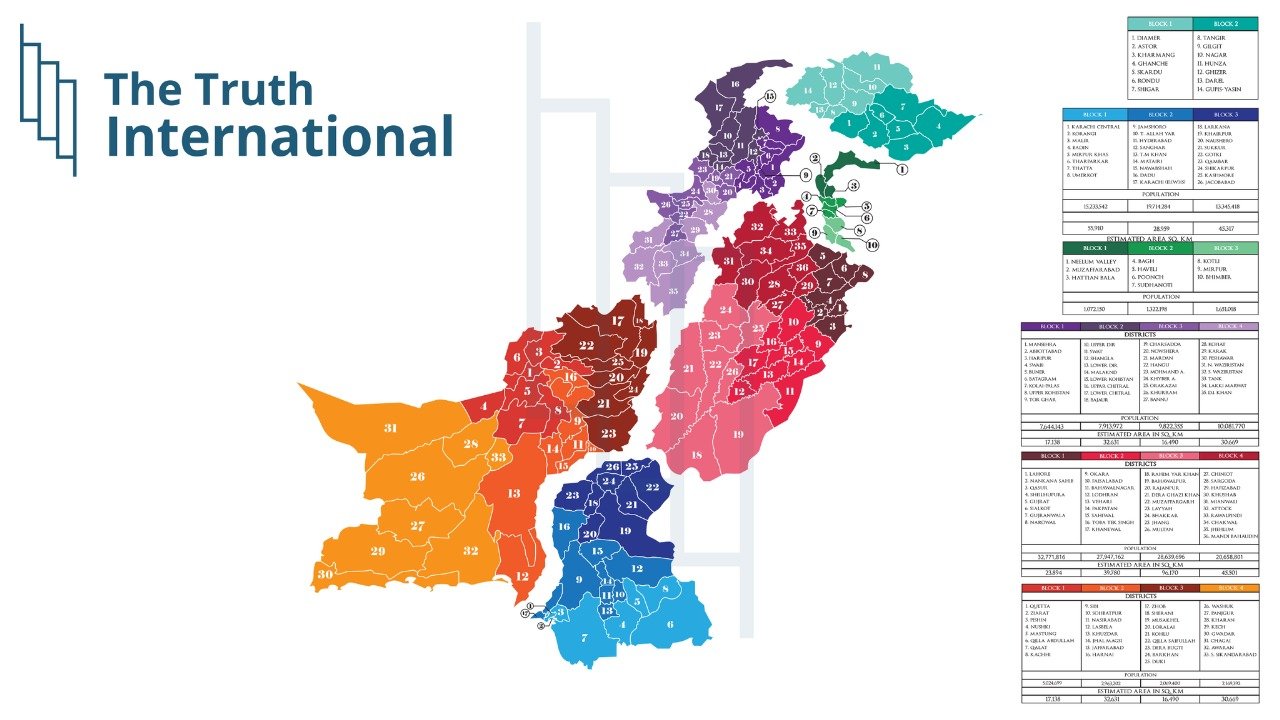
Carefully planned administrative restructuring can bring the state closer to its people. With clear fiscal frameworks, stronger administrative capacity, and inclusive safeguards, smaller, coherent provinces can make governance faster, fairer, and more responsive—putting citizens, not political maps, at the heart of decision-making.
Why administrative size affects everyday life
Pakistan’s provinces are vast and diverse. Punjab’s 127 million people are spread across 36 districts, while some districts in Balochistan are larger than entire countries. With provincial capitals often hundreds of kilometers away, two major problems emerge:
- Weak Monitoring: Supervisory visits are rare, decisions take longer, and essential services are delayed—like infrequent health inspections or teacher absenteeism.
- Policy Mismatch: Uniform provincial policies overlook local realities, leaving coastal, desert, and mountain communities underserved.
The result is tangible for citizens: empty schools, slow health services, delayed land records, and stalled infrastructure projects. Oversized provinces mean ordinary people experience inefficiency first.
International experiences show the benefits of smaller administrative units. In India, the creation of Chhattisgarh, Jharkhand, and Uttarakhand in 2000 allowed state governments to tailor services to local needs, improving health inspections, education monitoring, and infrastructure development. Indonesia’s establishment of new provinces along coastal and island regions enabled faster disaster response and more equitable resource allocation. In Europe, reforms of regional Länder in Germany strengthened economic planning and local accountability. These examples demonstrate that smaller, coherent administrative units can meaningfully enhance governance when paired with capacity and fiscal support.
How smaller, coherent provinces change outcomes
Crucially, smaller administrative units alone do not guarantee better governance—but when carefully designed around local needs rather than political convenience, they can significantly enhance service delivery, accountability, and responsiveness. The objective is not to simply redraw maps; it is to realign the state’s capacity with the everyday realities of its citizens. When provinces are structured around functional, geographic, and socio-economic cohesion, they allow governments to plan better, supervise more effectively, and respond faster. Smaller provinces also create clearer lines of responsibility—making it easier to trace where systems fail, who is accountable, and how quickly corrective action can be taken. Most importantly, restructuring builds a governance environment where policies, budgets, and institutions are closer to communities, not distant capitals.
- The state becomes physically closer to people
Distance between provincial capitals and districts often limits oversight and delays services. In India’s Chhattisgarh, bringing the state capital closer allowed officials to inspect schools and health centers more frequently and respond to complaints faster. This demonstrates that bringing the state closer to people can make everyday services more reliable and responsive. Proximity to citizens is only the first step; governance also needs policies that match local needs
- Policies can finally reflect local realities
A coastal belt requires a different health strategy than a desert region, while a mountain district needs tailored road budgets, school designs, and disaster-preparedness plans. Smaller, more coherent provinces allow governments to craft such context-specific policies instead of relying on one-size-fits-all provincial templates. This approach ensures that everyday services reach people more effectively and respond to the realities of their communities. Policies are effective only when backed by adequate resources, highlighting the importance of targeted budgets.
- Budgets become more targeted
In large provinces, metropolitan areas often dominate resource allocations, leaving rural and peripheral regions underfunded. Smaller, more coherent provinces enable more balanced and targeted budgeting, directing resources toward local priorities rather than diverting them to major cities. This creates fairer distribution and more effective public service delivery across all regions. Strong political representation within these provinces further ensures that regional priorities are not only identified but acted upon.
- Citizens gain more political voice
New provinces bring political power closer to the people, giving regions a stronger voice in decision-making.
- More provincial assemblies
- More ministers and administrative positions
- Greater representation for historically neglected regions
This broader participation helps reduce elite capture and ensures that political power is not concentrated in big-city centers. When leadership emerges from within smaller, more coherent regions, policy priorities naturally shift toward local issues—whether it is improving rural health facilities, strengthening border markets, or addressing chronic teacher shortages. Over time, this dispersal of political authority strengthens democratic accountability, builds citizen trust, and makes governance more responsive to the needs of communities that have long remained peripheral in provincial politics.
- Provinces can specialize
Smaller, geographically coherent provinces allow policy priorities to be tailored to local environments and economic needs.
A maritime province can focus on:
- Fisheries regulation
- Port-linked economic zones
- Coastal disaster mitigation
A northern province can invest in:
- Mountain roads
- Glacier early-warning systems
- Eco-tourism infrastructure
Such targeted approaches ensure that government resources and programs respond effectively to the unique challenges and opportunities of each region. However, even with specialization and targeted policies, restructuring requires careful planning to avoid unintended consequences.
These challenges—political resistance, fiscal pressures, ethnic or linguistic tensions, and administrative capacity gaps—can be mitigated through phased implementation, broad political consultation, constitutional safeguards, targeted capacity-building programs, and robust fiscal planning. Addressing these risks proactively ensures that restructuring strengthens governance rather than creating new inefficiencies.
Provinces must serve people — not political maps
Administrative restructuring is, at its core, a reform for citizens. It is meant to ensure that governance reflects people’s realities rather than outdated boundaries. Smaller and more coherent provinces can bring decision-makers closer to communities, improve oversight, and make services easier to access. When provincial governments operate nearer to the districts they serve, monitoring becomes more frequent, complaints are addressed faster, and policies can be shaped around the social and economic needs of each region. This shift allows neglected areas to finally receive focused attention and the institutional space to guide their own development priorities.
For restructuring to truly work, it must be supported by strong fiscal systems, capable institutions, and safeguards that keep the process inclusive. Done right, it can reduce long-standing inequalities, give local communities a stronger voice, and ensure that essential services reach people without unnecessary delays. The goal is simple: a governance structure where citizens feel seen, heard, and served. By redesigning provinces around functionality rather than politics, Pakistan can move toward a system where the state is closer to its people—and where the promise of effective public service delivery becomes a reality, not a distant expectation.
