

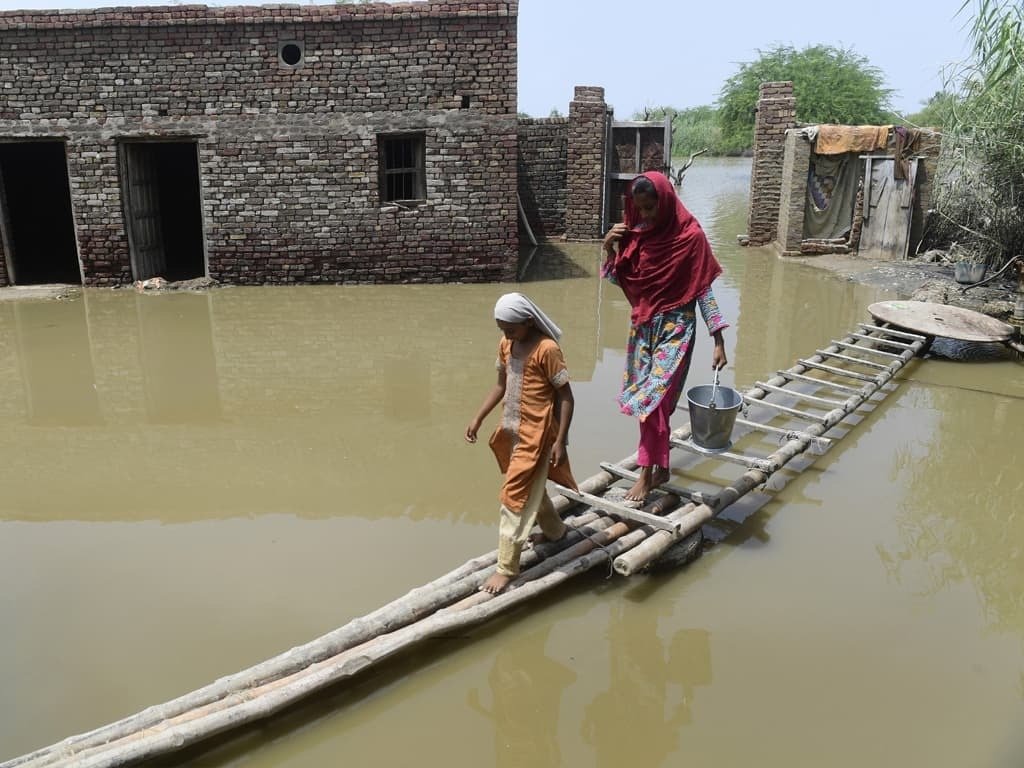

With nearly a thousand lives lost and millions displaced since June, Pakistan’s ongoing floods have exposed the country’s deep vulnerability to climate extremes, poor governance, and fragile infrastructure. Experts warn that floods must now be considered the “new normal,” demanding urgent adaptation strategies.
Muhammad Ehsan Leghari, a water management specialist and member of the Indus River System Authority, stresses that both natural and human-made factors are behind this devastation.
Intense monsoons, glacial melt, and India’s dam water releases worsened inflows, while deforestation, urbanisation, and encroachments on floodplains amplified the disaster. Weak governance, faulty planning, and outdated infrastructure have further turned hazards into national tragedies.
Climate change has intensified the unpredictability of floods, with accelerated Himalayan and Hindu Kush glacial melt synchronising with erratic monsoons. This combination overwhelms rivers like the Chenab and Sutlej, leading to devastating surges across Punjab, Sindh, and Khyber Pakhtunkhwa.
Studies show that the Indus riverbed’s capacity has already been reduced by sediment buildup, lowering flood-handling efficiency by nearly half. Without basin-wide sediment strategies and regional cooperation involving India and Afghanistan, risks will keep escalating.
Experts note that embankments and barrages, while useful in passing overflows, often create dangerous bottlenecks, shifting flood pressures downstream. They call for shifting from a “control floods” mindset to one of “living with floods,” restoring floodplains, and investing in AI forecasting and automated systems.
Vulnerable populations, especially in low-lying Punjab districts such as Multan, Jhang, and Layyah, and urban zones like Lahore and Sialkot, face severe risks.
Khyber Pakhtunkhwa has recorded the highest fatalities, while Sindh endures prolonged inundation due to flat terrain and poor drainage. Local solutions — such as strengthening embankments, relocating vulnerable populations seasonally, restoring wetlands, and empowering communities with disaster-preparedness training — are seen as critical.
Pakistan’s flood warning systems, though improved since 2010, still fall short due to poor communication, lack of local-language dissemination, and insufficient real-time accuracy. Cross-border data-sharing, especially with India, remains politically strained despite humanitarian needs.
Policy gaps remain Pakistan’s biggest challenge. Institutions like NDMA and provincial bodies often operate in silos, detached from ground realities. Projects such as the Ravi Urban Development Authority’s encroachment on floodplains worsen risks.
Experts argue that instead of costly mega-dams that displace communities and damage ecosystems, Pakistan should prioritise rainwater harvesting, urban water reuse, forestation, and habitat restoration.
Integrated watershed management, zoning enforcement, and stronger governance are essential to reducing losses. With projections showing that floods will only grow more frequent and intense, Pakistan must urgently rethink its approach, treating adaptation not as a choice but as a survival strategy.
