

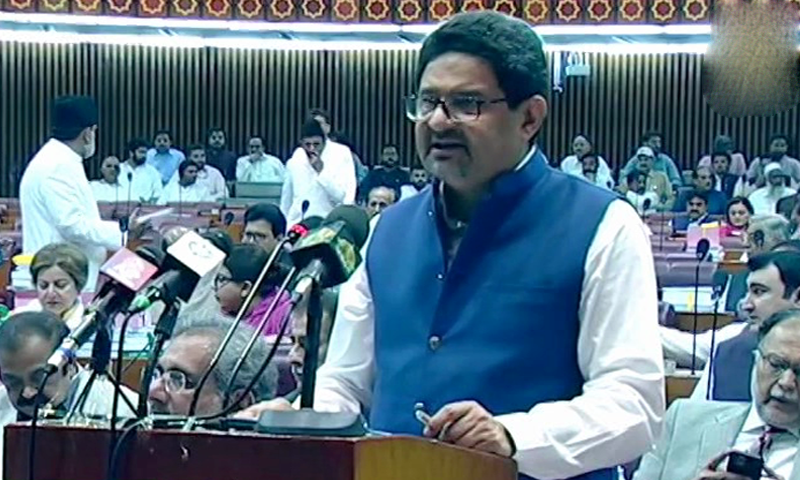

ISLAMABAD: The federal cabinet today approved 9.502 trillion rupees new budget for the fiscal year 2022-23. The tax collection target for 2022-23 would be around 7255 billion rupees while non-tax revenue collection is estimated at 1626 billion rupees. The budget outlay of Rs9,502 billion is almost a trillion rupees higher than last year’s budget. The government has budgeted total current expenditures at Rs8,694 billion for FY23, 15.5pc higher than last year’s budget.
The cabinet approved Rs 9.5 trillion new budget with a 15% pay-raise of federal government employee and a 5% increase in pensions. The cabinet approved the proposed budget an hour before the Prime Minister Shehbaz Sharif-led government is announcing its maiden budget.
The federal cabinet on Friday reviewed the budget proposals, gave its approval and Finance Minister Miftah Ismail presented it in the National Assembly.
Key budgetary proposals
- No tax on salaries of up to Rs100,000 per month; previously minimum taxable salary was Rs50,000/month
- Minimum tax bracket for small business persons is being raised from Rs0.4 million to Rs0.6m
- 15pc increase in salaries of government employees
- Sales tax exemption on import of solar panels and distribution
- Advance withholding tax will be collected from those sending remittances abroad via credit, debit and pre-paid cards
- Advance tax will be increased on cars above 1,600cc
- Exemption of complete custom duty on pharmaceutical ingredients
- Rs51bn proposed for education projects
- Rs24bn for health sector
- People earning an annual income of Rs300 million or more per year are proposed to pay 2pc extra tax
- Advance 2pc tax on the value for high-value hybrid and electric vehicles.
Budget outlay
The budget outlay this year is Rs9,502 billion, almost a trillion rupees higher than last year’s outlay. The government has budgeted total current expenditure at Rs8,694bn for FY23, which is 15.5pc higher than last year’s budgeted figure.
Defence expenditure is proposed at Rs1,523bn, which makes up 17.5pc of total current expenditure and is 11.16 per cent higher than last year.
Interest payments, or debt servicing, budgeted for FY23 have risen a whopping 29.1pc from last year to Rs3,950bn — making up the single largest expenditure of the government, which accounts for 45.4pc of total current expenditure.
Net federal revenue
Total revenue budgeted for FY23 stands at Rs9,004bn. After subtracting provincial transfer of Rs4,100bn as part of the National Finance Commission (NFC) Award, net revenue comes out at Rs4,904bn, nine per cent higher than last year.
FBR tax target
The government has set the tax collection target for the Federal Board of Revenue (FBR) at Rs7,004bn for FY23, which is 20.1pc higher than last year’s Rs5,829bn.
Fiscal deficit
Fiscal deficit, or overall budget deficit, which is the difference between the government’s total expenditure and revenue is calculated as: Gross Revenue at Rs9,004bn (minus) Transfer to Provinces Rs4,100bn (plus) Provincial Surplus Rs800bn (minus) Total Expenditure Rs9,502bn.
For FY23, overall deficit is budgeted at Rs3,798bn, which is 4.9pc of GDP. Last year, the deficit was budgeted at 6.3pc of the GDP.
PSDP
Meanwhile, the Federal Public Sector Development Program (PSDP) focuses on CPEC-related projects, the construction of dams, and other infrastructure development projects. The total national development budget stands at Rs2,263 billion with Rs800 billion from the PSDP, according to budget documents.
Provinces will be committing Rs1463 billion under their annual development programs. The government intends to increase the total PSDP for fiscal year 2022-23 to Rs900 with Rs100 spending through public private partnership, according to Planning Minister Ahsan Iqbal.
In the PSPD, at least 60% of the money has been earmarked for new projects and 40% for ongoing projects.
Rs433 billion have been allocated for infrastructure projects, including Rs84 billion for energy, Rs227 billion for transport and communication, Rs83 billion for water, and Rs39 billion for physical planning and housing.
The social sector gets Rs103 billion and Sustainable Development Goals (SDGs) receive Rs70 billion.
The government has increased the budget for the Higher Education Commission (HEC) to Rs45 and will relaunch the free laptop scheme for students. A total of Rs5 billion has been allocated to provide free laptops to students.
The CPEC-focused PSDP has allocated Rs33 billion for the Pakistan Railways including Rs5 billion for the ML-1 project, which is crucial for the improvement and exertion of the railway track to facilitate trade.
The Diamer-Basha dam project gets Rs25 billion in the upcoming fiscal years. The total cost of the dam has been estimated at Rs479 billion.
The government has also allocated funds for Mohmand and Dasu dams and K-IV projects.
It has earmarked Rs96 billion for Azad Kashmir and Gilgit-Baltistan while ex-Fata districts, which were merged with Khyber Pakhtunkhwa in 2018, will get Rs50 billion.
At least Rs16 billion has been allocated for public order, Rs12 billion for food security, and Rs5 billion for the industrial sector in the development budget.
According to the IMF requirements, the government is expected to abolish some of the ongoing subsidies in the new budget and announce new revenue generation measures can be:
Here is the list of things which are expected to become expensive as the government is looking to increase taxes and impose new ones.
- 4 to 7 per cent super tax is likely to be imposed on commercial banking.
- Buying products online from outside the country using credit and debit cards might get more expensive as additional taxes are likely to be imposed.
- Increase of Rs40,000 has been proposed on business class air tickets.
- Luxury vehicles to get more expensive as 1 per cent withholding tax is likely to be imposed on filers while 2 per cent for non-filers.
- Property rate and real estate sector to see a price increase
- The government may increase the tax net by expanding point-of-sale system in major cities.
- Rs5 per unit subsidy might be withdrawn on electricity
The government is expected to facilitate the import of raw materials for export and abolish sales tax on subsidies for power consumers.
