


Issue-Based Cooperation
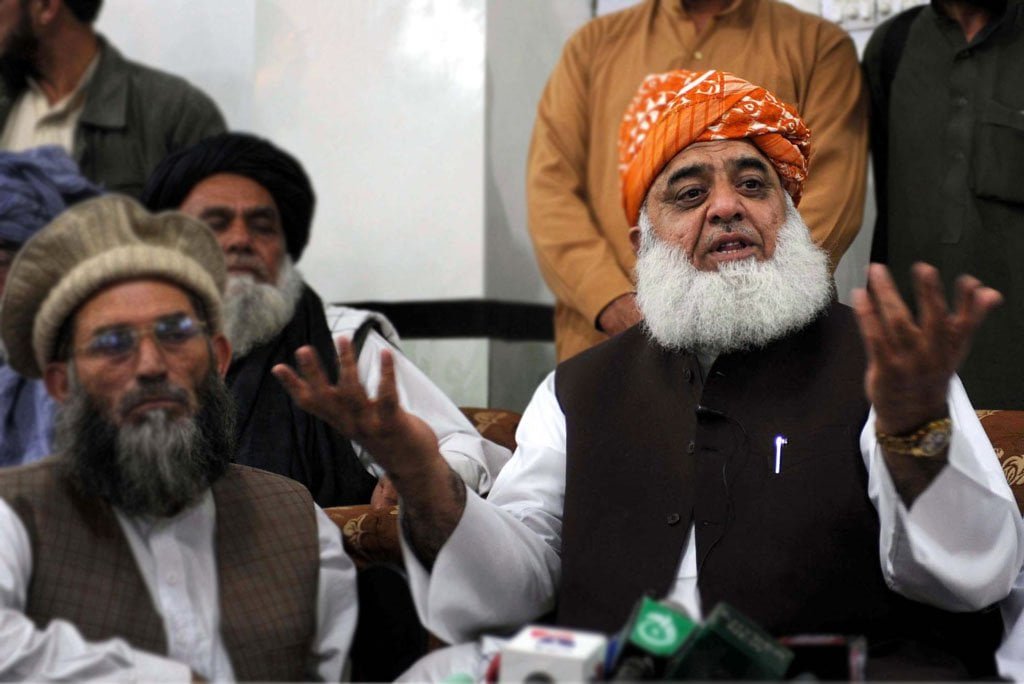
LAHORE: Jamiat Ulema-e-Islam-Fazl (JUI-F) chief Maulana Fazlur Rehman on Wednesday categorically ruled out the formation of a formal opposition alliance, while indicating that his party remains open to coordinating with other political forces on specific issues.
Addressing a press conference in Lahore following a meeting of the party’s Majlis-e-Shura, Fazl made it clear that any such coordination would be tactical rather than structural.
“There is no concept of a formal alliance in the opposition… that’s typically a feature of the government,” the veteran politico stated, underlining his party’s resolve to pursue an independent political course. His comments come amid growing speculation about a potential alliance between the JUI-F and the Pakistan Tehreek-e-Insaf (PTI), particularly in light of former prime minister Imran Khan’s instructions to strengthen ties with opposition parties from behind bars.
However, those hopes seem to have dimmed due to internal discord. Relations between the JUI-F and PTI grew tense after PTI leader Azam Swati claimed on April 12 that Imran Khan had tasked him with initiating dialogue with the establishment.
Reacting to this, JUI-F Senator Kamran Murtaza expressed strong reservations, stating, “It is unacceptable to expect us to form a political alliance while simultaneously maintaining undisclosed contacts with the establishment.” He criticized the PTI leadership for failing to provide a clear stance on the issue, stressing that mutual transparency was essential for any collaboration.
Murtaza added that while no formal alliance was on the cards, coordination on certain political or legislative matters was still a possibility. “Anything is possible in politics, but for now, we may coordinate on specific issues without becoming part of a formal alliance,” he remarked.
Fazl reiterated that the party’s consultative and executive bodies would determine any strategy for working with parliamentary parties in the future. He also clarified that it was the JUI-F, not the PTI, that had supported the 26th Constitutional Amendment at the latter’s request—a point he felt needed clarification amidst public confusion.
Turning to legislative matters, Fazl condemned the recent passage of the Mines and Minerals Bill, disclosing that his party had issued show-cause notices to JUI-F members in Balochistan who voted in favor of the bill. He warned that if their explanations were deemed unsatisfactory, their party memberships could be suspended.
Fazl also took aim at the state of governance across Pakistan, singling out Khyber Pakhtunkhwa, Balochistan, and Sindh as regions where law and order had drastically deteriorated. “There is no writ of the state in many areas, and armed groups are roaming freely,” he warned, accusing the government of failing to protect the lives and property of its citizens.
In a reaffirmation of his party’s stance on electoral legitimacy, the JUI-F chief reiterated his rejection of both the 2018 and 2024 general elections, labeling them as rigged. “The people must be allowed to freely exercise their right to vote,” he said, asserting that governments formed through manipulated electoral processes cannot claim to represent the public or safeguard provincial rights.
Criticizing what he described as the imposition of “selected governments,” Fazl concluded by stressing the importance of restoring democratic norms and respecting the will of the electorate.
