

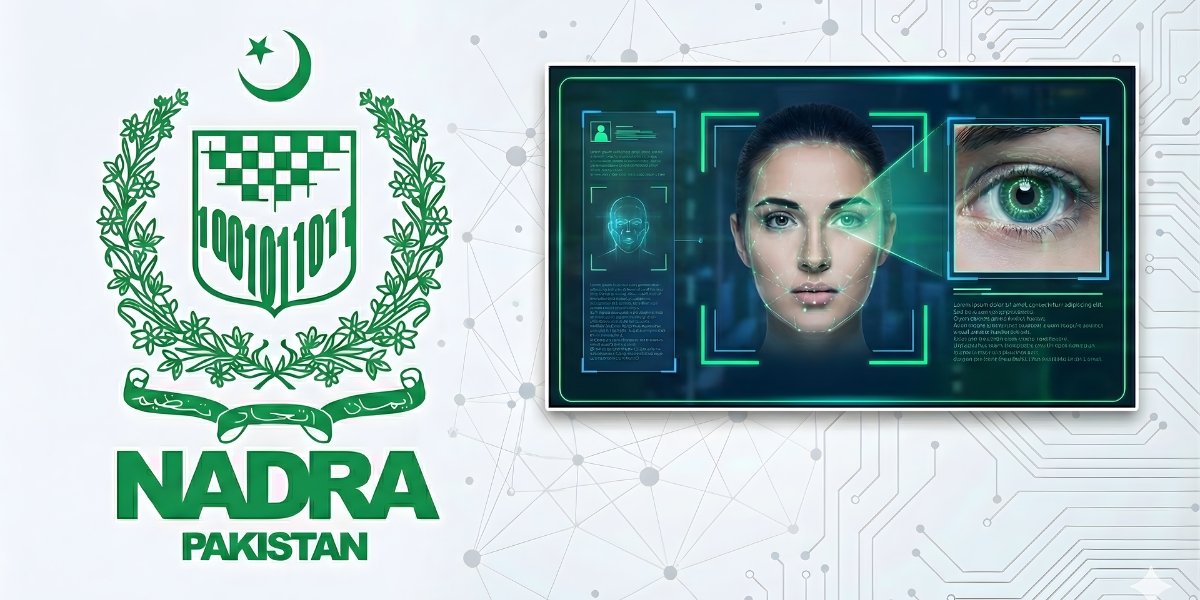

Government Amends NIC Rules to Expand Biometric Definition
In a major step toward modernising identity verification, the federal government has amended the National Identity Card (NIC) Rules to legally recognise facial and iris scans as valid biometric identifiers. Previously, fingerprints were the primary legally accepted biometric. The amendment, approved on the recommendation of the National Database and Registration Authority (Nadra), significantly widens the scope of biometric identification in Pakistan.
According to Nadra, this legal change provides a strong foundation for implementing a multi-biometric verification system across public and private sectors. It aims to reduce reliance on fingerprints alone and address long-standing problems faced by citizens whose fingerprints have faded due to age or medical conditions.
Contactless Biometric System and New Digital Services
Following the amendment, Nadra has introduced advanced technical solutions that enable contactless fingerprint scanning and facial recognition-based verification. These services are now available at Nadra Registration Centres and through the Pak-ID mobile application for services under Nadra’s jurisdiction.
The system is already being used for biometric verification in the transfer of Islamabad-registered vehicles and for online passport applications. Nadra has also confirmed that proof-of-life certificates for federal government pensioners will soon be issued through this new biometric framework. The authority said the scope of digital services will continue to expand in phases.
From January 20, 2026, Nadra will begin issuing facial recognition-based biometric verification certificates nationwide. This service will specifically support citizens who are unable to verify their identity through fingerprints. Citizens can obtain the certificate from any Nadra Registration Centre by paying a nominal fee of Rs20.
How the Facial Verification Certificate Will Work
Under the new procedure, if fingerprint verification fails at a bank, telecom franchise, or other institution, the citizen will visit the nearest Nadra Registration Centre. A fresh photograph will be taken and digitally matched with Nadra’s existing records.
Once verification is successful, Nadra will issue a certificate containing the purpose of verification, the citizen’s CNIC number, name, father’s name, recent photograph, record photograph, a unique tracking ID, and a QR code. The certificate will remain valid for seven days and can be verified online by the concerned institution through Nadra’s system.
In the future, this facility will also be extended to Nadra’s e-Sahulat franchises. After the formal launch of Pakistan’s Digital ID initiative, facial image-based verification will be accessible directly through the Pak-ID application for all supported services.
Institutional Readiness and Future Roadmap
Nadra stated it is fully prepared to implement the system but stressed the need for cooperation from regulators, government departments, and private organisations. Institutions will be required to upgrade their software in the first phase to integrate facial verification certificates. In the second phase, service counters must install cameras or upgrade existing know-your-customer biometric machines.
If institutions fail to make these upgrades, Nadra will not be able to provide direct facial verification services at their locations. Citizens facing issues after January 20, 2026, have been advised to lodge complaints with the relevant institution.
The initiative follows directives from Prime Minister Shehbaz Sharif and Interior Minister Mohsin Naqvi, aimed at resolving biometric verification problems nationwide. Nadra said the new system will significantly reduce hardship for citizens and strengthen safeguards against identity fraud.
