

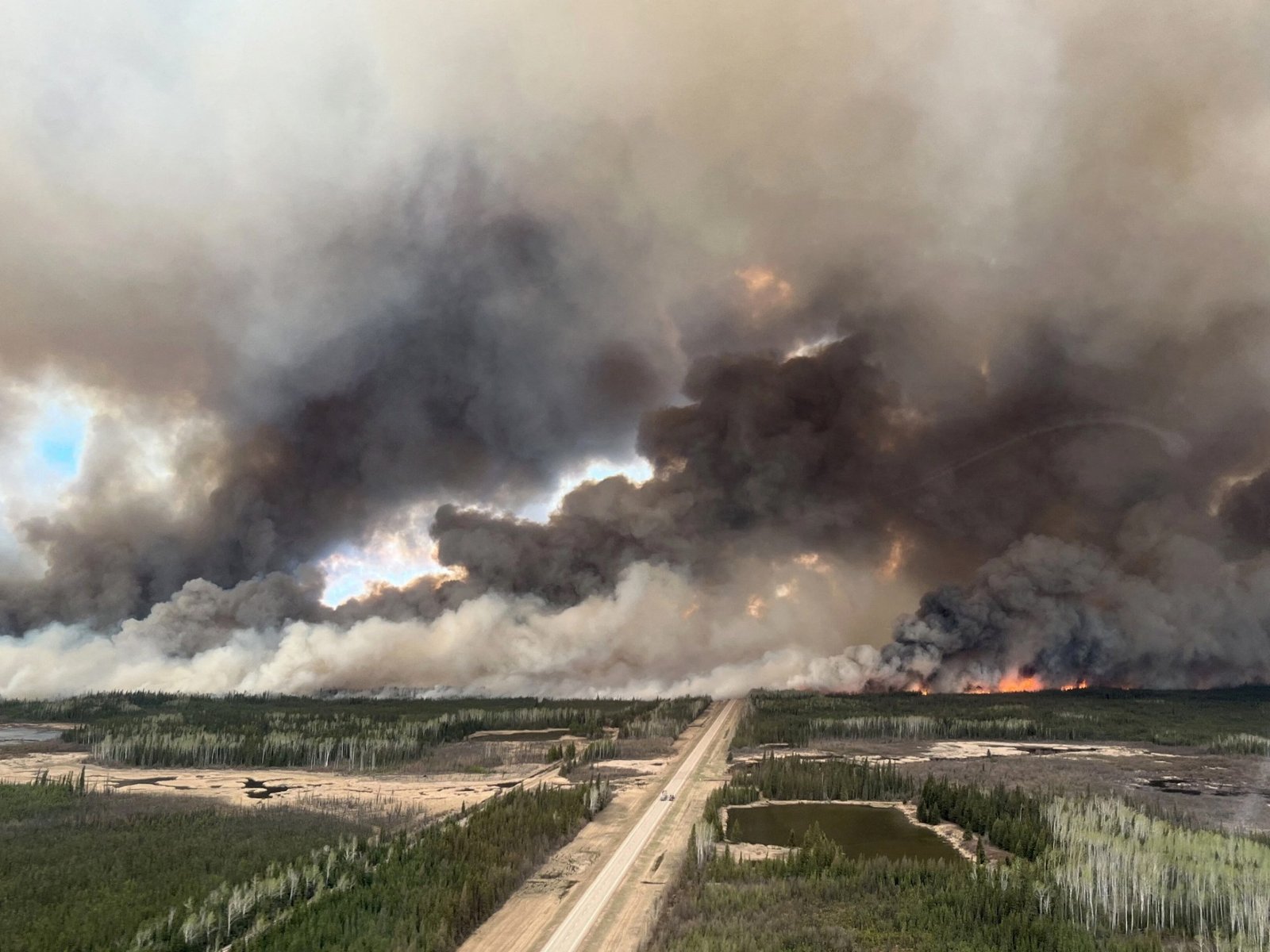

Enormous, out-of-control wildfires in western Canada have prompted the evacuation of thousands of people, raising concerns about another devastating fire season. In northeastern British Columbia, residents of Fort Nelson were forced to flee their homes as a rapidly growing blaze threatened the community.
Similarly, in Alberta, residents in parts of Fort McMurray were given only two hours to evacuate due to an approaching wildfire. Last year, Canada experienced its most intense fire season on record, exacerbated by climate change. Here’s an overview of the current wildfires.
Currently, more than 130 wildfires are ablaze throughout Canada, with 40 of them raging beyond control as of Wednesday morning, as reported by the Canadian Interagency Forest Fire Centre (CIFFC). This year alone, over 1,000 wildfires have scorched approximately 336,000 hectares (830,000 acres) of land, according to CIFFC’s findings.
The majority of these conflagrations are concentrated in British Columbia and Alberta, as noted on the CIFFC’s website. However, outbreaks have also been documented in Saskatchewan, Manitoba, and the Northwest Territories, among other regions nationwide.
Evacuation orders have been issued in various areas. In northeastern British Columbia, approximately 3,500 individuals from Fort Nelson and Fort Nelson First Nation were evacuated due to the expansion of the Parker Lake wildfire, which had ballooned to over 8,400 hectares (20,700 acres) by Tuesday.
Meanwhile, in Alberta, evacuation orders were enacted for the Abasand, Beacon Hill, Prairie Creek, and Grayling Terrace areas of Fort McMurray on Tuesday afternoon. Although Fort McMurray itself, still reeling from a devastating wildfire in 2016, is presently under an “evacuation alert,” indicating residents should prepare to evacuate if necessary.
The Alberta Wildfire agency has expressed optimism on Wednesday morning, expecting favorable winds to push the fire away from Fort McMurray while firefighting teams persist in containment efforts.
Additionally, evacuations have been underway in northern Manitoba, where an uncontrollable wildfire near the towns of Flin Flon and The Pas has expanded to 31,600 hectares (78,000 acres), near the provincial border with Saskatchewan.
Wildfires in Canada, often ignited by lightning or human activity, are exacerbated by factors like holdover fires, where fires linger under snow and reignite in warmer seasons. Drought conditions and strong winds fuel their spread.
Climate change, with warmer temperatures and extended wildfire seasons, intensifies these blazes, making them harder to control. Smoke from Canadian wildfires affects air quality in both Canada and the United States, prompting concerns about the long-term trend of increasingly severe wildfires becoming the new normal.
