

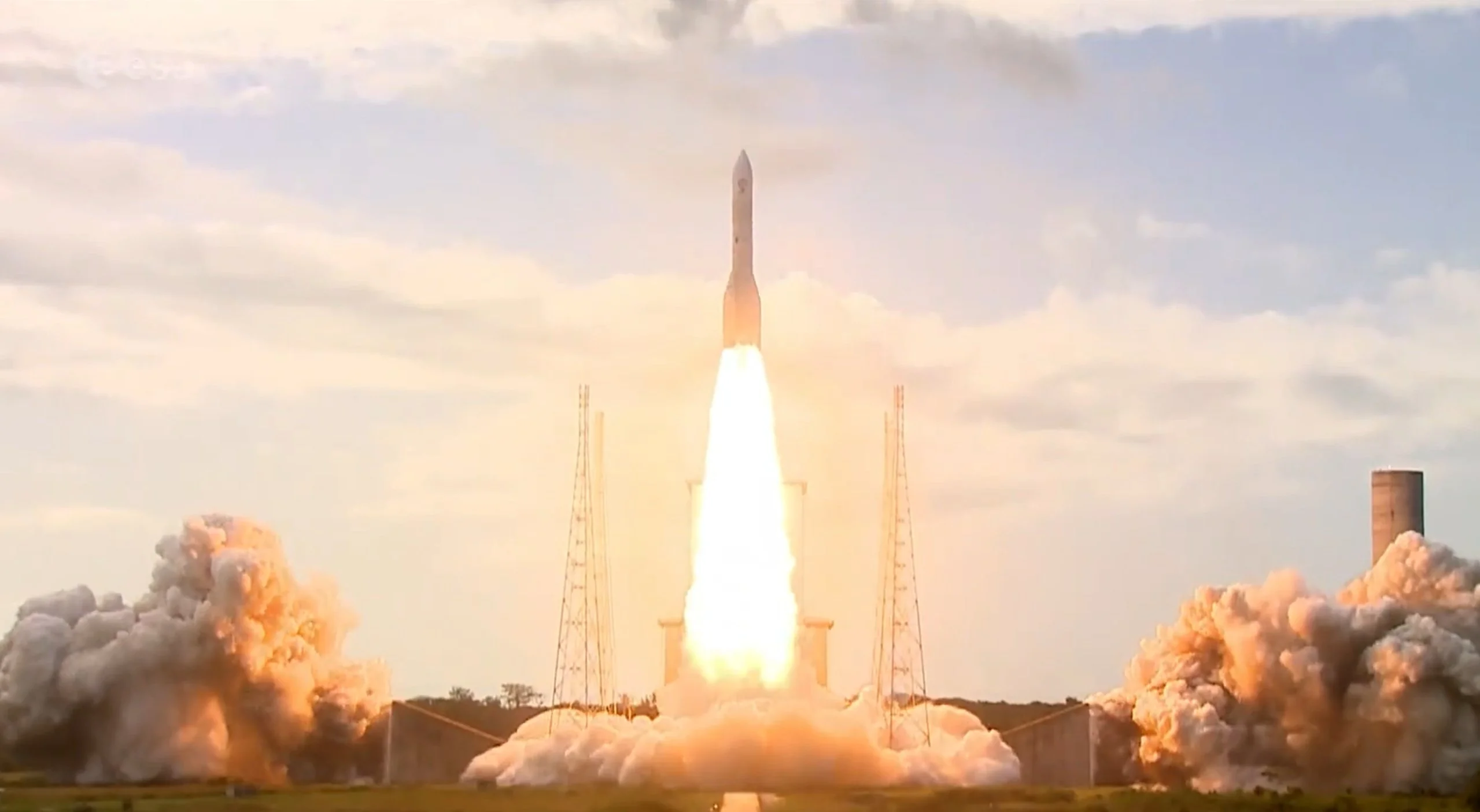

European space leaders celebrated the successful inaugural flight of the Ariane 6 rocket on Tuesday, marking a significant milestone in Europe’s return to space exploration. Despite encountering a setback where the rocket failed to release its final payloads, the mission reaffirmed Europe’s autonomous access to space following delays, political challenges, and funding debates, according to Reuters.
The launch, which took place at 4pm local time in Kourou, French Guiana, was accompanied by a Rafale fighter jet and successfully deployed three sets of micro-satellites for research purposes, underscoring the mission’s overall success despite its non-commercial nature.
European space officials hailed the maiden voyage as a triumph. “Europe is back in space,” declared Philippe Baptiste, head of France’s CNES space agency, via video link to the European Space Agency (ESA) headquarters in Paris, where employees and politicians celebrated the lift-off.
During the mission, the Vinci engine, capable of multiple restarts, achieved its first in-space restart, allowing Arianespace to place payloads into various orbits. However, the mission encountered a setback when a smaller power unit necessary for the rocket’s payload deployment malfunctioned, preventing the release of the final batch of payloads, including capsules designed to test re-entry conditions.
“We had an anomaly… We are not going to complete this part of the mission as planned,” explained Tina Buchner da Costa, an architect of the Ariane 6 launch system.
Despite this late-stage issue, ESA Director General Josef Aschbacher expressed confidence that the agency remains on schedule for a second flight by the end of the year. The Ariane 6 program, developed by ArianeGroup at an estimated cost of 4 billion euros and co-owned by Airbus and Safran, had faced multiple delays since its original launch target in 2020.
With the retirement of the Ariane 5 rocket over a year ago and disruptions in access to Russian Soyuz rockets due to the conflict in Ukraine, Europe has been without independent means to deploy its satellites into space, compounded by the grounding of Italy’s Vega C rocket.
