

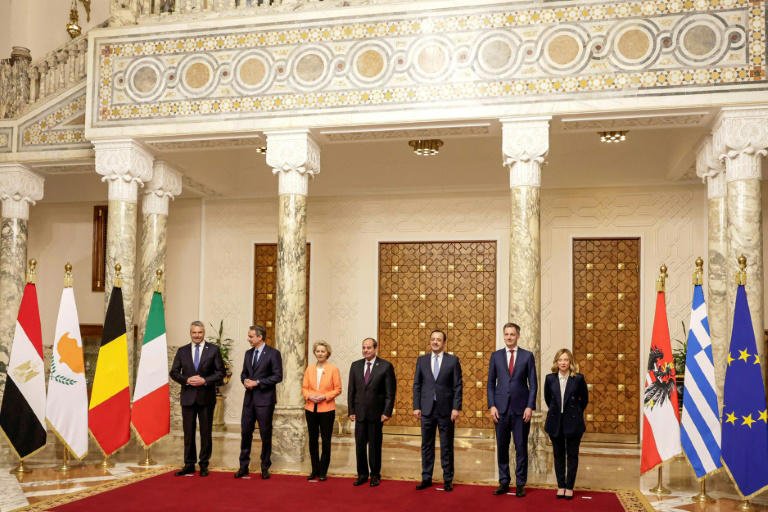

On Sunday, the European Union and Egypt finalized a significant financial package worth 7.4 billion euros, aimed at supporting Egypt’s struggling economy, enhancing energy trade with Europe, and addressing irregular migration flows.
The signing ceremony in Cairo was attended by European Commission President Ursula von der Leyen, along with leaders from Austria, Belgium, Cyprus, Greece, and Italy, joining Egyptian President Abdel Fattah al-Sisi.
The strategic partnership agreement encompasses various aspects such as extending substantial credit lines over the next few years and increasing energy exports, particularly gas, to aid Europe in reducing its reliance on Russian gas supplies. Von der Leyen emphasized the elevation of EU-Egypt relations to a Strategic and Comprehensive Partnership, covering areas such as trade, investment, renewable energy, migration management, and cultural exchanges.
Egypt, grappling with economic challenges, shares borders with conflict-ridden neighbors like Libya, Sudan, and the Gaza Strip. The deal acknowledges Egypt’s crucial role in regional stability and includes provisions for cooperation on security, counter-terrorism, and border protection, notably with Sudan.
The agreement also addresses migration issues, with a focus on eliminating irregular migration through job creation and youth empowerment. This initiative aligns with previous EU efforts in partnering with countries like Libya, Tunisia, and Mauritania to curb migrant flows across the Mediterranean.
However, the EU’s approach has drawn criticism from human rights organizations, citing concerns over human rights abuses and authoritarian tendencies in recipient countries like Egypt. Despite Egypt’s claims that no migrant boats have departed from its shores since 2016, human rights groups have documented instances of mistreatment and arbitrary arrests by Egyptian authorities.
Economically, Egypt faces significant challenges, including high inflation and mounting external debt exacerbated by disruptions to Suez Canal revenues due to regional conflicts and attacks on shipping. The International Monetary Fund recently approved an $8 billion loan package for Egypt following economic reforms, yet the country’s financial outlook remains precarious.
In sum, the EU-Egypt partnership seeks to address multifaceted challenges spanning economic, security, and migration concerns, emphasizing cooperation and financial assistance to foster stability and prosperity in the region.
