

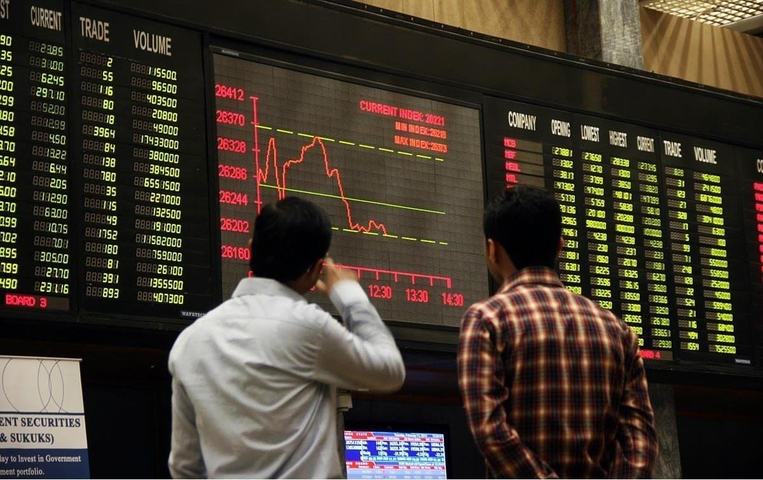

KARACHI – The Pakistan Stock Exchange (PSX) experienced a sharp sell‑off on Monday, with the benchmark KSE‑100 Index tumbling by 3,855.77 points (3.21%) to close at 116,167.47, its lowest level since May 9, 2025, according to Arif Habib Ltd.
Intra‑day, the index hit a low of 115,887.49 as investors reacted with caution to escalating geopolitical tensions following recent US air strikes on Iran’s nuclear facilities. The impending threat of Iranian retaliation triggered a wave of panic selling, particularly in heavy‑weight sectors such as automobile assemblers, oil & gas exploration companies (OGDC, PPL, MARI), OMCs (POL, PSO), power generation, and commercial banks.
“PSX experienced a subdued session, mirroring global market caution,” noted Topline Securities, adding that major index-heavy stocks—ENGROH, PPL, LUCK, OGDC, and MARI—alone knocked off 1,054 points from the benchmark.
Last week also saw a 1.7% drop in the KSE‑100, closing at 120,023.23, amid a swirl of Middle East unrest, commodity price volatility and domestic economic concerns.
On the global front, Asian markets slid on Monday, with oil prices spiking nearly 2.8%—Brent crude at $79.12 and U.S. crude at $75.98—on fears of disruptions through the Strait of Hormuz. While safe‑haven assets like the US dollar and gold saw modest movement, broader equity markets shed about 0.5–0.9%.
Locally, the Pakistani rupee weakened slightly by 0.06%, closing at PKR 283.87/USD, while trading volumes surged to 595 million shares—up from 422 million—and turnover rose to Rs 23.49 billion, up from Rs 15.65 billion.
WorldCall Telecom led in volume with 53 million shares, followed by Sui South Gas (36 million) and Pervez Ahmed Co (24 million). Of the 468 listed companies trading Monday, 56 saw gains, 386 fell, and 26 remained flat.
Key takeways:
- Mass sell-off across major sectors as investors flee amid geopolitical uncertainty.
- Oil price surge on potential supply disruption through Hormuz.
- PSX decline marks its lowest point since early May.
- Local currency and market activity moderately affected, reflecting cautious sentiment.
With tensions in the Middle East escalating, the market awaits signs of Iran’s response—a critical factor for regional stability and investor confidence.
