


By Col. (Retd) Sabahuddin Chaudhry
Introduction
From 2023 to mid-2025, Pakistan has redefined its approach to international engagement through a calibrated dual-track foreign policy. On one track, its strategic alliance with China has deepened, providing Pakistan with advanced defence technologies, cyber capabilities, and battlefield intelligence. On the other hand, Pakistan has maintained and expanded its cooperation with the United States in areas such as education, health, climate resilience, defence, and institutional development.
This duality has shaped Pakistan’s strategic posture—balancing hard power with soft power to enhance national security and international legitimacy. The May 2025 conflict with India amplified this dynamic, with India portraying Pakistan as a proxy of China, while Pakistan asserted its indigenous capabilities and long-term modernization as the core drivers of its military success. This article explores the evolution of Pakistan’s bilateral partnerships with China and the U.S., the narratives surrounding the May 2025 conflict, and the broader implications for regional security and strategic autonomy.
I. Strategic Bilateral Relations with China and the United States (2023–Mid 2025)
A. Pakistan–China: Consolidating Hard Power and Strategic Depth
1. Science, Technology, and Innovation
Pakistan’s partnership with China has extended beyond conventional military cooperation into high-technology sectors:
Space and Satellite Development: Joint projects such as PAKSAT-MM1R and ICube-Qamar, alongside advanced earth observation through PRSC-EO-1, have bolstered Pakistan’s remote sensing and communications capabilities.
Cybersecurity and AI: Collaboration in artificial intelligence, 5G infrastructure, cloud computing, and cybersecurity has enabled Pakistan to modernize its defence systems and align with CPEC’s smart-city development goals.
2. Military Modernization and Strategic Equipment
Next-Generation Platforms: China has supplied Pakistan with cutting-edge military platforms, including J-10C fighter jets, upgraded JF-17 Block III aircraft, PL-15E air-to-air missiles, and CH-4 armed drones.
Naval Strengthening: Co-production of the Hangor-class submarines has further strengthened Pakistan’s undersea warfare capabilities.
3. Conflict-Time Assistance and Diplomatic Backing
Real-Time Intelligence: During the May 2025 conflict, China reportedly provided satellite intelligence, radar recalibration assistance, and secure tactical communication through the Beidou navigation system.
International Advocacy: On diplomatic fronts, China supported Pakistan at the UN and other global platforms, blocking unfavorable resolutions and countering Indian narratives.
B. Pakistan–United States: Building Institutional Resilience and Soft Power
1. Scientific, Educational, and Technological Cooperation
Human Capital Development: U.S.-funded programs such as Fulbright, UGRAD, and teacher-training initiatives have significantly contributed to Pakistan’s educational infrastructure and research capabilities.
Digital Economy Support: Through USAID, the U.S. has supported the growth of Pakistan’s digital economy, including initiatives in cybersecurity and ICT development—critical to economic modernization.
2. Climate Action, Health Systems, and Trade
Climate and Public Health: U.S. assistance exceeding $200 million has supported flood recovery, healthcare reforms, and climate resilience, in collaboration with institutions like the CDC and NIH.
Economic Engagement: Bilateral trade, particularly in textiles and IT services, has added balance to the relationship—emphasizing economic stability and sustainable growth over military dependency.
3. Strategic Defence Reengagement Post-Conflict
In a major recalibration, the U.S. resumed defence dialogue with Pakistan following the May 2025 conflict:
High-Level Military Visits: Air Chief Marshal Zaheer Ahmed Babar Sidhu’s visit to the U.S.—the first by a PAF chief in over a decade—followed closely on the heels of Army Chief Field Marshal Asim Munir’s tour. These visits were pivotal in renewing defence engagement.
Expanded Cooperation: Meetings with U.S. military and political leadership led to agreements on joint training, operational exchanges, and potential technological cooperation.
Congressional and State-Level Dialogue: The PAF Chief engaged with members of Congress and officials from the Departments of State and Defense to discuss regional security, counterterrorism, and the future of bilateral military cooperation.
Strategic Significance: The timing of these visits—immediately following the Pakistan–India conflict—signals a deliberate U.S. strategy to reestablish a defence dialogue with Pakistan in the context of rising regional tensions.
II. The May 2025 Conflict: Competing Strategic Narratives
A. India’s Allegation: A China-Assisted Pakistani Offensive
India’s narrative surrounding the May 2025 conflict accuses China of enabling Pakistan’s military effectiveness:
Intelligence Support: Indian officials allege that China supplied real-time satellite imagery and ISR data that allowed Pakistan to rapidly adapt its air defences and strike strategies.
Chinese Hardware Deployment: The use of Chinese-origin platforms such as J-10C fighters, PL-15E missiles, and CH-4 drones is cited as evidence of Beijing’s operational influence.
Encrypted Communications: India claims Pakistan leveraged Chinese 5G-based encrypted communications for battlefield coordination.
Diplomatic Shielding: China’s efforts to protect Pakistan diplomatically at multilateral platforms are seen as part of a coordinated campaign.
India concludes that the conflict reflected China’s expanding footprint in the region, with Pakistan acting as a strategic proxy.
B. Pakistan’s Rebuttal: Indigenous Capability and Strategic Autonomy
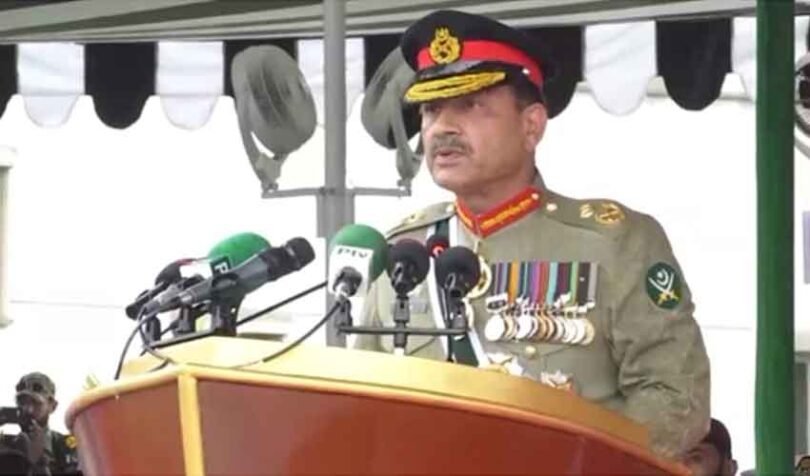
Pakistan strongly refutes these claims, asserting the conflict as a demonstration of indigenous capability. Field Marshal Syed Asim Munir, in his address at the National Defence University (NDU) on 7 July 2025, provided a firm counter-narrative to Indian accusations, categorically denying any direct Chinese military involvement in Operation Bunyan-un-Marsoos.
Indigenous Technological Development
Pakistan has invested heavily in indigenous R&D in cybersecurity, artificial intelligence, drone warfare, missile technology, and electronic warfare since 2019.
Platforms like JF-17 Block III, Babur missile systems, and home-grown battlefield AI tools were developed with local expertise and integrated into operational plans well before the conflict.
Strategic Modernization (2020–2025) Key modernization steps included:
PAF restructuring, enhancing rapid redeployment.
Integration of IT, surveillance, and hybrid warfare units.
Expansion of multi-domain operations via civilian-military tech coordination.
Acquisition and adaptation of advanced unmanned systems and counter-drone technologies from Türkiye and Azerbaijan.
Marshal Munir announced plans for acquiring J-20, J-35, and Turkish KAAN stealth fighters, KJ-500 AWACS, and HQ-19B air defense systems—highlighting long-term procurement, not last-minute reliance.
Operational Preparedness
Pakistan’s Operation Bunyan-un-Marsoos was conceived, rehearsed, and positioned well in advance of the May 2025 conflict, based on precise strategic anticipation—not foreign guidance.
Pakistan’s own satellite platforms, PakTES-1A and data from SPARCO, supported its defense network.
Rebuttal of India’s Claims
Army Chief Field Marshal Asim Munir called Indian claims “factually baseless and operationally dishonest.”
He emphasized India’s intelligence and strategic misjudgment, rather than Chinese involvement, as the root of its failure:
Failure to locate dispersed high-value Pakistani assets.
Miscalculated PAF’s operational depth and adaptive capabilities.
Overconfidence due to Rafale and S-400 systems.
Strategic surprise due to multi-layered Pakistani air defense and EW warfare.
Pakistan’s Position:
Victory was a result of national effort, backed by years of self-reliant defense innovation and multi-domain readiness, not foreign intervention.
III. Regional Implications and the Future of Pakistan’s Dual Engagement
A. Strategic Autonomy Through Dual Partnerships
Pakistan’s evolving partnerships illustrate a strategy that avoids overdependence on any single actor:
China contributes advanced defence technologies, real-time intelligence, and tactical support during crises.
The United States provides long-term development assistance, institutional support, and international legitimacy.
This dual-track model supports strategic autonomy—blending deterrence with diplomacy.
B. India’s Narrative as a Tool of Strategic Posturing
India’s focus on Chinese influence serves key political and strategic purposes:
Domestic Deflection: Framing Pakistan’s success as Chinese-enabled helps India shift blame from its own operational lapses.
Regional Signaling: It reinforces India’s efforts to portray itself as a bulwark against growing Sino-Pakistani alignment.
Undermining Self-Reliance: By questioning the authenticity of Pakistan’s achievements, India attempts to discredit Islamabad’s technological and strategic maturity.
C. Policy Recommendations and Strategic Outlook
Moving forward, Pakistan’s dual-engagement strategy suggests key policy directions:
Continue Indigenous Investment: R&D in space, defence, AI, and cyber technologies must remain central to national security planning.
Optimize Partnerships: Pakistan should deepen cooperation with both China and the U.S., ensuring that military and developmental ties reinforce rather than contradict one another.
Assert Diplomatic Agility: Balancing neutrality and engagement will be crucial amid global rivalries. Pakistan must maintain its sovereignty while leveraging strategic partnerships for regional stability.
Conclusion: Strategic Maturity in a Complex Environment
Between 2023 and mid-2025, Pakistan’s foreign policy matured into a multidimensional strategy that combines defence modernization, institutional strengthening, and international diplomacy.
With China, Pakistan has solidified a comprehensive hard-power partnership that enhances military capability and strategic deterrence.
With the United States, Pakistan has revitalized critical development sectors while renewing defence dialogue in the post-conflict context.
The May 2025 conflict served as a litmus test for Pakistan’s strategic preparedness. While Indian narratives frame the conflict as a proxy war, Pakistan’s emphasis on indigenous preparedness, operational foresight, and institutional readiness presents a more balanced and credible perspective.
Pakistan’s foreign policy trajectory reflects a clear aim: achieving strategic autonomy through diversified partnerships and domestic capacity building. As geopolitical tensions continue to evolve in South Asia, Pakistan appears poised to act as a stabilizing force—leveraging both hard power and developmental diplomacy to safeguard its national interests.
