



By Javed Mahmood, Kanwal Munir, Romana Afsheen and Hina Kashif’
ISLAMABAD: Islamabad witnessed a thought-provoking seminar on Wednesday titled “Rethinking Building a Resilient Pakistan – Rethinking Climate Adaptation and Disaster Management”, organized by The Truth International (TTI). The discussion strongly emphasized that devolving power, creating new administrative units, and restoring Local Governments remain vital for Pakistan’s resilience, stability, and effective disaster management.
Speakers argued that Pakistan cannot achieve sustainable growth and stronger disaster response mechanisms without empowering grassroots institutions. They stressed that new provinces and an effective local government system would ensure better service delivery, efficient resource allocation, and timely responses to natural calamities. According to them, decentralization would not only stabilize the country but also minimize vulnerabilities caused by climate change and other disasters.
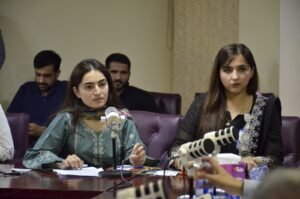
Senator Hidayatullah, Parliamentary Secretary for Information and Broadcasting Daniyal Chaudhry, Lt-Gen. (Retd) Samrez Salik from the National Defence University, Abdullah Khan, Managing Director of the Pakistan Institute for Conflict and Security Studies (PICSS), and renowned climate expert Dr. Sohail Malik addressed the gathering as keynote speakers. Each highlighted governance challenge is rooted in outdated administrative structures and proposed reforms to strengthen Pakistan’s resilience.
Abdullah Khan pointed out that Pakistan has continued to follow the colonial British model of governance since its independence. He reminded participants that Pakistan began with four provinces in 1947 and, disappointingly, still operates with the same number despite its growing population and complex challenges. He argued that maintaining this outdated administrative setup hampers development and prevents Pakistan from adapting effectively to modern realities.
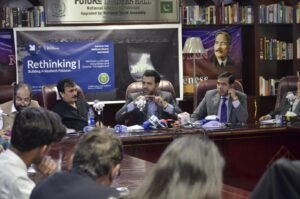
The session attracted significant public interest, with the Seminar Hall of the National Library in Islamabad filled to capacity. Ms. Rabia Ali hosted the event, while Ms. Kainaat Asad moderated the proceedings. The seminar began promptly at 11 am and concluded before 1 pm.
The consensus emerging from the discussion was clear: Pakistan must urgently move towards devolution of power and revival of local governance if it aims to build a stronger, more resilient nation capable of confronting natural disasters and future vulnerabilities.
Meanwhile, The Truth International (TTI) successfully organized a seminar titled “Rethinking Building a Resilient Pakistan: Disaster Management and Climate Adaptation” at the National Library, Islamabad. The seminar brought together eminent experts, scholars, and policymakers who underscored the urgent need for decentralized governance, smaller administrative units, and empowered local governments to build climate resilience and strengthen disaster management in Pakistan.
Major General (R) Samrez Salik
Major General (R) Samrez Salik, HI(M), emphasized the deep connection between climate change and governance structures, stressing that smaller administrative units could strengthen resilience and improve governance. He highlighted Pakistan’s unique geography as both a blessing and a challenge, underscoring the country’s vulnerability to climate-induced disasters.
He noted the importance of aligning political interests with national interests, pointing out that where national interest demands an educated and resilient population, political interests often seek to maintain the status quo. This disconnect, he argued, undermines progress in disaster preparedness and overall governance.
General Salik strongly supported the concept of smaller administrative divisions, stating that such reforms would not only improve service delivery but also influence political and institutional structures positively. He lamented the governance and management failures in Pakistan, particularly the absence of quality leadership, which continues to impede meaningful progress in resilience-building.
Barrister Daniyal Chaudhry
Barrister Daniyal Chaudhry, Parliamentary Secretary for Information and Broadcasting, described Pakistan as one of the most climate-affected countries despite contributing minimally to global emissions. He identified deforestation as a major cause of environmental vulnerability and stressed the need for consistent, long-term climate policies rather than short-term firefighting strategies.
He highlighted the adverse effects of recurring floods and criticized the fact that critical decisions were often made far from the affected regions, leading to delayed and ineffective responses. For him, the issue was not political but one of survival, requiring serious policy reforms to safeguard communities at risk.
Chaudhry also underscored the importance of devolution of power, advocating for smaller administrative units to ensure better service delivery. He noted that no one was willing to surrender authority, which remains a barrier to genuine decentralization. He emphasized that the delay in response was directly proportional to the scale of destruction, making devolution essential for a stronger, climate-resilient Pakistan.
Dr. Sohail Malik
Dr. Sohail Malik, a leading expert on climate and sustainable development, framed climate change as a “threat multiplier” rather than just an environmental risk. He pointed out that while provincial headquarters often remain untouched, disasters devastate vulnerable communities at the local level, proving the need for governance structures that directly respond to people’s needs.
He drew a distinction between decentralization and revolution, explaining that decentralization does not necessarily mean upheaval but does demand systemic restructuring. However, he argued that any such division or decentralization must be accompanied by a revolutionary approach that brings real change in governance and people’s lives.
Dr. Malik spoke from a citizen’s perspective, stressing that governance and resilience-building efforts must be rooted in the realities of local communities. He strongly backed Barrister Daniyal Chaudhry’s point that this was a matter of survival, not choice. Instead of continuously debating divisions, he suggested revitalizing and empowering local government systems to address people’s needs effectively and sustainably.
Abdullah Khan
Abdullah Khan, Managing Director of the Pakistan Institute for Conflict and Security Studies (PICSS), provided historical context by pointing out that Pakistan has retained the same four provinces since Independence in 1947. He regretted that despite changing needs and recurring disasters, the country continues to operate under a governance system introduced by British colonial rulers at Partition.
He argued that this outdated structure prevents Pakistan from effectively addressing climate vulnerabilities and disaster risks. Larger provinces, he explained, cannot adequately respond to localized hazards such as flash floods, glacial outbursts, and landslides, resulting in widespread suffering in disaster-hit regions.
Khan endorsed the creation of new administrative units aligned with Pakistan’s geographic and ecological realities. He stressed that governance reforms are critical not only for improved service delivery but also for minimizing disaster impacts and achieving long-term stability. His remarks echoed the seminar’s central theme: resilience requires governance closer to the people.
Senator Hidayatullah Khan
Senator Hidayatullah Khan highlighted Pakistan’s recurring governance failures in tackling disasters and emphasized the urgency of systemic reform. He noted that despite the passage of decades, the government has consistently failed to address critical issues, particularly in disaster preparedness and response.
He drew attention to the fact that while Pakistan faced major challenges at the time of Independence in 1947, today the situation has worsened. The population has grown nearly four times, while problems have multiplied many times over. Resources remain scarce, and when they are available, corruption and mismanagement prevent them from being used effectively. This has left the country increasingly vulnerable to disasters such as floods.
The Senator stressed that honest leadership and effective checks and balances are essential for resilience. He lamented that many citizens now choose to leave the country rather than contribute to its progress, while weak governance leaves the nation unprepared for recurring crises. He called for long-term planning and proactive reforms to address these challenges instead of short-term responses that fade with time.
Closing Note
The seminar concluded with a strong consensus that the devolution of power and the creation of climate-responsive administrative units are essential for Pakistan’s survival in the face of intensifying climate change. Speakers highlighted that strengthening local governance, ensuring timely responses, and aligning administrative structures with ecological zones would not only build resilience but also foster inclusive socio-economic development.
The event was hosted by Ms. Rabia Ali, moderated by Ms. Kainaat Asad, and attended by a packed audience of policymakers, civil society members, students, and researchers. The Truth International reaffirmed its commitment to advancing evidence-based reforms that can guide Pakistan toward a more resilient and sustainable future.
