

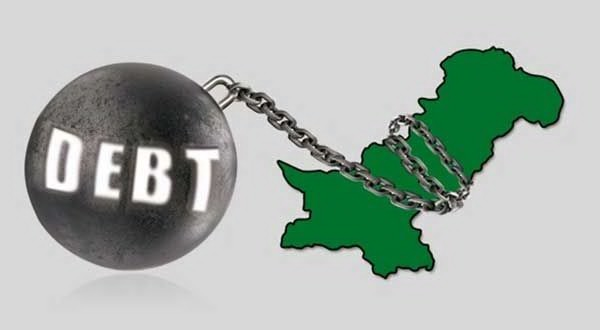

ISLAMABAD: In the fiscal year 2025–26, nearly half of Pakistan’s federal budget—46.7% or Rs8.2066 trillion out of a total Rs17.573 trillion—will be consumed by debt servicing. This marks the single largest allocation in the budget, dedicated to interest payments and loan repayments, leaving limited fiscal space for health, education, and development spendings.
Although the allocation is Rs 739 billion (8.26%) lower than the revised estimate of Rs 8.945 trillion for the outgoing fiscal year, the burden remains immense. The breakdown shows Rs7.197 trillion earmarked for domestic debt servicing and Rs1.009 trillion for foreign loan repayments.
As of end-March 2024, Pakistan’s public debt had reached a massive Rs76.01 trillion (US$269 billion)—more than quadruple its size a decade ago. Of this, Rs51.52 trillion was domestic and Rs24.49 trillion was external debt. Public debt now stands at 66.27% of GDP, breaching the legal limit set by the Fiscal Responsibility and Debt Limitation Act (FRDLA).
During the first nine months of FY2024-25, the government already paid Rs6.44 trillion in interest—66% of the annual debt servicing target. This included Rs5.78 trillion to domestic creditors and Rs656 billion to foreign lenders.
Despite government claims of improved cash-flow planning and long-term borrowing strategies, the debt trap remains a significant challenge. The growing repayment obligations are crowding out private investment, weakening the rupee, contributing to inflation, and reinforcing the country’s dependency on further borrowing—a self-reinforcing cycle of fiscal stress.
From July to March FY25, gross external inflows amounted to $5.07 billion, mainly sourced from multilateral institutions ($2.8 billion), commercial sources ($2.01 billion), and bilateral partners ($258 million). However, Pakistan did not issue any global bonds during this period.
Meanwhile, external outflows exceeded inflows, reaching $5.636 billion, with repayments of $2.828 billion to multilaterals, $1.565 billion to bilateral partners, and $1.243 billion to commercial lenders—further straining the already pressured foreign exchange reserves.
