

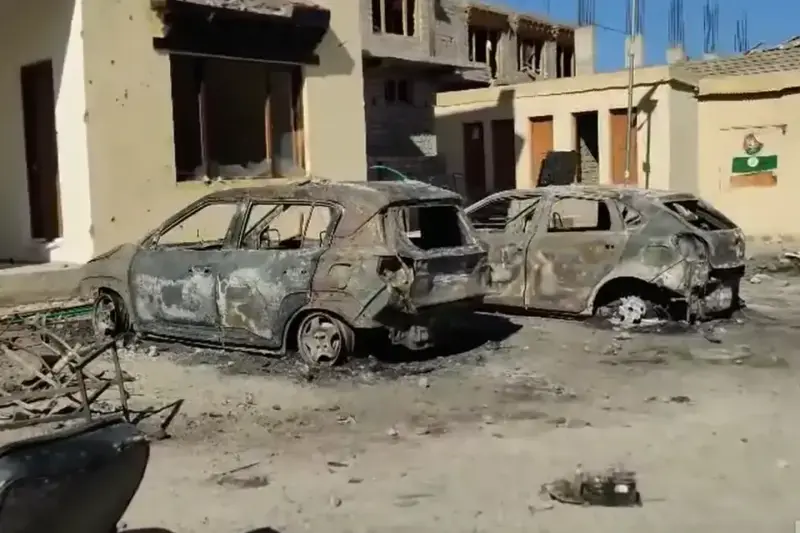

Authorities in Indian-occupied Ladakh enforced a strict curfew on Thursday following violent protests led mainly by Gen Z demonstrators. At least four people were killed, and dozens sustained injuries as unrest spiraled out of control.
The protests erupted on Wednesday when hundreds of young people marched through the streets demanding constitutional protections, democratic rights, and employment opportunities. Police resorted to force, triggering fierce clashes with demonstrators. Enraged protesters torched vehicles, government buildings, and the local Bharatiya Janata Party (BJP) office.
Heavy Security and Lockdown in Leh and Kargil
Officials confirmed that around 40 protesters were arrested overnight. By Thursday, both Leh and Kargil districts were under complete lockdown. Heavily armed police and paramilitary forces patrolled the streets to prevent further unrest. Local organisations in Kargil called for a strike, and businesses closed voluntarily in solidarity with the victims.
Lieutenant Governor Kavinder Gupta described the deaths as “tragic and shocking.” He justified the curfew, saying it was necessary to contain violence and protect lives. Meanwhile, political leader Sajjad Kargili urged New Delhi to “show wisdom, not force” and resume meaningful negotiations with the people.
Roots of Ladakh’s Discontent
The anger traces back to the Indian government’s 2019 revocation of Article 370, which stripped Jammu and Kashmir — including Ladakh — of semi-autonomous status. Initially, some residents welcomed the move, but fears soon grew over land loss, weakened local businesses, and political disenfranchisement.
Since then, Ladakh has been administered by unelected bureaucrats, leaving residents frustrated over the lack of democratic representation. Despite several negotiation rounds with New Delhi, no major progress has been achieved. Another round of talks is scheduled for October 6.
A Region on the Edge
The unrest underscores Ladakh’s complex identity. Leh remains largely Buddhist, while Kargil is predominantly Muslim, creating a delicate demographic balance. Climate threats add another layer of instability, as thousands of glaciers in the Himalayan region continue to melt, raising fears of future water scarcity.
Adding to the volatility, border tensions with China since 2020 have already militarised Ladakh, turning it into a potential flashpoint. Analysts warn that ignoring local demands could push the region deeper into crisis, jeopardising stability across the fragile Himalayan frontier.
About The Truth International
The Truth International (TTI), based in Islamabad, is a private organization, doing research work/projects and running its print and digital media wing _ a website, a fortnightly magazine, a YouTube Channel, and social media pages on all platforms. Stay up to date by staying connected to The Truth International.
