

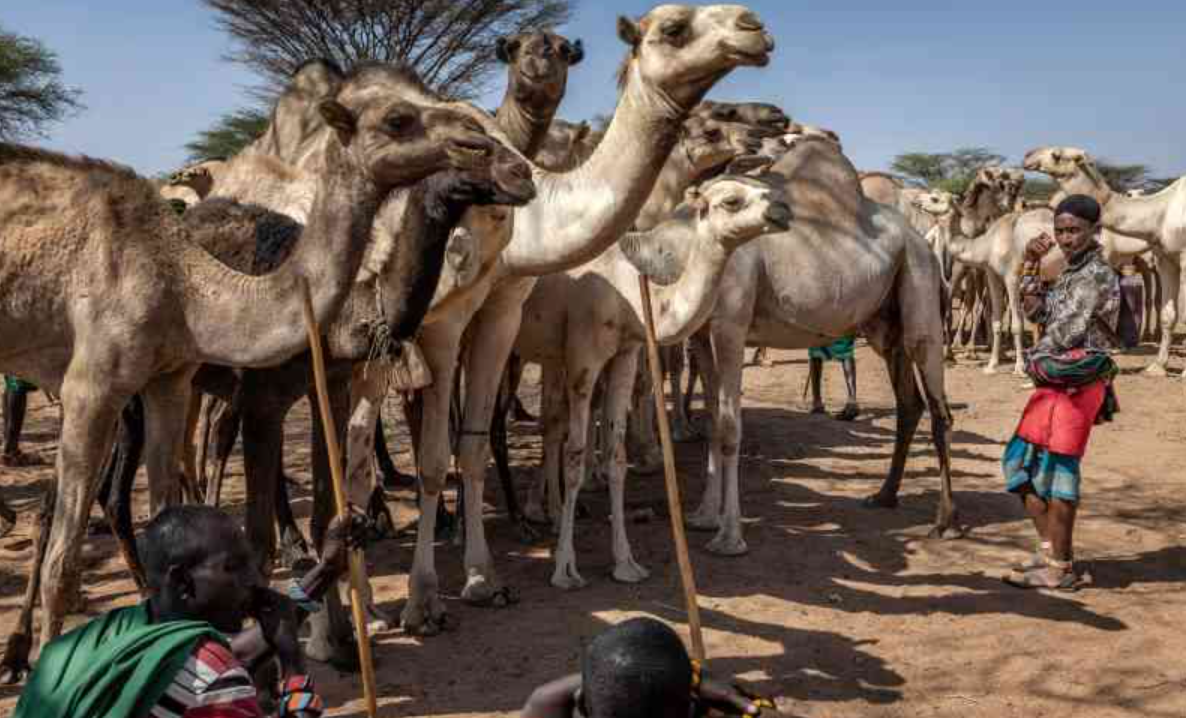

Northern Kenya’s relentless drought has forced pastoral communities to make a drastic change — abandoning cattle in favor of camels. With rainfall missing since April and dry riverbeds stretching for miles, herders say they have no other choice.
“We no longer have cattle at home. We only raise camels,” says Chapan Lolpusike, a member of the semi-nomadic Samburu community. Like many others, he lost all his cows and oxen after the country’s worst drought in forty years.
The drought, fueled by consecutive failed rainy seasons in 2021 and 2022, has devastated livestock populations and livelihoods. Yet, amid the hardship, camels have emerged as an unlikely symbol of hope and survival.
Camels: The Lifeline of Kenya’s Arid North
Camels have proven to be better suited to Kenya’s changing climate. They can survive for over a week without water, graze on dry grasses, and produce up to six times more milk than cattle. For communities struggling with food insecurity, their resilience has become invaluable.
Recognizing this, Samburu County launched a camel distribution program in 2015 after droughts wiped out more than 70 percent of the region’s cattle. Since then, around 5,000 Somali camels, a stronger and more productive breed, have been distributed to local families.
For herders like Lolpusike, who received camels in 2023, the shift has been life-changing. “Camels are now our future,” he says, tending to his animals in the dusty savannah where once cows used to graze.
Milk That Sustains Communities
Camel milk has become a vital source of nutrition for many families in northern Kenya. It can be collected up to five times a day, even in the driest months — unlike cow’s milk, which stops when grass disappears.
“During the dry season, camels still provide milk, and that makes all the difference,” says local resident Naimalu Lentaka.
A 2022 study by Meru University found that camel milk shares similar nutritional and therapeutic properties with human breast milk. For many pastoral families, it now contributes nearly half of their total nutrient intake during drought periods.
Village administrator James Lolpusike says the shift has already brought visible benefits. “Children are healthier, and families are more stable,” he explains. “If the drought continues, cattle will disappear entirely from this region.”
Challenges Ahead: Disease and Dependency
While camels have transformed local livelihoods, new challenges have also emerged. The animals are prone to specific diseases that could affect herd health. Veterinary experts are now working to train herders in camel care and disease prevention.
Despite these risks, the benefits remain undeniable. Families now depend heavily on camels — for milk, income, and even cultural identity. The animals have become both a necessity and a symbol of resilience.
Camels as a Symbol of Peace and Resilience
Beyond survival, camels are also fostering unity. The Maralal International Camel Derby, held each September, celebrates their importance through a 21-kilometer endurance race. The event promotes “peaceful cultural interactions,” bringing together communities that once clashed over scarce resources.
Camels, unlike cattle, can stay in one place during droughts, reducing conflicts caused by migrating herds. For many, they represent not just adaptation but peace itself.
“Camels keep us grounded,” says administrator Lolpusike. “They help us survive and live together in harmony.”
Prayers for Rain Continue
Even as camels help sustain life, communities still pray for rain. Wells continue to run dry, and grasslands vanish under the sun’s relentless heat.
“We only pray the situation doesn’t get worse,” says Lolpusike, looking out over his herd.
For Kenya’s pastoralists, camels have become more than livestock — they are the bridge between survival and extinction in a land where rain no longer comes.
