

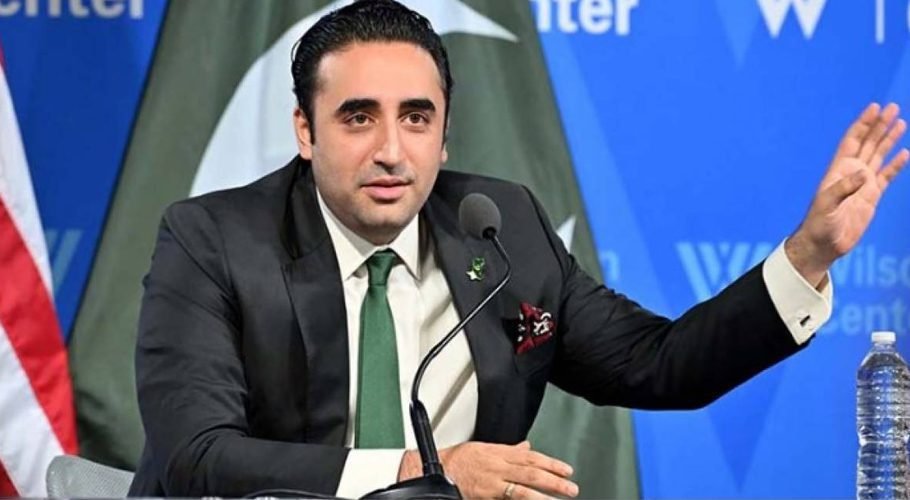

ISLAMABAD: Pakistan Peoples Party (PPP) Chairman Bilawal Bhutto-Zardari has called for a transformative partnership between Pakistan and India to jointly confront terrorism, urging New Delhi to move away from hostility and engage in meaningful dialogue for lasting peace in the region.
Speaking at a seminar in Islamabad titled “Pakistan: A Bulwark Against Terrorism,” Bilawal extended a powerful message to Indian leadership, stressing that regional cooperation—not confrontation—is the path forward.
“Pakistan is ready to build a historic and phenomenal partnership with India to defeat terrorism,” Bilawal said. “Let us move beyond zero-sum politics and recognize our shared responsibility to protect over a billion lives in South Asia.”
Calling on Indian leaders to abandon what he described as a “high horse” approach, Bilawal said: “It’s time to pursue peace with Pakistan. Sit with us. Talk to us. Let us resolve the Kashmir dispute in accordance with the will of its people.”
He also condemned what he termed the “weaponisation of water,” referencing India’s suspension of its participation in the Indus Waters Treaty (IWT)—a landmark 1960 agreement brokered by the World Bank to manage shared river resources.
“Let us end the weaponisation of water and instead build a peace as mighty as the Himalayas,” he urged. “Let us return to our common heritage rooted in the soil of the Indus Valley Civilization, not in animosity.”
Bilawal’s remarks came amid renewed tensions between the two nuclear-armed neighbours, following India’s accusation that Pakistan was behind the killing of 26 civilians in Indian Illegally Occupied Jammu and Kashmir (IIOJK) earlier this year—an allegation Islamabad strongly denies. The spike in violence led to one of the most serious escalations in recent years before both sides reached a ceasefire.
India’s decision in April to suspend the IWT prompted a strong reaction from Islamabad, which welcomed a ruling by the Permanent Court of Arbitration (PCA) that reaffirmed Pakistan’s position. Islamabad insists that the treaty does not permit unilateral withdrawal or suspension.
Highlighting Pakistan’s extensive counterterrorism experience, Bilawal invited the international community to benefit from the country’s hard-won knowledge.
“Come train with us. Learn from our armed forces, our special forces, our police,” he said. “We’ve led one of the most sustained battles against terrorism and violent extremism across generations.”
Bilawal’s appeal marks a rare moment of diplomatic outreach, framing Pakistan not only as a frontline state against terror but also as a willing partner for regional stability and peace.
