

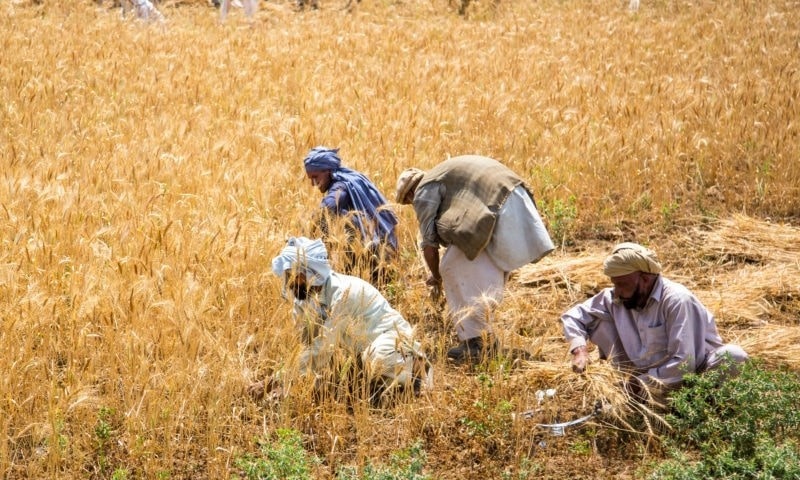

By Aamir Latif
KARACHI: Agriculture makes up nearly a quarter of Pakistan’s gross domestic product and employs close to 40% of its workforce – yet the sector is edging toward crisis.
Often described as the backbone of the national economy, Pakistan’s farm industry has been stifled by a range of pressures: high input costs, outdated irrigation methods and degrading soils.
Now, experts warn, climate change could deal an even heavier blow – potentially slashing overall productivity by 8-10% by 2040.
But climate change is just one part of the storm. Zahid Hussain Bhurgri, secretary general of the Sindh Chamber of Agriculture, told Anadolu that the crisis is multifaceted.
“All of this is going to turn the country into a total import economy,” he said.
With nearly 58% of Pakistanis already food insecure, according to estimates, dwindling agricultural output threatens to worsen the humanitarian situation.
Hostile market forces
Falling commodity prices and soaring input costs have already discouraged many farmers from sowing crops, Bhurgri said.
“Prices of fertilizers, oil, electricity, seeds, and pesticides have gone up dramatically in recent years, which is taking a heavy toll on farmers,” he explained.
The effects are already showing in production data.
According to the Economic Survey of Pakistan, the country recorded a 13.5% drop in major crop output in the last fiscal year. Wheat production in southern Sindh – Pakistan’s second-largest agriculture region – fell from 4.1 million metric tons to 3.1 million tons.
Cotton yields plunged from 15.5 million bales to 5.2 million bales over the past five years.
“Why on Earth would someone produce a commodity that he or she has to sell in deficit?” Bhurgri said, referencing a price rift between farmers and the government in northeastern Punjab, the country’s food basket.
While farmers accuse the government of underpaying for crops, officials argue that price controls have helped curb food inflation. Bhurgri called the approach a “short-term slaughter” of the agriculture sector, warning it will have long-term consequences for Pakistan’s agricultural economy.
Asif Kamran, director of the Agriculture Policy Centre at the University of Agriculture Faisalabad, agreed that market dynamics are skewed against farmers. Middlemen, he told Anadolu, also exploit their financial vulnerability.
“For small land owners, it is not feasible to make heavy investments and compete with large farmers,” he said. “It also decreases our farmers’ ability to compete with farmers in other countries where the land holdings are very large.”
Kamran said Pakistan should revive cooperatives to give farmers collective bargaining power and improve access to supplies, technology and markets.
No ‘future farmers’
Beyond market pressures, deeper structural issues loom, including the very future of who will farm the land.
Pakistan’s shrinking land-holding ratio could also lead to a shortage of “future farmers,” Kamran warned, which could have cascading effects on the country’s food security.
Rising population and housing demand have already turned large swaths of green land into concrete jungles in both major cities and smaller districts across Punjab and Sindh.
“Rural areas lack basic facilities and are becoming non-livable because of the urban bias of development policies in the past several decades,” he added.
This neglect is fueling migration to cities, accelerating farmland conversion and draining the agricultural labor force.
Bhurgri echoed the concern, noting that Pakistan already spends $11 billion annually on agricultural imports – including essential food staples – as domestic production falters.
Shaukat Ali Chadhar, secretary-general of the Kisan Board of Pakistan, a non-governmental agricultural advocacy group, estimated that 20% to 30% of Punjab’s fertile land – the source of 65% of the country’s food – has been lost to industrial projects and housing schemes.
In provincial capital Lahore, 70% of agricultural land has been converted to housing and industrial units, he said. In Gujrat, that figure is at 60%.
In key agricultural districts of central Punjab – such as Faisalabad, Gujranwala, Sheikhupura, and Kasur – between 30% and 40% of fertile land has been sold to developers and industrialists.
Still, he noted, the land-holding ratio remains relatively strong in southern Punjab and northern Sindh, which currently produce more than half of the country’s wheat, sugarcane and cotton.
Pakistan’s vulnerability to climate change
Fahd Rasul, an associate professor of agronomy at the University of Agriculture Faisalabad, said climate change is already affecting Pakistan’s agriculture, leading to lower yields and greater economic vulnerability for farmers.
“Wheat, rice, cotton, sugarcane and maize are major crops highly prone to sudden temperature fluctuations and unpredictable, less frequent but more intense rains,” he told Anadolu.
Heat waves, he said, reduce wheat grain size and weight, cutting yields by 4-6% annually. Mango production has also taken a hit from extreme weather.
Rasul warned that climate-related losses in wheat and rice could cost Pakistan $19.5 billion by 2050, up from $2 billion annually today.
Overall, he projects an 8-10% drop in agricultural productivity by 2040 due to climate change.
Wheat yields may drop by up to 50% by 2050, he said, while heat waves could become 30 times more frequent.
Melting glaciers, erratic monsoons, and prolonged droughts are also disrupting water supplies. With over 60% of Pakistan’s farms reliant on rainfall or canal irrigation, the risks are dire.
He cited the catastrophic 2022 floods, which submerged a third of Pakistan’s farmland, as a warning.
Rising temperatures and shifting weather patterns are also affecting livestock, Rasul said, degrading soil, reducing milk output, raising animal mortality and threatening the livelihoods of some 30 million people.
Altered monsoons and warming waters are also disrupting fish stocks, he added, hurting both food access and income.
Hope in adaptation
Still, experts stress that Pakistan’s agricultural future is not doomed, but it does require urgent reform.
Kamran urged a shift to crop diversification, restorative crop cycles, and sustainable farming to preserve long-term soil health.
He urged farmers to switch to low delta crops that require less water and move away from outdated flood irrigation systems. The “judicial” use of strategic groundwater reserves is also critical, he added.
He hailed some of the government’s recent steps, including financial aid and loans to farmers, electronic warehouse receipts, an import tax on cotton and tax breaks on fertilizers and pesticides.
Bhurgri added that if farmers are supported through consistent and agriculture-friendly policies, the return on investment would be enormous.
