



AI Safety Summit
China, the United States, the European Union, and other nations agreed to collaborate in managing the risks associated with artificial intelligence (AI) at a British summit. The summit aimed to establish a safe path for AI’s rapid advancement.
Some tech leaders and political figures have expressed concerns about the uncontrolled development of AI, seeing it as a potential global threat. This has led to a race among governments and international organizations to create safeguards and regulations.
In a significant step, a Chinese vice minister, alongside U.S. and EU leaders, and tech figures like Elon Musk and Sam Altman, gathered at Bletchley Park, the historic site of Britain’s World War Two code-breakers. Over 25 countries, including the U.S., China, and the EU, signed the “Bletchley Declaration,” emphasizing the need for international cooperation and a common approach to AI oversight.
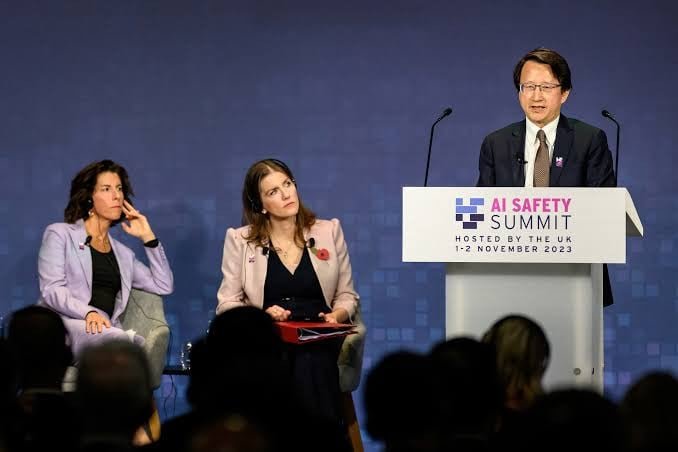
Wu Zhaohui, China’s vice minister of science and technology, expressed China’s readiness to increase collaboration in AI safety to help establish a global governance framework. He emphasized that all countries, regardless of size, have equal rights to develop and use AI.
Concerns about AI’s impact on economies and society grew when OpenAI released ChatGPT, sparking fears that machines could surpass human intelligence, potentially leading to unintended consequences. Governments and officials are now working with AI companies to navigate these challenges, with Elon Musk suggesting the use of a “third-party referee” to signal risks.
While the European Union focuses on data privacy and surveillance, the British summit addresses “existential risks” from highly capable general-purpose AI models known as “frontier AI.” Mustafa Suleyman, the co-founder of Google Deepmind, highlighted the importance of planning ahead as the industry trains increasingly large AI models, despite the belief that current models do not pose significant catastrophic harms.
Code Breakers Venue: Bletchley Park
British Prime Minister Rishi Sunak conceived the summit, aiming to position the UK as a mediator between the U.S., China, and the EU in the post-Brexit era.
British Digital Minister Michelle Donelan celebrated the gathering of key players and revealed plans for two more AI Safety Summits in South Korea and France.
Donelan stated, “For the first time, countries agree on the need to collectively address frontier AI risks.”
Governments, like tech companies, compete for AI regulation leadership. China’s participation, considering its role in AI development, raised questions about trust among Beijing, Washington, and European capitals.
The U.S. clarified that the invitation to China originated from the UK. U.S. Vice President Kamala Harris’s speech and meetings in London during the summit stirred discussions about overshadowing the event’s focus. British officials refuted this, emphasizing their desire for diverse voices.
Shortly after President Joe Biden’s AI executive order, the U.S. announced the launch of a U.S. AI Safety Institute at the British summit. Harris will meet Sunak and attend the summit’s second day.
