

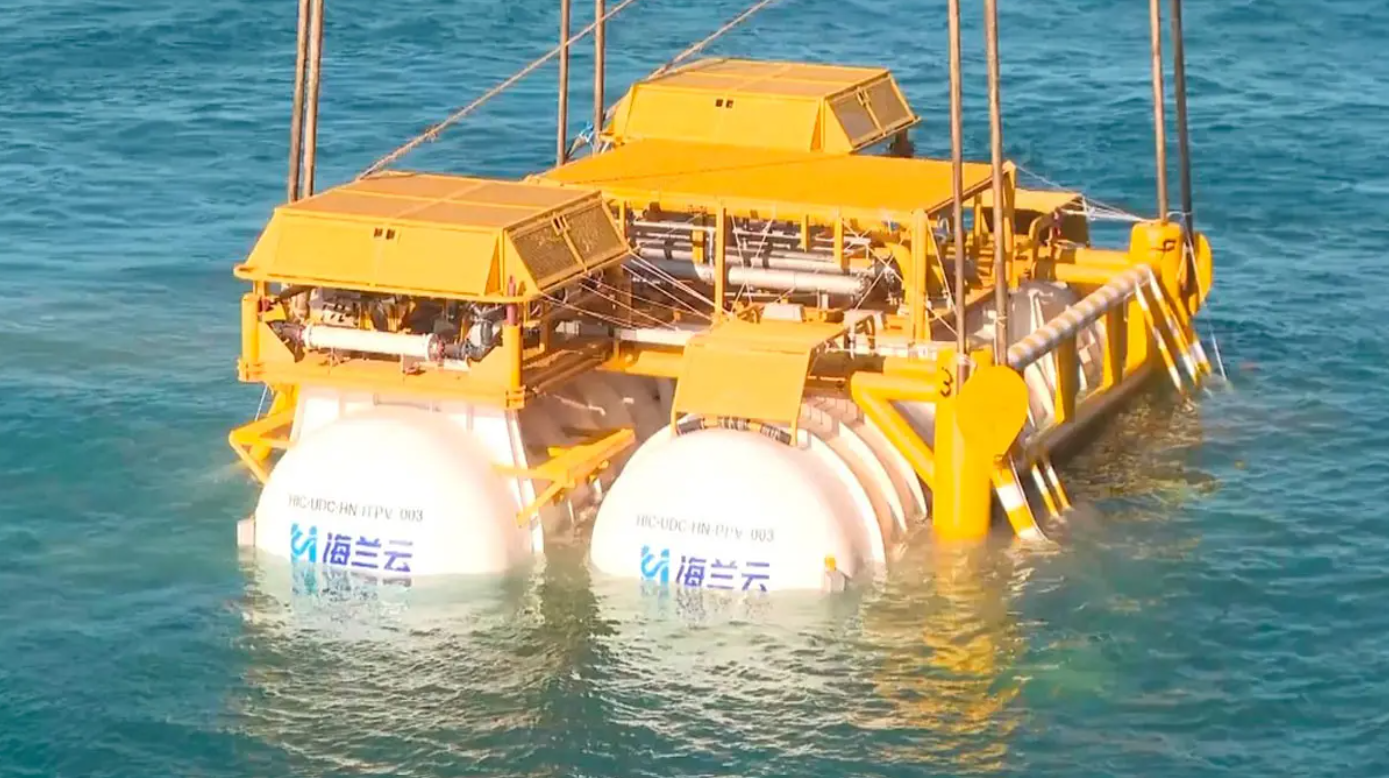

China Prepares to Launch First Commercial Underwater Data Center
China is set to make a groundbreaking move toward sustainable computing by launching its first commercial underwater data center off the coast of Shanghai in mid-October. The project, led by Highlander, a maritime equipment company, aims to significantly reduce the energy required to cool servers while promoting environmentally friendly data infrastructure.
On a wharf near Shanghai, engineers are finalizing work on a large yellow steel capsule that will soon be submerged beneath the sea. The structure, developed in collaboration with several state-owned construction firms, represents a key step in China’s technological and environmental ambitions.
Underwater Data Centers Offer Major Energy Savings
“Underwater operations have inherent advantages,” said Yang Ye, Vice President of Highlander. He explained that submerging servers under the sea can reduce cooling energy consumption by up to 90 percent compared to traditional land-based facilities.
The system will rely on naturally cold ocean currents for cooling rather than electricity-driven systems, allowing the facility to drastically lower its carbon footprint. This innovation comes at a time when artificial intelligence and cloud computing are pushing global energy demands to record levels.
Although the idea of underwater computing is not new—Microsoft tested a similar concept off the coast of Scotland in 2018—China’s project marks one of the first commercial-scale deployments in the world.
Supporting China’s Green Data Infrastructure Goals
The underwater data center is part of Beijing’s broader push to make computing infrastructure more sustainable. The facility will serve key clients, including China Telecom and a state-owned AI company. Government support has played a vital role, with Highlander having previously received a 40 million yuan (about $5.6 million) subsidy for a similar project in Hainan.
While Microsoft’s experiment proved the feasibility of such designs, the company did not continue with commercial expansion. In contrast, China’s financial and regulatory backing is now accelerating progress toward mass adoption.
Technical Challenges Beneath the Waves
Building an underwater data center presents numerous challenges. Zhou Jun, one of the project’s engineers, noted that construction complexities exceeded early estimates. The capsule, built onshore, will be assembled in sections and then lowered into the ocean, with power supplied primarily by offshore wind farms. Highlander claims that over 95 percent of the energy used will come from renewable sources.
The capsule’s glass-flake coating protects it from corrosion, while a small elevator system connects the submerged structure to a surface station for maintenance.
However, experts warn of potential technical and cybersecurity challenges. Shaolei Ren, a computer scientist at the University of California, Riverside, explained that linking underwater data centers to mainland internet networks remains complex. He also highlighted possible sound wave-based cyber threats, which could target the servers through vibrations or acoustic interference.
Environmental and Ecological Concerns
Beyond technical barriers, scientists are also raising environmental concerns about the impact of submerged data centers on marine ecosystems. Andrew Want, a marine ecologist from the University of Hull, cautioned that the heat emitted by underwater servers could disturb local habitats, attracting certain species while repelling others.
“These are unknowns at this point,” he said. “There’s not enough research yet to determine the long-term ecological effects.”
Highlander maintains that an independent study conducted in 2020 on its earlier Zhuhai project found no significant temperature rise in surrounding waters. Still, experts urge more research before scaling up. Ren added, “For megawatt-scale underwater data centers, the risk of thermal pollution must be studied more carefully.”
A Complementary Solution, Not a Replacement
Industry specialists believe that underwater data centers could complement traditional land-based facilities, especially in regions where land availability or cooling resources are limited. “They’re unlikely to replace existing data centers,” said Ren, “but they can serve specific high-performance or remote applications efficiently.”
A Milestone for Green Technology
China’s upcoming underwater data center launch symbolizes a major step toward sustainable digital transformation. The project not only demonstrates innovation in energy-efficient computing but also reflects the country’s commitment to reducing emissions in one of the most energy-intensive industries.
As the capsule prepares for deployment off Shanghai’s coast, the world will be watching closely. The initiative could reshape how data is stored, cooled, and powered, marking a significant stride in the global race for green technology and responsible innovation.
