

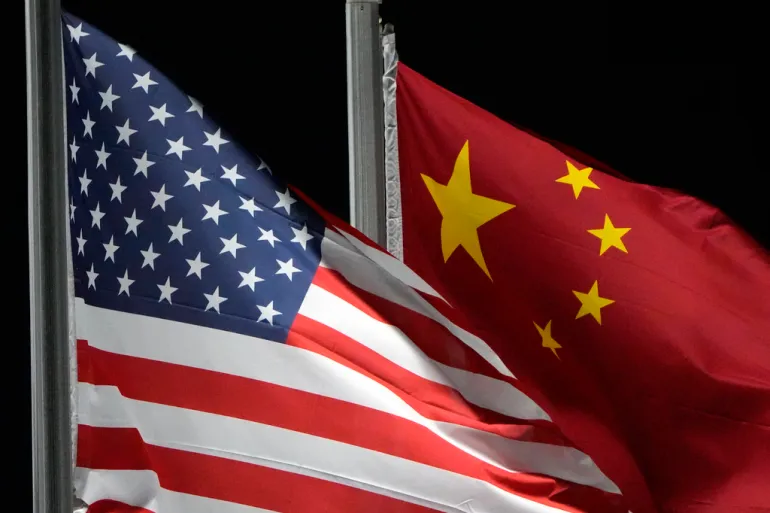

China has announced a 34% tariff on US imports, becoming the first major economy to counter President Donald Trump’s sweeping new trade duties. This move escalates the ongoing global trade conflict, which has rattled financial markets and heightened concerns about a potential economic downturn.
In response to the US tariffs, Beijing also plans to impose export controls on key rare earth elements used in medical and consumer technology. Additionally, China intends to challenge the US trade measures at the World Trade Organization (WTO).
Global markets reacted sharply to the escalating trade tensions. Asian and European stock markets extended their losses following a significant drop in the US markets. Frankfurt’s index plunged by 5%, Paris declined over 4%, and London fell nearly 3.8%. Tokyo’s Nikkei closed 2.8% lower, prompting Japan’s Prime Minister Shigeru Ishiba to describe the situation as a “national crisis.”
Despite market volatility, Trump downplayed concerns, stating that stocks would recover. He introduced a 10% import tariff applicable to all nations, set to take effect on Saturday, with additional higher duties targeting specific countries.
While most affected nations have refrained from immediate retaliation, they have voiced strong opposition and sought negotiations with the US. The European Union (EU) is considering countermeasures, including a potential tax on American technology companies. EU trade officials are scheduled for discussions with US representatives to address the situation.
France and Germany have suggested alternative responses rather than direct retaliatory tariffs. France’s Economy Minister Eric Lombard emphasized that Europe’s countermeasures could involve taxation and data regulations rather than mirroring US actions.
In Japan, officials are seeking diplomatic talks between Prime Minister Ishiba and Trump, especially after Japanese exports were hit with a 24% tariff. Meanwhile, Canada has imposed its own 25% levy on US car imports, following the US decision to enforce a similar tariff on all foreign-made vehicles.
The automotive industry is swiftly adapting to the new trade landscape. Stellantis, which owns Jeep, Chrysler, and Fiat, has suspended production at certain assembly plants in Canada and Mexico. Japanese automaker Nissan is reassessing its US production strategy, planning to discontinue two vehicle models produced in Mexico. Volvo Cars, owned by China’s Geely, is ramping up production in the US and may introduce a new model there.
Trump remains firm on his protectionist trade stance, stating that his goal is to reduce the US’s dependence on foreign manufacturers. Commerce Secretary Howard Lutnick defended the policy, urging patience and asserting that Trump understands how to manage the global economy. However, opposition is growing, even within Trump’s own party. Republican Senator Mitch McConnell criticized the tariffs as detrimental, advocating for cooperation with allies rather than confrontation.
The head of the WTO, Ngozi Okonjo-Iweala, warned that the ongoing trade turmoil could reduce global merchandise trade volumes by 1% this year.
