

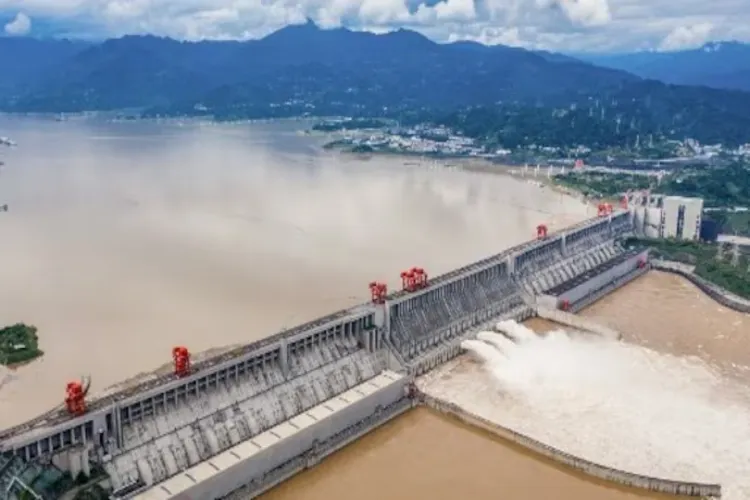

China has started work on the world’s largest hydropower dam in Tibet. Chinese Premier announced the start of construction on the Tibetan Plateau, which is set to become the world’s largest hydropower dam. It is located on the eastern edge of the Tibetan Plateau, with a projected cost of $170 billion, according to state-run Xinhua News Agency.
Touted as China’s most ambitious energy project since the Three Gorges Dam, the massive undertaking is expected to become operational sometime in the 2030s. The project comprises five cascading hydropower stations along the lower stretches of the Yarlung Zangbo River, where the river drops an astonishing 2,000 metres (6,561 feet) over just 50 kilometers (31 miles)—a natural feature ideal for generating massive hydroelectric power.
China claims the dam will generate 300 billion kilowatt-hours of electricity annually, helping to meet growing energy demands in Tibet and across China. Authorities have assured that the project will not significantly impact downstream water supplies or the surrounding environment.
Regional and Environmental Concerns
India and Bangladesh, both located downstream on the Brahmaputra River—the name of the Yarlung Zangbo once it exits Tibet—have expressed apprehension over the potential disruption to water flow that could affect millions of people and agricultural systems in their regions.
The Chinese government has yet to release any details on potential displacement or ecological assessments tied to the project.
Premier Li called the initiative a “project of the century” and emphasized the importance of environmental conservation during its development.
Economic and Market Reactions
News of the project sparked a rally in China’s stock markets, especially among construction and engineering firms. The CSI Construction & Engineering Index surged nearly 4%, reaching a seven-month high.
Several companies hit their 10% daily price limit, including:
- Power Construction Corporation of China
- Arcplus Group PLC
- Xizang Tianlu Co Ltd (cement manufacturer)
- Tibet GaoZheng Explosive Co (civil explosives)
Shares of Hunan Wuxin Tunnel Intelligent Equipment Co, a producer of tunneling machinery, soared 30%, as did Geokang Technologies Co Ltd, known for smart monitoring systems.
The megaproject will drive demand for materials such as cement and explosives, presenting broad opportunities for companies in construction, infrastructure, and energy equipment sectors.
Investment manager Wang Zhuo of Shanghai Zhuozhu Investment Management noted that while the project offers long-term value, the current market response is also driven by short-term speculation, potentially inflating valuations.
Unknowns and Legacy
Despite the massive scale, China has not disclosed how many jobs the project will create or the number of residents who might be displaced. By comparison, the Three Gorges Dam created around a million jobs but also displaced a similar number of people.
As China continues expanding its hydropower network in Tibet—including existing operations upstream—environmental advocates and neighboring countries will be closely watching how this latest project unfolds, for its promises of clean energy.
