


Moon Landing
China successfully landed an uncrewed spacecraft on the far side of the moon on Sunday, marking a landmark mission aimed at retrieving the world’s first rock and soil samples from the moon’s dark hemisphere.
This mission, according to China’s space agency, underscores the country’s growing prominence in space exploration amid a global push to exploit lunar resources for sustaining long-term astronaut missions and establishing moon bases within the next decade.
The Chang’e-6 craft, equipped with advanced tools and its own launcher, touched down in the vast South Pole-Aitken Basin at 6:23 a.m. Beijing time (2223 GMT).
The China National Space Administration (CNSA) detailed the mission’s complexities and innovations in a statement, emphasizing the high risks and significant engineering challenges involved. The payloads aboard the Chang’e-6 lander are set to perform scientific exploration tasks as planned.
This mission marks China’s second successful venture to the moon’s far side, a feat no other country has achieved. The far side of the moon, which perpetually faces away from Earth, presents unique challenges due to its deeply cratered surface and communication difficulties.
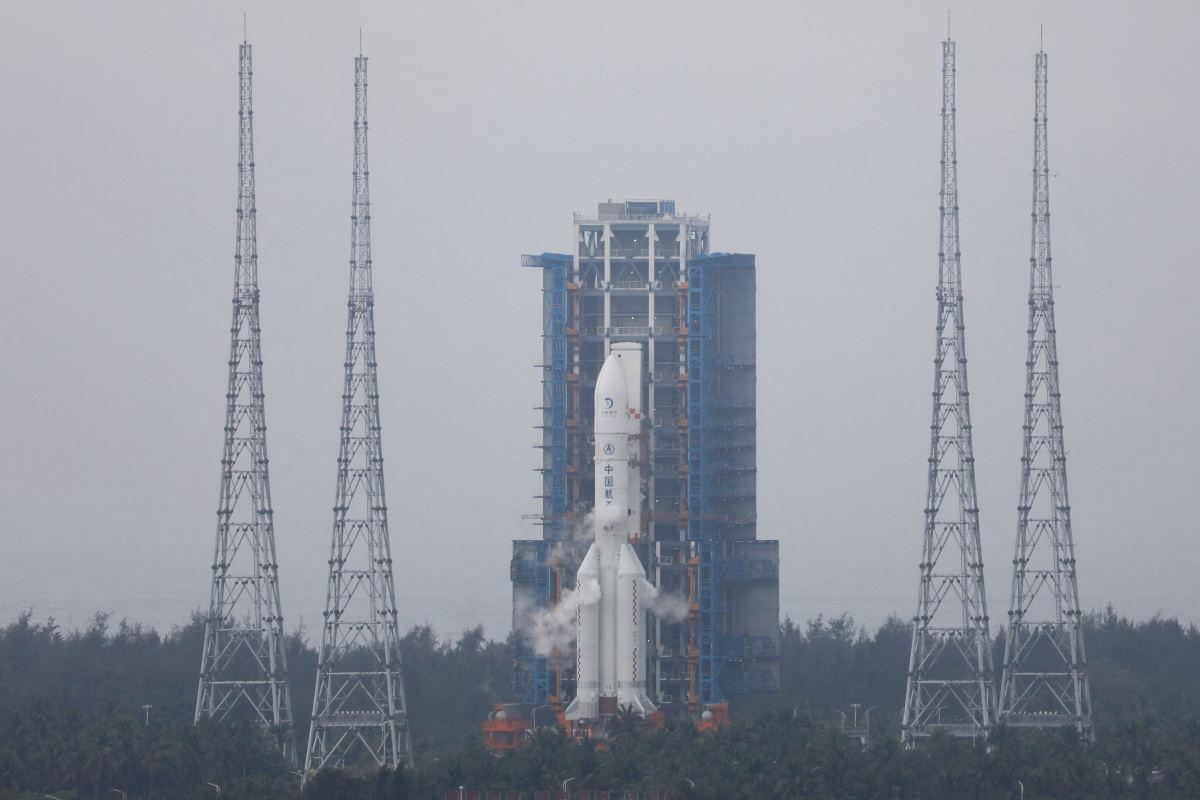
The Chang’e-6 probe was launched on May 3 using the Long March 5 rocket from the Wenchang Satellite Launch Center on Hainan Island. After approximately a week of travel, the spacecraft tightened its orbit in preparation for the historic landing.
The lander is tasked with collecting 2 kilograms (4.4 pounds) of lunar material using a scoop and drill. These samples will then be transferred to a rocket booster on the lander, which will launch back into lunar orbit to rendezvous with another spacecraft. The samples are expected to return to Earth, with a landing in Inner Mongolia projected around June 25.
If successful, the mission will provide China with pristine records of the moon’s 4.5 billion-year history, offering new insights into the formation of the solar system. It will also enable a comparative study between the moon’s far side and the more familiar Earth-facing side.
China’s broader lunar strategy includes plans for its first crewed moon landing around 2030, with Russia emerging as a key partner in this endeavor. This follows China’s 2020 success with the Chang’e-5 mission, which retrieved samples from the moon’s near side.
Meanwhile, the United States, under its Artemis program, is also planning a crewed moon landing by late 2026 or later. NASA has partnered with space agencies from Canada, Europe, and Japan, whose astronauts will join U.S. crews on future Artemis missions. This collaborative effort underscores a new era of international cooperation in space exploration.
