

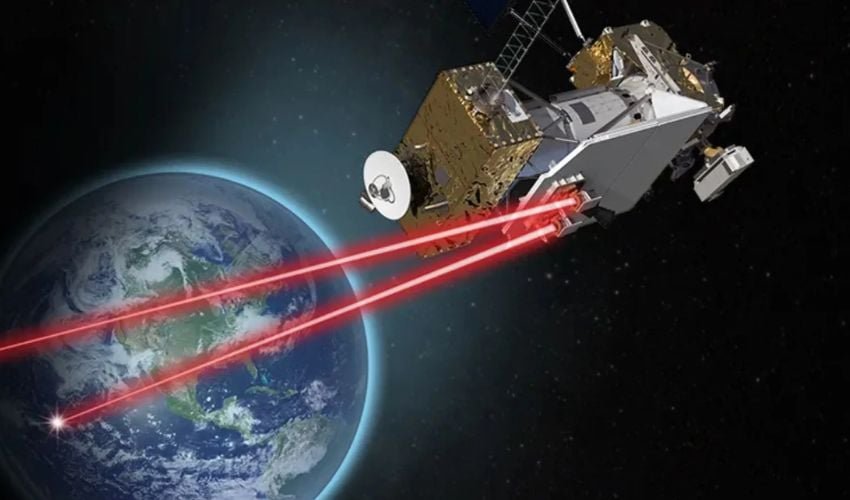

Chinese scientists have successfully transmitted data from space to Earth at a blazing speed of 1 gigabit per second (Gbps) using a low-powered 2-watt laser, outperforming SpaceX’s Starlink by a factor of five. The laser transmission originated from a satellite in geostationary orbit, approximately 36,000 kilometers above Earth.
The breakthrough experiment was led by Professor Wu Jian of Peking University of Posts and Telecommunications and Liu Chao of the Chinese Academy of Sciences. The team employed an innovative combination of Adaptive Optics (AO) and Mode Diversity Reception (MDR)—a technique designed to counter the disruptive effects of atmospheric turbulence that usually weaken and distort laser signals during long-distance space transmissions.
A key component of the experiment was a 1.8-meter ground-based telescope located at the Lijiang Observatory in southwest China. The system was capable of capturing the laser signal from a classified satellite positioned 36,705 kilometers away. The receiver’s cutting-edge design featured 357 adaptive micro-mirrors that reshaped incoming light in real time and a multi-plane signal converter guided by a custom chip-based algorithm to maintain a stable data stream.
According to findings published in the journal Acta Optica Sinica, the new method significantly enhanced transmission reliability, boosting the percentage of usable signals from 72% to over 91%.
This marks a major step forward in China’s space laser communication capabilities. While China’s Shijian-20 satellite previously set a record with a 10Gbps laser downlink in 2020, the technical details—including power levels—remain classified. At the time, U.S. surveillance of Shijian-20 prompted evasive maneuvers, highlighting the strategic sensitivity of this technology.
As nations race to dominate the next frontier of satellite-based internet and communications infrastructure, China’s latest success positions it as a strong contender in high-speed, space-based laser data transmission—surpassing existing low-Earth orbit systems such as Starlink in speed and efficiency.
