

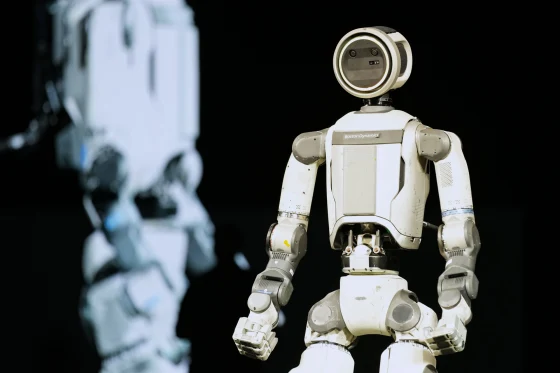

LAS VEGAS – CES 2026 delivered a major surprise as Hyundai shifted the spotlight from automobiles to robots. On Monday, the company unveiled Boston Dynamics’ Atlas humanoid robot on a public stage for the first time, giving audiences a rare glimpse of its abilities outside the lab.
Robots Take Center Stage
Expectations of sleek car reveals were replaced by cutting-edge robotics. Hyundai’s press conference focused entirely on Boston Dynamics’ innovations, highlighting the company’s vision to integrate robots into daily life.
The event opened with a choreographed dance performance by Boston Dynamics’ Spot robots, demonstrating precision movement, coordination, and the advanced engineering behind the company’s creations. This performance set the stage for Atlas, the humanoid robot designed for more complex, human-like tasks.
Atlas Steps Into the Public Eye
Although Atlas has been widely seen in online videos, those demonstrations were filmed in controlled lab environments. CES 2026 marked its first appearance before a live audience, showing how the robot moves and balances in a real-world setting.
During the demonstration, Atlas rose from the floor in a deliberate, slightly awkward motion. Engineers explained that the robot’s movements are engineered for function and stability, not for human-like grace. Unlike humans, Atlas optimizes its balance, energy efficiency, and safety, allowing it to adapt to unpredictable surfaces and tasks.
The public debut allowed visitors to observe Atlas performing controlled walking, lifting objects, and minor obstacle navigation, highlighting its potential for industrial and household applications.
Hyundai’s Crucial Role in Atlas Production
Hyundai is not just showcasing the robot—it is actively involved in its production. The company supplies actuators, builds critical components, and manages the robot’s supply chain. This partnership ensures that Atlas can be scaled from prototypes to real-world deployment.
All robots produced in 2026 are scheduled to be shipped to Hyundai’s Robotics Metaplant Application Center (RMAC). There, they will be tested in controlled industrial environments and integrated into manufacturing and logistics systems. Hyundai plans to gradually expand Atlas’ applications to assistive roles in healthcare, eldercare, and domestic settings.
Enhancing Intelligence with Google DeepMind
Hyundai and Boston Dynamics are collaborating with Google DeepMind to equip Atlas with advanced AI capabilities. This integration will allow the robot to interpret complex instructions, recognize objects, adapt to changing environments, and perform tasks autonomously.
By combining physical engineering with AI, Atlas aims to bridge the gap between laboratory prototypes and practical applications. Engineers emphasized that these cognitive upgrades are crucial for deploying robots safely in factories, warehouses, and eventually homes.
Industrial First, Household Next
The immediate goal is to deploy Atlas in industrial settings where safety, precision, and reliability are paramount. Once proven, the robot could perform a variety of domestic tasks, such as lifting objects, assisting elderly residents, or handling routine chores.
Boston Dynamics and Hyundai also stressed Atlas’ potential in disaster response, search and rescue missions, and environments unsafe for humans, showcasing the versatility of humanoid robotics.
Implications for the Future of Robotics
CES 2026 highlights Hyundai’s commitment to making robotics a core part of its strategy, beyond traditional automotive innovations. By putting Atlas in front of the public, Hyundai signals a new era where humanoid robots could become part of everyday life, from factories to homes.
The demonstration also underlines the growing role of AI-powered machines in industry, healthcare, and personal assistance. Hyundai’s investment in both hardware and software suggests that commercially viable humanoid robots could arrive sooner than many expect.
Key Facts:
-
Atlas made its first public appearance at CES 2026.
-
The robot was designed for stability and functional movement rather than human-like grace.
-
Hyundai will manufacture Atlas and supply critical components for global deployment.
-
Google DeepMind will integrate AI to enhance task understanding and environmental awareness.
-
Initial applications are industrial, with potential expansion into homes and healthcare.
