

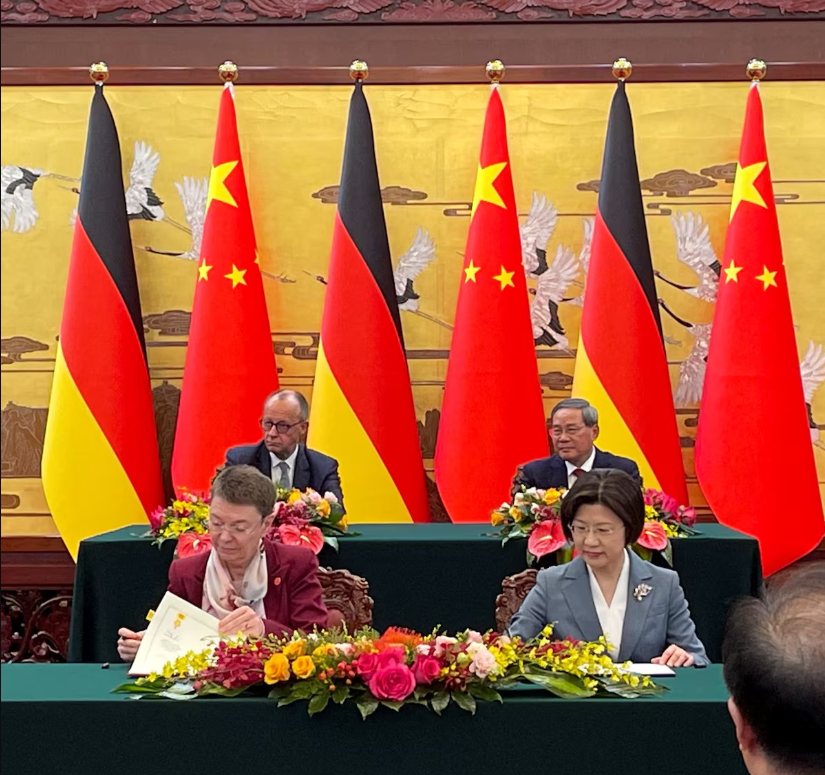

China and Germany have agreed to deepen cooperation during high-level talks in Beijing. German Chancellor Friedrich Merz met Chinese Premier Li Qiang to discuss economic relations.
Merz began his visit with a focus on resetting ties. The discussions come amid a widening trade imbalance between the two economies.
Germany considers China its largest trading partner last year. Therefore, Berlin wants to maintain strong economic exchanges. However, leaders also stressed the need for fair cooperation.
Merz emphasized open communication during his meeting. He noted specific concerns in bilateral cooperation. Moreover, he called for improvements to ensure balanced trade relations.
Li also highlighted the importance of collaboration. He urged both countries to safeguard multilateralism and free trade. Furthermore, he encouraged joint efforts to promote a fair global governance system.
Limited Agreements Signed During Visit
Despite positive rhetoric, the signed agreements remained limited in scope. The two sides formalized five documents after their meeting.
These agreements covered climate change and green transition initiatives. In addition, both countries agreed on cooperation in animal disease prevention.
A poultry products protocol also formed part of the discussions. Moreover, the two sides signed sports collaboration agreements for football and table tennis.
However, these deals focused on peripheral sectors. They did not address major structural trade concerns.
Nevertheless, further discussions may produce additional outcomes. Merz traveled with a delegation of 30 German firms.
German Industry Faces Growing Pressure
Major carmakers such as Volkswagen and BMW accompanied the delegation. These companies face intense competition from Chinese manufacturers.
As a result, Germany’s manufacturing-heavy economy feels mounting pressure. The trade imbalance has widened in recent years. Consequently, policymakers in Berlin have raised concerns.
Some voices in Germany now call for protective measures. However, leaders continue to seek constructive engagement.
Merz faces a delicate balancing act. He must protect German interests while maintaining strong economic ties.
Broader Implications for EU-China Relations
The visit carries wider significance for Europe. Engagement between Europe’s largest economy and China may shape EU-China relations this year.
China has presented itself as a reliable economic partner. This message resonates as global trade tensions persist.
At the same time, Europe worries about supply chain vulnerabilities. Concerns about dependence on China have also grown.
European officials recently highlighted troubling trade trends. They pointed to rising imbalances and shrinking market share for EU firms in China.
Moreover, China’s domestic economy has slowed. Consumer demand has weakened in recent years. Consequently, manufacturing overcapacity has pushed Chinese firms to expand abroad.
Business Community Shows Continued Interest
Despite political debate, German businesses remain engaged. Surveys suggest innovation gains in China benefit German headquarters.
Chinese commentators argue that economic cooperation can stabilize global trade. They believe commercial interests outweigh political rhetoric.
Critics, however, warn about systemic rivalry and de-risking strategies. Yet business leaders continue to pursue opportunities in China’s vast market.
Conclusion
China and Germany have signaled a desire to deepen cooperation. However, trade imbalances and competitive pressures remain serious challenges.
While limited agreements marked this visit, broader economic questions persist. Therefore, future negotiations will determine whether both nations can achieve fair and balanced cooperation.
