


Budget 2025-26
ISLAMABAD: Finance Minister Muhammad Aurangzeb has issued a stern warning that the federal government may be forced to impose an additional Rs400 to Rs500 billion in taxes if key enforcement provisions of the 2025-26 budget are not approved by parliament.
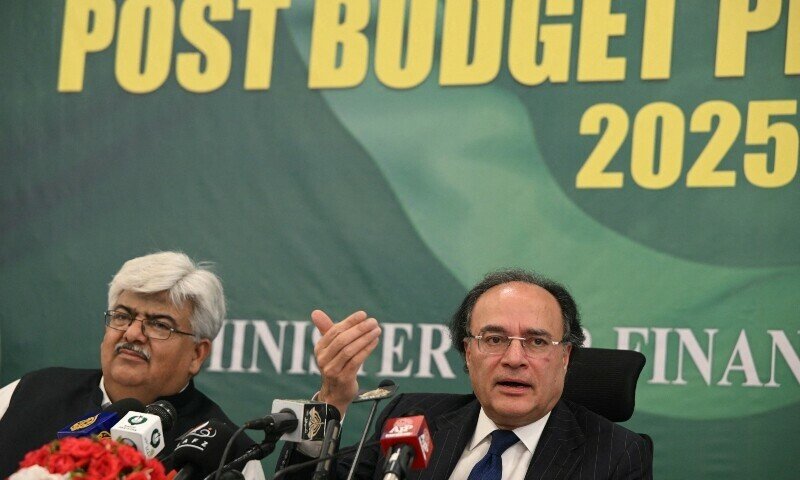
Speaking at a post-budget press conference, the minister underscored the urgency of passing the enforcement measures already endorsed by the International Monetary Fund (IMF), cautioning that failure to do so would jeopardize fiscal stability and revenue targets.
Addressing members of both houses of parliament, the finance minister urged them to pass the enabling clauses required for implementation of sweeping enforcement reforms. Without them, he stressed, the government would have no choice but to turn to heavy taxation to fill the fiscal gap. He hinted that resistance could come not just from opposition parties but also from within the ruling coalition and various pressure groups.
Though Aurangzeb refrained from naming specific provisions, it is widely understood that the proposed enforcement measures pertain to expanded powers for the Federal Board of Revenue (FBR). These include blocking high-value transactions by tax non-filers, such as property and vehicle purchases, investment in financial instruments, and opening of elite bank accounts.
Other proposed powers include sealing unregistered business premises, confiscating goods, and collecting taxes from public and private entities.
The finance minister made it clear that of the Rs700 billion additional revenue targeted for the upcoming fiscal year, Rs389 billion is tied directly to these enforcement mechanisms, while Rs312 billion is expected from new tax measures.
Finance Secretary Imdadullah Bosal added that these figures are already locked in under Pakistan’s agreement with the IMF. He also noted the additional fiscal burden of Rs28 billion due to the federal cabinet’s last-minute decision to raise government salaries by 10%, instead of the previously planned 6%.
The budget event was disrupted by a walkout from journalists protesting the cancellation of the traditional technical briefing. Information Minister Attaullah Tarar had to intervene to address the media’s concerns and restore order. Meanwhile, Aurangzeb defended the significant salary increases—up to 550%—for parliamentarians and ministers, saying they were long overdue since the last revision in 2016.
On pension reforms, the finance secretary admitted there would be delays in implementing the contributory pension scheme for military personnel, which was previously set to launch on July 1, 2025.
Both he and the minister evaded questions about salary hikes for armed forces and the enhanced Rs70 billion allocation for parliamentarians’ development schemes, which exceeded the Rs50 billion recommended by the Annual Plan Coordination Committee.
Aurangzeb also defended minor tax relief for the salaried class and corporate sector, calling it a step in the right direction as the government seeks to build more fiscal space. He confirmed that the provinces had been asked to submit their nominations for the new National Finance Commission (NFC), with a meeting expected in August.
The finance minister also addressed confusion around the proposed debt servicing surcharge (DSS) on electricity bills, noting that legal amendments would allow the government to exceed the current 10% cap on a case-by-case basis. When asked about the minimum wage, Aurangzeb cited private sector resistance as a major hurdle to enforcement.
Looking ahead, Aurangzeb said Pakistan is well-positioned to meet upcoming international bond payments and is planning to issue Panda bonds later this year to access Chinese capital markets. A return to Western markets is expected in 2026, contingent on improved credit ratings.
As part of wider structural reforms, the government has eliminated additional customs duties on 4,000 tariff lines and reduced duties on 2,700 more, with an emphasis on raw materials and intermediate goods to boost exports. These reforms aim to reduce Pakistan’s average tariff rate to just over 4%.
Closing the presser on a different note, Aurangzeb commended DawnMedia’s climate change initiative, Breathe Pakistan, calling it a vital step toward raising awareness of the environmental crisis. “We are living climate change daily,” he said, pointing to frequent storms in Islamabad and other signs of shifting weather patterns.
