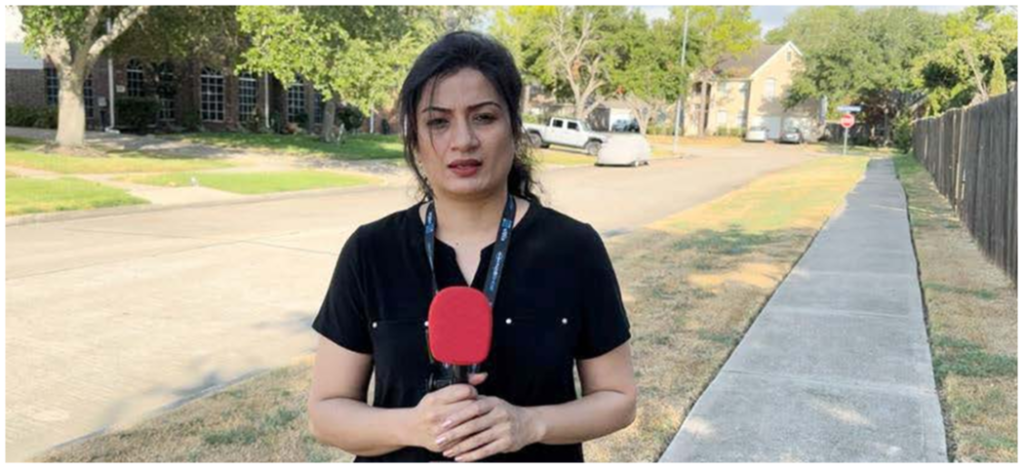
Sobia Cheema stands as a trailblazer among the rare female journalists in Pakistan who defied societal barriers to ascend to the pinnacle of broadcast journalism. Commencing her journey in the world of broadcast media as a producer in 2004, she would go on to assume the role of Director of Programming at 92 News in 2013. Born and raised in the unassuming town of Arifwala, Punjab, her early education was rooted in these humble surroundings.
“In remote locales like Arifwala, the birth of daughters often goes unnoticed, and the idea of educating them remains largely overlooked,” Sobia shared during our conversation, conducted from her current residence in Texas. She recollects the prevailing mindset that relegated girls to the sole role of caretakers within their families, a mindset that significantly contributes to the persistently low literacy rates in such towns and villages. “We adhered to the joint family system, where familial decisions were rendered by other family members, and individual voices were stifled. Thankfully, my father was a man of progressive ideals who championed the cause of educating his daughters,” she continued. “I have one brother and a sister, both now established in their careers as a banker and lecturer, respectively. My father, a government employee, sadly passed away just last year,” Sobia disclosed.
“The environment in which I was raised was one where the plight of women was characterized by oppression. It was a world devoid of independence and the autonomy to make one’s own choices. The deficiency in literacy and power was palpable. Invariably, sons were accorded preferential treatment over daughters. Even within the confines of my joint family, I encountered prejudices, as my male cousins were undeniably esteemed in many regards, while my gender made me feel inferior.”
Speaking of the opportunities available to women in her hometown, Sobia pointed out that Arifwala did indeed have women’s colleges, yet the prevailing sentiment still discouraged women from pursuing careers, instead relegating them to domestic chores. “In many instances, women in these areas are married off while they’re still in school, thus truncating their educational journeys. This is a deeply concerning issue that afflicts our nation,” she lamented.
Following her primary education, her family relocated to Lahore, where she completed her secondary education at a government-run school. “In Lahore, I also ventured into athletics and achieved district-level victories,” Sobia mentioned.
Sobia pursued her undergraduate studies at Lahore College for Women University, one of Pakistan’s premier women-only institutions of higher learning. Following her undergraduate degree, she majored in journalism and earned an MSc in Mass Communication. Throughout her academic pursuits, she maintained a strong focus on sports, amassing several medals. She attributes all of her accomplishments to the unwavering support and encouragement of her father.
Lahore, she found, was a city brimming with opportunities, and she soon secured a position as a producer at the newly-launched Geo News, Pakistan’s largest media outlet. “It was a dream come true, as I had always harbored the ambition of proving myself in this field, one that offered a pathway to empower the women of Pakistan,” she expressed. “While society tends to cast a disparaging eye on women in media roles, I did not face direct opposition from my family. However, the extended relatives were another matter altogether. My aunts and uncles exerted pressure, particularly on my father, urging him to dissuade me from pursuing a career in media, deeming it ‘inappropriate’ for women. Instead, they insisted on marriage,” she recalled.
Sobia notes that workplace pressures and discrimination form another formidable hurdle that working women must navigate, in addition to familial and societal criticism. “Working as a female team leader in most of the news outlets I’ve been part of was no walk in the park, primarily due to the lingering presence of male chauvinism,” she recounted.
“Notwithstanding, not all male colleagues subscribed to this viewpoint. I encountered difficulties in executing tasks, especially when dealing with the Master Control Room, and sometimes my male team members would decline to assist. Managing live outdoor shows posed distinct challenges. Yet, I refused to yield, taking charge of every situation with a positive and determined approach. This demonstrated my leadership abilities and my capacity to uplift my team, fostering a sense of unity that propelled us forward,” Sobia elucidated regarding the challenges she confronted.
Sobia observes that media organizations in Pakistan have much ground to cover when it comes to providing on-the-job support and facilities for their female employees. In her pursuit of equality, diversity, and inclusion, she contends that women, just like their male counterparts, deserve a work environment that is respectful, accommodating, and conducive to their professional advancement. “Women are consistently underpaid, and the glass ceiling remains intact, with few women ascending to top-tier positions,” she noted.
Sobia has lent her expertise to several prominent news channels in Pakistan, including Geo News, Express News, 92 News, Dunya TV, ATV (an entertainment channel), and Suno News. Presently, she serves as a Special Correspondent for Suno News, stationed in Texas, USA.

Her illustrious career has afforded her the privilege of being selected for the US State Department’s International Visitors Leadership Programme (IVLP). Additionally, she received Honorary Citizenship from the Mayor of South Dakota. Sobia has also been an active member of the South Asian Free Media Association (SAFMA), an organization dedicated to fostering peace among South Asian nations.
As for her future endeavors, Sobia aspires to become a part of global organizations addressing women’s rights issues and promoting cross-cultural understanding and collaboration.