

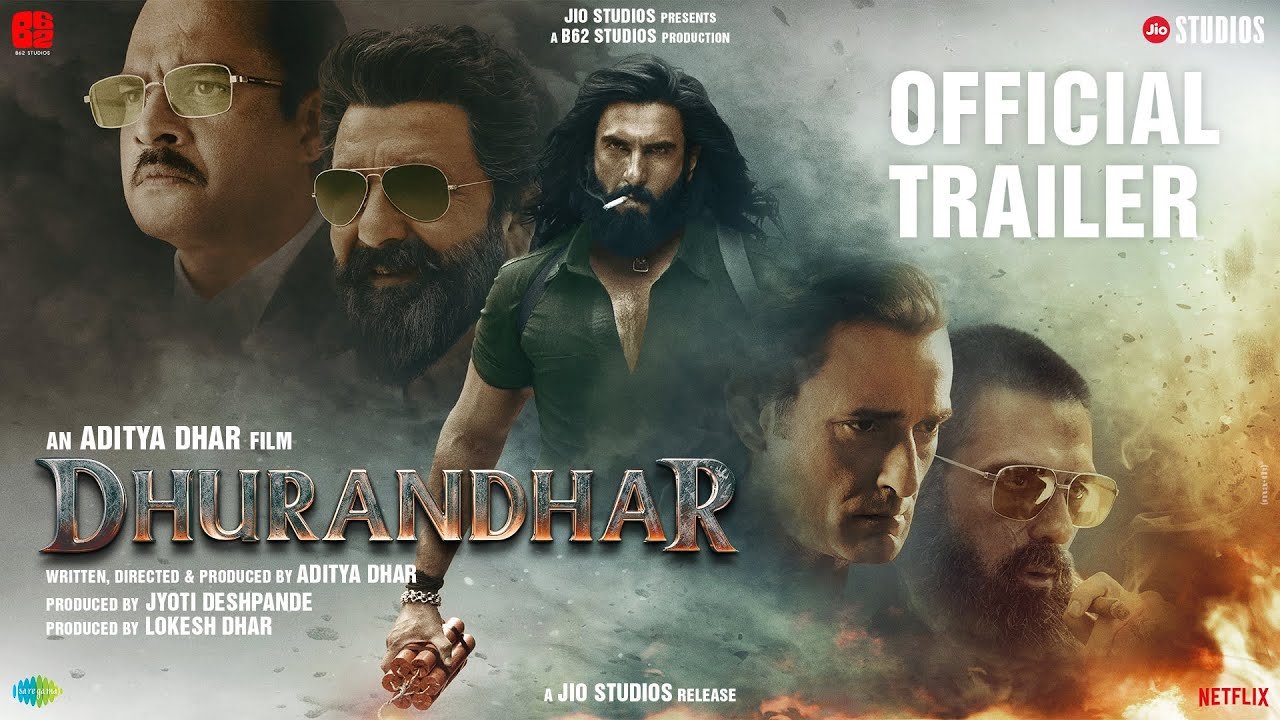

Bollywood’s upcoming film Dhurandhar has faced widespread criticism following the release of its trailer, with many reactions coming from Indian social media users themselves.
The trailer portrays Karachi’s Lyari district as a war zone, featuring Ranveer Singh as a RAW agent infiltrating “hostile” Pakistani territory, while Arjun Rampal plays Major Iqbal, a Pakistani intelligence officer nicknamed the “Angel of Death” intent on “making India bleed.”
R. Madhavan portrays Ajay Sanyal, a character inspired by India’s National Security Adviser Ajit Doval, who views Lyari as the “heart of terrorism” in Pakistan that must be infiltrated to combat terrorism. The film also incorporates Pakistani political imagery, including a Pakistan Peoples Party (PPP) rally, images of the late Benazir Bhutto, and party flags, which has drawn additional scrutiny.
Observers in Pakistan note that Dhurandhar reflects a growing trend in Indian cinema of intensifying anti-Pakistan narratives. Casting choices, such as Sanjay Dutt as the late SSP Chaudhry Aslam and Akshaye Khanna as gangster Rehman Dakait, have been widely mocked online for their implausibility. Many critics argue that the film exaggerates events and relies on sensationalism rather than historical accuracy.
Set to release in early December, the film has already become a source of embarrassment for Bollywood. Critics, including many within India, have condemned the movie for its distortions, unrealistic characterizations, and over-the-top portrayal of Pakistan.
Historically, the Lyari gang wars were an internal conflict between rival gangs in Karachi, shaped by complex ethnic, social, and political dynamics. Figures such as Rehman Dakait, Arshad Pappu, Chaudhry Aslam, and Uzair Baloch were central to the violence, which claimed numerous lives and affected countless residents.
Critics argue that Bollywood’s appropriation of these events, filtered through an Indian nationalist perspective, ignores the real experiences of Karachi’s people, reducing a nuanced and tragic chapter of the city’s history to a simplified, dramatic narrative for entertainment purposes.
Dhurandhar’s trailer has thus ignited debates over historical accuracy, nationalistic framing, and the responsibility of filmmakers in portraying real-world conflicts.
