

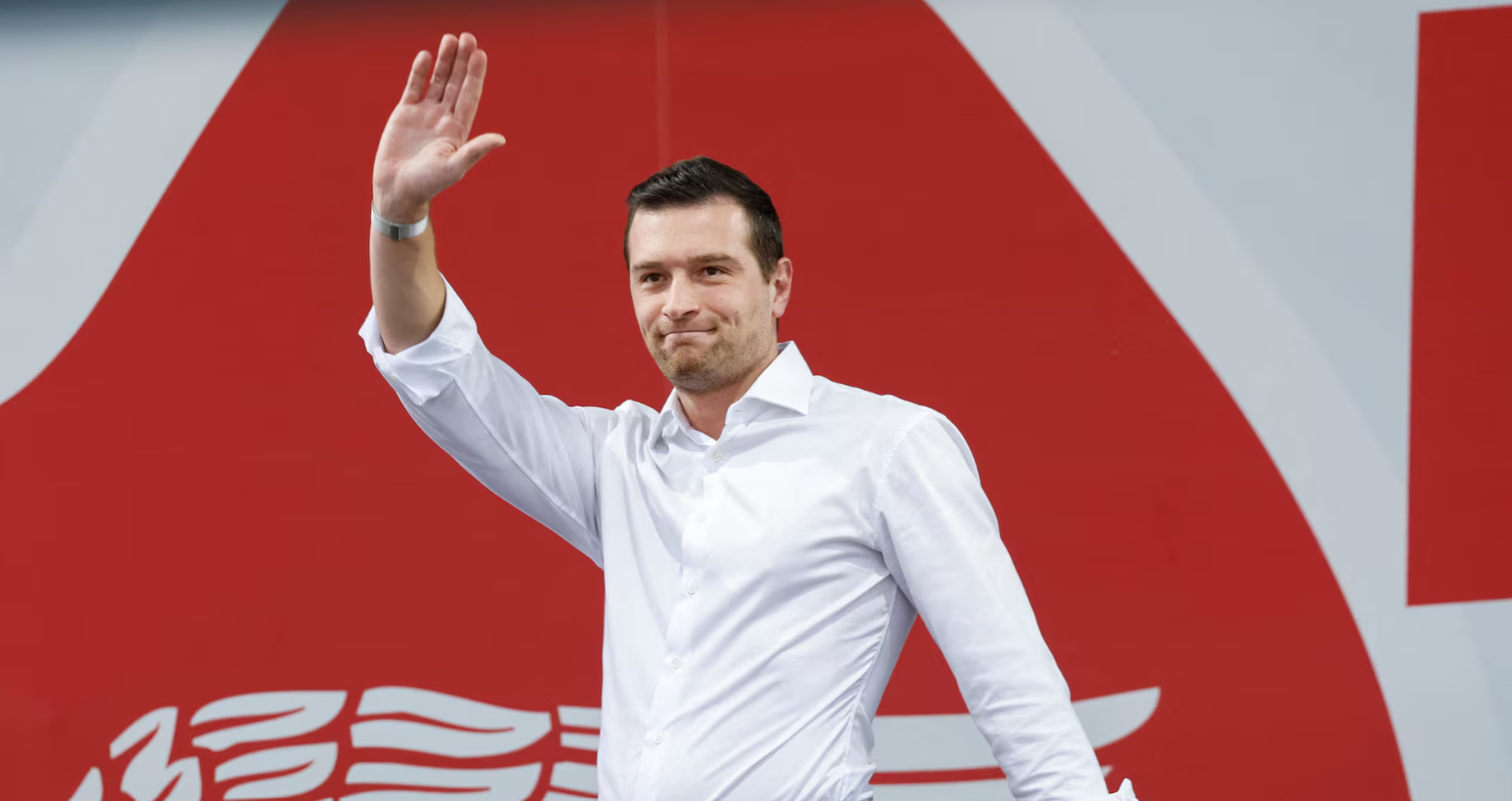

A new national poll in France has triggered intense political debate as far-right leader Jordan Bardella emerges as the projected winner of the 2027 presidential election. The findings reveal a dramatic shift in public opinion and signal a changing political climate ahead of a vote still two years away. Although elections often shift in later stages, this early prediction has already captured widespread attention due to the scale of Bardella’s projected lead.
Bardella Emerges as the Strongest Contender
According to the poll, Bardella would defeat every potential rival if the election were held now. The survey sampled 1,000 respondents on November 19 and 20, and the numbers highlight his growing influence across France. As the current president of the National Rally party, Bardella appears positioned to lead the movement once dominated by Marine Le Pen.
His support in the first round ranges from 35% to 36%, depending on who stands against him. These numbers place him significantly ahead of other major figures in the French political landscape. Moreover, the data suggests he maintains a strong advantage in a second-round scenario, regardless of which candidate advances to face him.
A Rise Rooted in Shifting French Politics
France’s political environment has transformed rapidly in recent years. As economic uncertainty, social tension and leadership fatigue intensify, public preferences have shifted. Therefore, Bardella’s rise reflects more than personal popularity. It also represents a broader realignment in French political sentiment, especially after the volatility following the 2024 general election.
The current government struggled to form a stable coalition after the election resulted in a hung parliament. This deadlock weakened public confidence and created space for opposition figures to expand their influence. Consequently, Bardella’s support grew steadily among voters seeking a decisive alternative.
Marine Le Pen’s Absence Alters the Landscape
The poll arrives at a pivotal moment for the National Rally. Marine Le Pen, long seen as the party’s face, is currently barred from holding public office for five years. A court ruling earlier this year led to her disqualification. Although she has appealed the decision, the uncertainty surrounding her future has pushed Bardella further into the spotlight.
Bardella’s approval ratings have surpassed those of his predecessor, allowing him to consolidate leadership within the party. His political style and communication strategy appear to resonate strongly with younger voters and those frustrated with traditional political alliances.
Poll Tests Bardella Against Diverse Opponents
The survey tested Bardella against several major figures across the French political spectrum. The list included far-left leader Jean-Luc Mélenchon, moderate leftist Raphaël Glucksmann, and centrist former prime ministers Gabriel Attal and Édouard Philippe.
In second-round projections, Bardella defeats Mélenchon with a significant 74% of the vote. Against Philippe, the margin narrows considerably, with Bardella receiving 53%. These results indicate that although Bardella dominates early matchups, some centrist candidates remain competitive. The poll specifies a margin of error of 2.5 percentage points, which still leaves Bardella comfortably ahead in every scenario.
Early Lead Does Not Guarantee Victory
While Bardella’s lead appears strong, electoral history in France suggests caution. Being the early favourite has not always translated into a final victory. Marine Le Pen and her father Jean-Marie Le Pen also led in several early surveys in past election cycles. However, they later faced powerful alliances formed by parties across the political spectrum, ultimately losing three different presidential run-offs.
Therefore, even with his current lead, Bardella may eventually confront a united front seeking to block the far-right from securing the presidency. French elections often produce new coalitions in the decisive weeks before voting, which could influence final outcomes.
Growing Discontent with Macron’s Successors
The poll also reflects the weakening influence of political figures linked to President Emmanuel Macron. Public support for Macron’s allies has declined sharply since his decision to dissolve parliament in mid-2024. The move resulted in a fractured legislature, political paralysis and growing frustration among voters.
Because of this, many centrist and moderate candidates now face an uphill challenge in rebuilding public trust. Their weakened position has indirectly boosted Bardella’s rise.
Bardella’s Appeal Expands Among Key Demographics
Although the poll does not detail demographic breakdowns, recent political patterns offer some insight. Younger voters have increasingly gravitated toward Bardella due to his active online presence and direct communication style. Additionally, rural communities and working-class areas, which often feel disconnected from traditional parties, appear more willing to support his message.
Moreover, Bardella has positioned himself as a figure promising firm leadership, national security and economic protection. These themes continue to shape voter sentiment across Europe, contributing to the broader rise of right-wing movements.
A Closer Look at Bardella’s Momentum
While his rise has been steady, the scale of his current projected advantage raises new questions about the future of France’s political scene. His image as a youthful alternative, paired with his party’s established structure, has turned him into a dominant force at a surprisingly early stage.
However, political momentum can shift quickly. Although Bardella leads now, upcoming debates, unforeseen crises and new alliances could reshape the race. Therefore, his current lead offers a snapshot of political opinion rather than a final outcome.
A Climate Ripe for Political Change
France has entered a turbulent political period marked by voter fatigue, economic concerns and institutional challenges. As a result, many voters seek clarity and renewed confidence in the country’s direction. Bardella’s rise signals a public desire for change, even if the final political direction remains uncertain.
Because the election is still two years away, candidates across the political spectrum have significant time to reshape narratives, mobilise supporters and build alliances. Therefore, the political landscape may still transform several times before the final vote.
A Landmark Poll That Signals New Fault Lines
Bardella’s projected victory in every tested scenario marks a historic shift for France. Although early polls cannot predict a final outcome, they reveal a changing mood across the country. As political tensions deepen and public frustrations grow, France’s 2027 presidential race is set to become one of the most consequential contests in decades.
For now, the momentum belongs to Jordan Bardella. Whether it stays with him will depend on how rival candidates, political parties and shifting alliances respond in the months ahead.
