

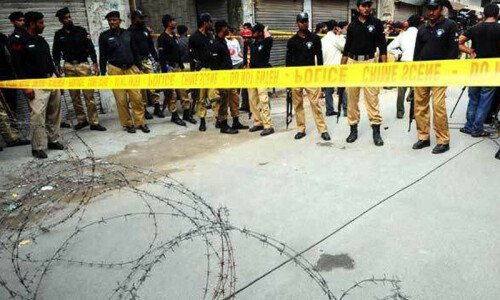

At least seven members of a peace committee were killed in a gun attack by terrorists in Bannu district, Khyber Pakhtunkhwa, police reported on Friday.
The attack took place at around 9pm in the Hoveed area, targeting the peace committee’s office. In the exchange of fire, seven committee members lost their lives while one person was injured. Those killed and wounded were immediately shifted to the District Headquarters Hospital (DHQ) for medical treatment.
The attack comes a day after security forces neutralized 30 Indian proxy Fitna al-Khawarij terrorists in multiple operations across KP as part of ongoing counterterrorism efforts.
In separate operations, the military also eliminated at least 12 terrorists in Kurram and 11 more in other regions. Additional counterterrorism actions took place in Tank, Mohmand, and Lakki Marwat, highlighting Pakistan’s intensified drive to eradicate terrorist networks.
Terrorist incidents have sharply increased in Pakistan, particularly in border provinces such as KP and Balochistan, following the Taliban’s return to power in Afghanistan in 2021. According to a police report, over 600 terror incidents occurred in KP alone during the first eight months of 2025, resulting in the deaths of at least 79 police personnel and 138 civilians.
Violence has also spread to other parts of the country. In Islamabad, a suicide bombing on November 11 claimed 12 lives and injured 36 others, including lawyers and petitioners.
Pakistan has repeatedly urged the Afghan Taliban regime and the international community to take action against terrorist safe havens in Afghanistan, including those used by the outlawed Tehreek-e-Taliban Pakistan (TTP).
Despite ongoing diplomatic engagement, Kabul has largely failed to address Islamabad’s concerns regarding cross-border terrorism, leaving Pakistan to continue its counterterrorism operations independently.
The Bannu attack underscores the persistent threat posed by terrorist networks in Pakistan and the ongoing challenges faced by law enforcement and security forces in protecting citizens and local governance structures in conflict-prone regions. Efforts to dismantle these networks continue, but the rising violence highlights the enduring complexity of the security landscape.
