



“I’m an artist working with my Chuvash heritage,” says Aysha Demina, 25, when asked what audiences should keep in mind when engaging with her work.
“The Chuvash people have been colonized many times… yet they continue to hold onto their fading traditions,” she told The Moscow Times.
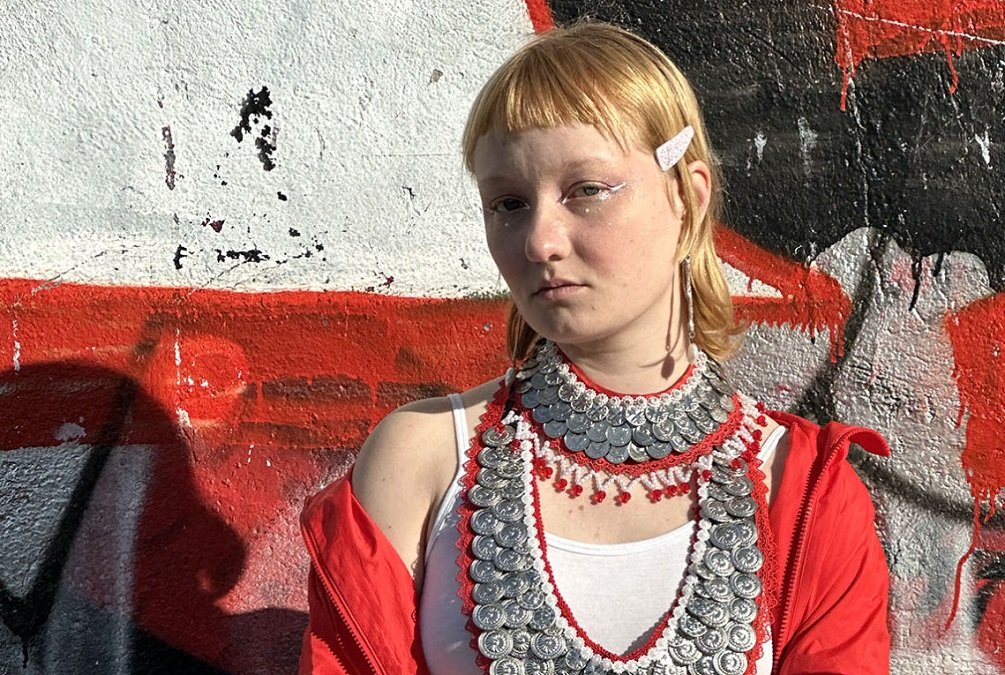
The Chuvash are a Turkic ethnic group of just over 1.1 million people, most of whom live in Chuvashia, a republic in Russia’s Volga region. While the majority of Chuvash today follow Orthodox Christianity, some maintain links to their pre-Christian polytheistic roots. Their language—Chuvash—is the only surviving member of the Bulgharic branch of the Turkic language family and is currently endangered, having lost over one million speakers between 2010 and 2021.
Born in Moscow, Demina gradually reconnected with her ancestral identity, learning the Chuvash language and studying her people’s history—both of which have been deeply affected by Russian colonization.
As an artist, Demina draws inspiration from Chuvash handweaving traditions, aligning herself with a new wave of Indigenous creators in Russia who push back against the state-imposed, museum-style framing of Indigenous art. Her work stands in deliberate opposition to aesthetic norms shaped by Moscow’s centralized cultural institutions.
Demina’s latest pieces will be featured in the upcoming Artists Against the Kremlin exhibition, co-organized by The Moscow Times and the All Rights Reversed gallery. The exhibit opens on August 15 at De Balie in Amsterdam and runs through September 4.
A Myth Reimagined in Tapestry
For the show, Demina created a new series: three large-scale tapestries inspired by an ancient Chuvash myth about the three suns.
“According to the legend, there was once a time when three suns lit the sky. People, overwhelmed by the heat, called upon an archer to shoot two of them down—and he did. Since then, we’ve been living in a broken fairy tale.”
The myth, still represented today in Chuvashia’s coat of arms and traditional designs, explores the consequences of human intervention.
“To me, the story is about responsibility. Each tapestry features an arrow—one piercing a word, another a sun, and the last a heart,” Demina explained. “They represent the power of weapons, but also the idea that sometimes those weapons should be turned inward—to pierce our own outdated ideas and cleanse the mind.”
The tapestries are handwoven, made with fabrics and threads collected from exile, Russia, and even her grandmother’s sewing kit. This tactile softness contrasts with the harsh imagery of arrows, a deliberate tension that underscores the emotional layers in her work.
Reviving Chuvash Craft Through Decolonial Art
Demina’s chosen medium—textile weaving—is itself a statement.
“Weaving runs deep in my family. I learned from my mother, and during my volunteer travels across Russia, I picked up more techniques and patterns.”
She emphasizes that in Soviet times, craftsmanship—particularly handmade work—was dismissed as old-fashioned and counter to industrial progress.
“That’s why I insist on weaving everything by hand, even if it takes an enormous amount of time and energy,” she said. “I intentionally leave a rawness in my tapestries—so it’s clear that they were made by human hands.”
For Demina, each woven thread is more than artistic material—it’s a quiet act of cultural resistance, a way to decolonize identity and reassert Indigenous presence in a system that has tried to erase it.
