

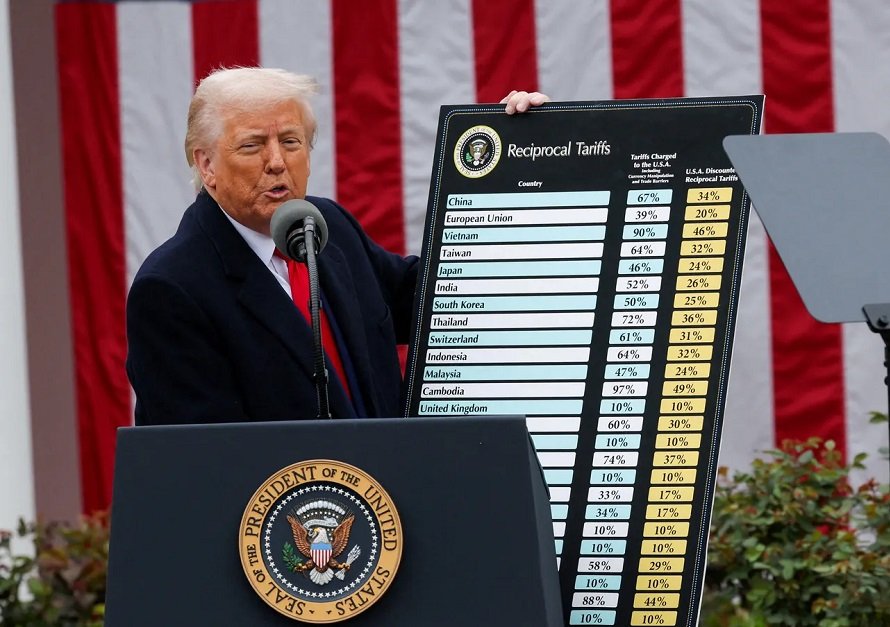

A federal appeals court on Thursday temporarily reinstated former President Donald Trump’s sweeping tariffs, just one day after a lower court ruled he had overstepped his authority by imposing them.
The U.S. Court of Appeals for the Federal Circuit in Washington granted a stay on the decision by the U.S. Court of International Trade, allowing the tariffs to remain in place while the government’s appeal is considered. The court ordered responses from plaintiffs by June 5 and from the Biden administration by June 9.
The trade court’s ruling on Wednesday had delivered a significant blow to Trump-era tariff policy, blocking what were known as the “Liberation Day” tariffs — duties levied against most U.S. trading partners — as well as additional tariffs on Canada, Mexico, and China. These measures were justified by Trump under the International Emergency Economic Powers Act (IEEPA), which he invoked citing the alleged role of those nations in facilitating the flow of fentanyl into the U.S.
However, the trade court ruled that only Congress has the constitutional authority to impose tariffs and taxes, not the president. It found that the IEEPA, a law meant for national security emergencies, had been improperly used to enforce broad economic penalties.
Despite the ruling, senior Trump officials remained defiant, expressing confidence that they would win on appeal or find alternative legal avenues to reinstate the tariffs.
Trump himself condemned the trade court’s decision on social media, calling it “horrible” and “country-threatening.” He argued that the ruling undermines presidential authority and urged the U.S. Supreme Court to overturn it.
“The horrific decision stated that I would have to get the approval of Congress for these Tariffs,” Trump wrote. “If allowed to stand, this would completely destroy Presidential Power — The Presidency would never be the same!”
Global and Domestic Reactions Mixed
International responses were measured. The U.K. labeled the issue a domestic legal matter, while Germany and the European Commission declined to comment. Canadian Prime Minister Mark Carney welcomed the ruling, stating it aligned with Canada’s longstanding view that the tariffs were unlawful.
Financial markets responded with cautious optimism to the initial trade court ruling, though gains were tempered by expectations of a prolonged legal battle. Analysts say the long-term fate of Trump’s tariff strategy remains uncertain. According to a Reuters analysis, the tariffs have cost U.S. businesses over $34 billion in increased costs and lost sales.
Notably, tariffs imposed under separate national security provisions — including those on steel, aluminum, and automobiles — remain unaffected by the trade court’s ruling.
Small Businesses at the Center of the Legal Challenge
The Liberty Justice Center, a nonprofit representing five small businesses that challenged the tariffs, downplayed the impact of the appeals court’s temporary stay, calling it a routine procedural step.
Jeffrey Schwab, senior counsel at the center, said the lower court’s ruling accurately reflected the harm these businesses faced: disrupted supply chains, lost customers and suppliers, and threats to their survival.
Separately, another federal court ruled on Thursday that Trump had exceeded his authority in invoking IEEPA for a different set of tariffs — a 10% duty on goods from most trading partners and a 25% tariff on products from Canada, Mexico, and China related to fentanyl. That ruling, however, was narrower in scope and applied only to the toy company that filed the lawsuit. The administration has appealed that case as well.
As legal battles continue, the future of Trump’s tariff legacy hangs in the balance — with global trade relations and domestic industries closely watching the next steps.
