

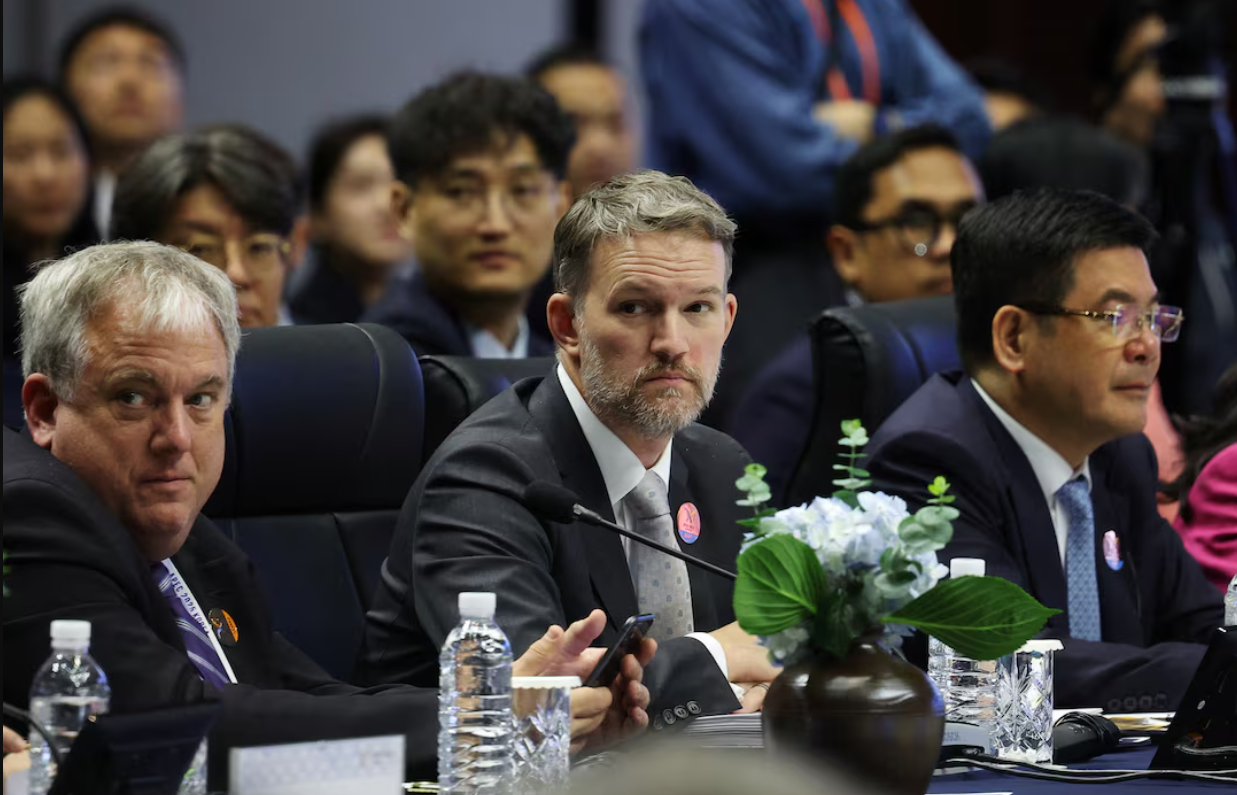

The Asia-Pacific Economic Cooperation (APEC) warned on Thursday that regional exports are projected to stagnate this year due to rising trade barriers, particularly U.S.-imposed tariffs. This cautionary note was delivered as trade officials from the United States and China met on the sidelines of the APEC trade ministers’ meeting on Jeju Island, South Korea.
According to APEC’s 2025 regional trends report, exports among the 21-member economies are expected to grow by a mere 0.4%—a sharp drop from 5.7% recorded in the previous year. The bloc also revised its regional economic growth forecast downward, from 3.3% to 2.6%, citing waning external demand and increased uncertainty around trade policy.
“Trade growth is expected to fall significantly across APEC due to weaker demand for manufactured and consumer goods, while uncertainty surrounding goods-related measures continues to impact the services sector,” APEC said in its statement.
The imposition of tariffs by the Trump administration has directly impacted more than half of APEC’s member economies. Since APEC’s formation in 1989, average regional tariffs dropped from 17% to 5.3% by 2021—coinciding with a more than ninefold increase in goods trade. The recent reversal of that trend due to protectionist policies has begun to weigh heavily on the region’s economic trajectory.
In a sign of potential progress, U.S. Trade Representative Jamieson Greer met with Chinese trade envoy Li Chenggang during the summit, following up on prior discussions in Geneva on May 10-11, where both sides agreed in principle to reduce steep tariffs.
South Korea’s Trade Minister, Cheong In-kyo, who is hosting the two-day conference, emphasized the need for APEC economies to foster open dialogue amid mounting political and economic tensions. His prepared remarks stressed that the global trading system faces “increased stress from rising uncertainty and fragmentation.”
Carlos Kuriyama, APEC’s policy director, noted that the downgraded outlook for trade reflects the broader impact of U.S. tariffs, which are now influencing not just goods trade, but also services and financial markets. “Trade activity is still not back to pre-April levels,” he stated.
Alongside multilateral discussions, Greer is expected to hold bilateral meetings with trade officials from South Korea, New Zealand, and several other Asian nations. Ahead of his departure, he told a broadcaster that “we’re moving as quickly as possible with partners ready to advance ambitious goals.”
The Jeju meeting includes representatives from Japan, Canada, Mexico, Russia, and other member economies. It serves as a precursor to the upcoming APEC leaders’ summit set to take place later this year in Gyeongju, South Korea. APEC members collectively account for about 50% of global trade and 60% of the world’s GDP.
