

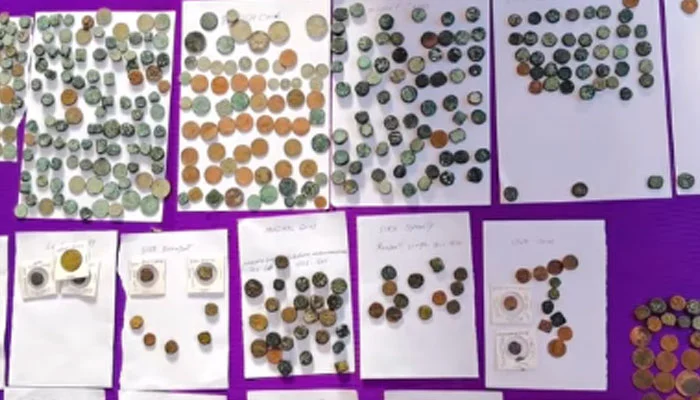

Flash floods from the Koh-e-Suleman mountain range have wreaked havoc across Dera Ghazi Khan’s tribal belt, but amid the destruction, they have also unearthed rare treasures believed to be thousands of years old. Torrents of water carried with them ancient coins and artefacts from multiple eras, drawing the attention of locals and authorities alike.
Among the most remarkable finds are coins dating back two millennia to the reign of Vima Deva Kushan, a prominent ruler of the Kushan Empire.
The discovery is not limited to one historical period; coins from the Lodhi, Tughlaq, Durrani, Sikh, Mughal, and British empires were also recovered, along with pieces believed to have originated from Central Asia, China, Khorasan, and the Arab world.
Locals were the first to spot the precious antiquities near Sakhi Sarwar, where mountain streams had carried them downstream. The coins, adorned with engravings and inscriptions, were later secured by the political administration and handed over to the relevant departments for preservation.
Officials stressed the significance of these discoveries, highlighting that the coins are far more than relics of the past. Each engraving tells a story, reflecting the region’s historical role as a crossroads of civilisations and trade routes. They offer insights into the grandeur of ancient empires, cultural exchanges, and the long-standing economic significance of the area.
The district administration has announced that archaeologists will soon launch formal excavations in the affected areas to search for additional treasures that may have been buried over centuries. Experts believe these findings could deepen understanding of South Asia’s ancient history and the vital role Punjab played in connecting empires and trade networks.
For now, the floodwaters of Koh-e-Suleman have not only carved paths of destruction but also opened a rare window into the region’s past.
