

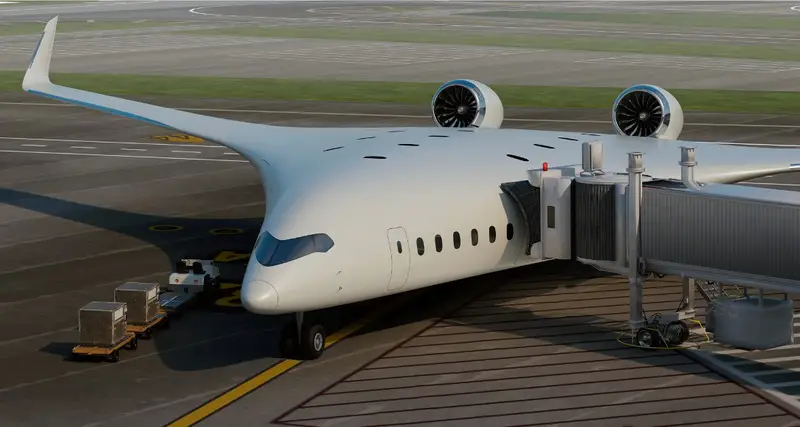

The future of commercial aviation may soon shift away from the familiar tube-and-wing shape toward something far more radical — a design that looks closer to the B-2 stealth bomber or even the triangular paper airplanes many people folded as kids. In an interview with German newspaper Bild, Airbus CEO Guillaume Faury said that over the next 30 to 40 years, aircraft manufacturers could adopt blended-wing body (BWB) designs for large passenger jets.
A Single, Sweeping Wing Could Replace Today’s Aircraft Shape
A blended-wing body merges the fuselage and wings into one wide, thick aerodynamic structure that houses the cabin inside the wing itself. Faury explained that this design distributes lift across the entire surface, making it more efficient and capable of carrying heavier loads than traditional airliners. He said the concept would work best on future widebody jets.
But the futuristic shape comes with challenges. A BWB may require removing windows altogether, leaving passengers without natural light and possibly causing discomfort, disorientation, or claustrophobia. Safety concerns also arise: with passengers seated deeper inside the cabin and farther from exits, emergency evacuations could be more complex. The lack of external visibility for crew members poses additional hurdles.
A Long History of Experiments — and a New Race to Be First
Although the idea feels futuristic, blended-wing aircraft have existed for decades. The Northrop B-2 Spirit — the most famous flying-wing aircraft — first flew in 1989. McDonnell Douglas explored BWB passenger planes in the 1990s through a NASA partnership that led to the BWB-17 concept. After merging with Boeing in 1997, that research continued through the X-48 subscale demonstrators until 2013.
Today, no full-size BWB passenger aircraft has been certified or flown, and Boeing has not announced development plans. Airbus, however, has steadily advanced its own BWB research since 2017. A 200-seat blended-wing design is central to its ZEROe program, which aims to develop zero-emission hydrogen-powered aircraft. A small demonstrator flown in 2019 showed up to 20% fuel savings and new cabin layout opportunities thanks to the wider interior.
But Airbus has delayed its original 2035 ZEROe timeline by nearly a decade, citing certification difficulties, limited hydrogen infrastructure worldwide, and questions about whether passengers would accept windowless seating deep inside the cabin.
Startups Challenge Airbus and Boeing With Bold BWB Designs
The BWB race is no longer limited to aerospace giants. Several startups hope the unconventional shape will finally break the Airbus-Boeing duopoly.
San Diego-based Natilus is developing Horizon, a BWB narrowbody aimed at the A320 and 737 market. It promises 25% lower fuel burn, 40% more cabin space, and full compatibility with existing airports. Horizon designs released in July show three aisles and windowed cabin walls, with skylights planned for central seats. CEO Aleksey Matyushev believes the aviation industry may face a shortage of 40,000 narrowbody jets over the next two decades — far more than Airbus and Boeing alone can supply.
In Long Beach, JetZero is pursuing a widebody BWB called the Z4, targeting jets like the Boeing 767 and Airbus A330. The Z4 promises up to 50% lower fuel burn, a spacious cabin, and the feel of a “living room in the sky,” according to United Airlines Ventures. The airline has already signaled interest in purchasing up to 200 of the 250-seat aircraft. JetZero successfully flew its subscale Pathfinder model in 2024.
As competition intensifies, industry leaders see BWBs as a major step toward greener, more efficient aviation — even if the world’s first full-scale passenger flying-wing plane is still decades away.
