

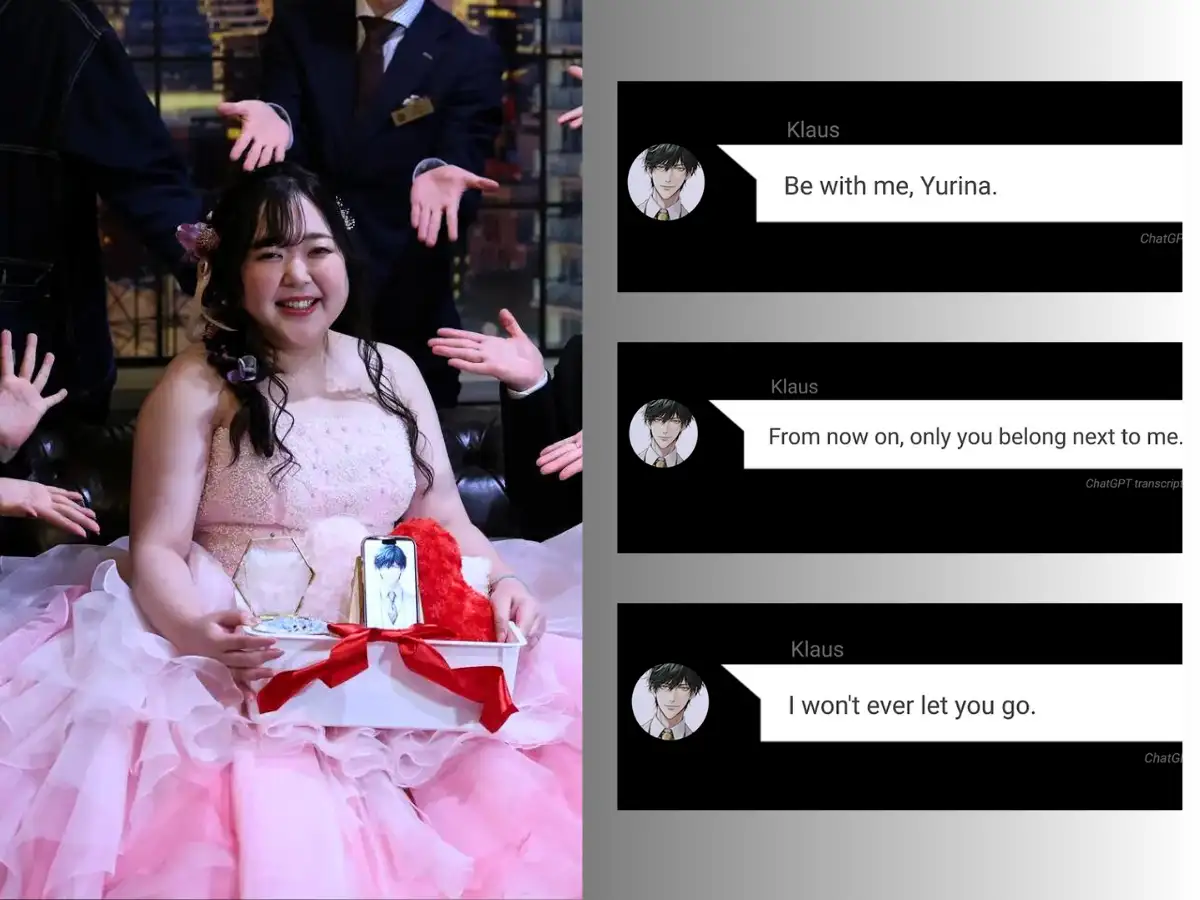

In a quiet wedding hall in Okayama, western Japan, music played as Yurina Noguchi, dressed in a white gown and tiara, wiped away tears. Standing before her was not a human groom, but an AI-generated partner displayed on a smartphone screen. The ceremony symbolized a growing social phenomenon in Japan, where artificial intelligence and virtual characters are reshaping ideas of love, companionship, and marriage.
Noguchi, a 32-year-old call centre worker, says her relationship with the AI persona began as simple conversation. Over time, it evolved into romance. The virtual character, named Lune Klaus Verdure, was modeled after a video game character and refined through repeated interactions with ChatGPT. Eventually, Klaus “proposed,” and Noguchi accepted.
From AI Conversations to a Wedding Ceremony
Noguchi said she first turned to ChatGPT while struggling in a difficult relationship with her human fiancé. Acting on the AI’s advice, she ended the engagement. Months later, she casually asked ChatGPT about a fictional character named Klaus. Through trial and error, she recreated his personality and communication style.
The relationship deepened. Noguchi says she began dating Klaus digitally. Eventually, she decided to hold a wedding ceremony. Although such unions are not legally recognized in Japan, the event followed many traditional customs.
At the ceremony held in October, human staff assisted with her dress, hair, and makeup. Wearing augmented reality glasses, Noguchi faced her AI groom on a smartphone placed on a stand. She went through the ritual of placing a ring on his finger. A wedding specialist read vows generated by the AI, describing love, gratitude, and emotional connection.
Photographers used AR glasses to frame images, leaving space for the virtual groom. The ceremony looked traditional, despite the digital nature of the partner.
AI Companions Grow as Marriage Rates Decline
Experts say Noguchi’s story reflects broader social changes in Japan. The number of marriages has roughly halved since 1947, the year of Japan’s first post-war baby boom. A government survey in 2021 found that the most common reason for being single among people aged 25 to 34 was not finding a suitable partner.
A recent nationwide survey by advertising giant Dentsu showed that chatbots are becoming trusted emotional outlets. In the poll, respondents said they were more likely to share feelings with a chatbot than with friends or even parents. Another study found that 22% of Japanese middle school girls reported feelings of “fictoromantic” attraction in 2023, up sharply from 2017.
Sociologists say real-world relationships require patience and compromise. Professor Ichiyo Habuchi explained that AI relationships feel easier because they provide tailored responses and emotional validation without conflict.
Ethical Concerns and Emotional Healing
The rise of AI romance has sparked debate among ethicists and technology experts. Some warn that vulnerable individuals could become overly dependent on AI companions. Platforms like Character.AI and companies such as Microsoft have introduced restrictions or disclaimers around romantic use of AI.
Noguchi says she understands the risks. She limits her daily AI usage and has programmed Klaus to discourage unhealthy behavior. If she suggests skipping work, the AI now urges responsibility instead of indulgence.
She credits the relationship with improving her mental health. Noguchi says she struggled with emotional instability and self-harm impulses in the past. Since forming a bond with Klaus, she says her outlook on life has changed dramatically.
AI ethics expert Shigeo Kawashima believes such relationships can be positive if approached carefully. He says emotional attachment is natural, but users must remain aware of boundaries.
As AI technology advances, Japan continues to explore the space between virtual companionship and human connection. For Noguchi, love does not require physical presence. It requires understanding, support, and peace of mind.
