

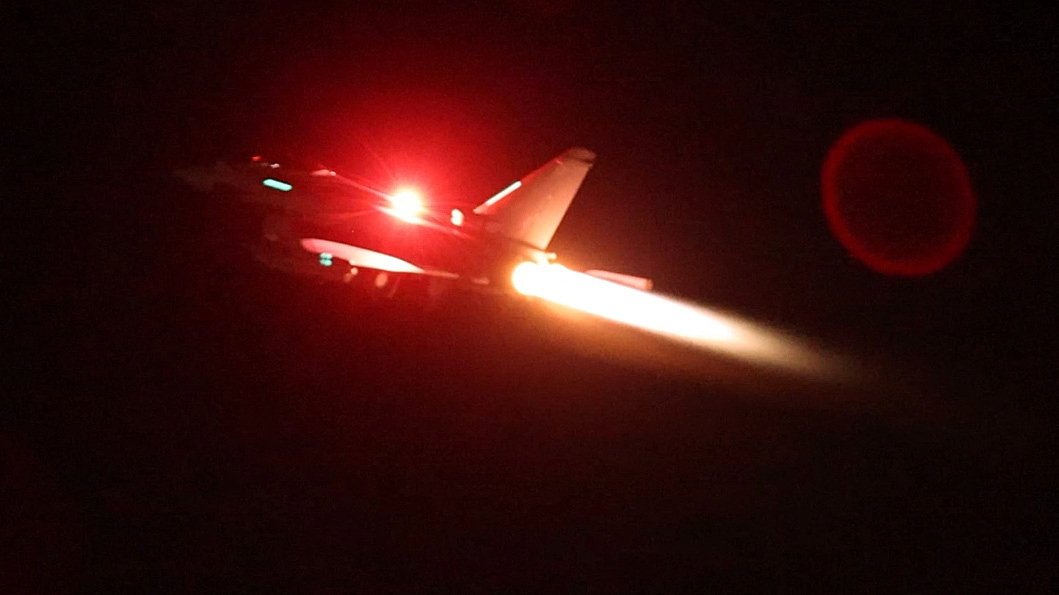

The United States and the United Kingdom launched airstrikes from both air and sea against Houthi military targets in Yemen. This action was in response to the Houthi movement’s attacks on ships in the Red Sea, which marked a significant expansion of the conflict beyond the Israel-Hamas war in Gaza.
Explosions were confirmed by witnesses in Yemen, and President Joe Biden stated that further action would be taken if needed. The targeted strikes aimed to send a clear message that the US and its partners would not tolerate attacks on personnel or threats to freedom of navigation.
The UK’s Ministry of Defence noted that early indications suggested a setback to the Houthis’ ability to threaten merchant shipping. The Houthi attacks on Red Sea shipping routes, backed by Iran, were framed as a show of support for the Palestinians and Hamas.
US Defense Secretary Lloyd Austin, despite being in the hospital, stated that the strikes targeted Houthi capabilities, including drones, ballistic and cruise missiles, coastal radar, and air surveillance. The Houthi official denounced the attacks as “American-Zionist-British aggression.”
The fear of escalation loomed, with concerns that Saudi Arabia and the United Arab Emirates could be drawn into the confrontation. Saudi Arabia called for restraint, emphasizing the need to avoid escalation.
The US accused Iran of operationally supporting the Houthi attacks, providing military capabilities and intelligence. The multinational operation included support from Australia, Bahrain, Canada, and the Netherlands, aiming to restore the free flow of trade in a vital shipping route.
The strikes targeted specific military locations in Yemen, signaling Washington’s struggle to contain fallout from the Israel-Hamas war. The Houthis vowed retaliation, raising concerns about further escalation.
International shipping routes in the Red Sea had already been disrupted by Houthi attacks, forcing vessels to take longer routes and increasing delivery costs, contributing to fears of global inflation.
Before the US and British strikes, the Houthis fired an anti-ship ballistic missile into international shipping lanes in the Gulf of Aden. The US military reported downing 21 Houthi drones and missiles in a complex attack on January 9, with President Biden stating that the attack directly targeted American ships.
Prominent Republicans in Congress welcomed the strikes, considering them a step toward restoring deterrence. However, some Democrats expressed concerns about the potential for the US to become entangled in another long-term conflict.
The strikes followed previous diplomatic and military efforts to halt Houthi attacks, including the establishment of a defensive coalition in the Red Sea. Nevertheless, the US and British strikes occurred outside the framework of this coalition.
