

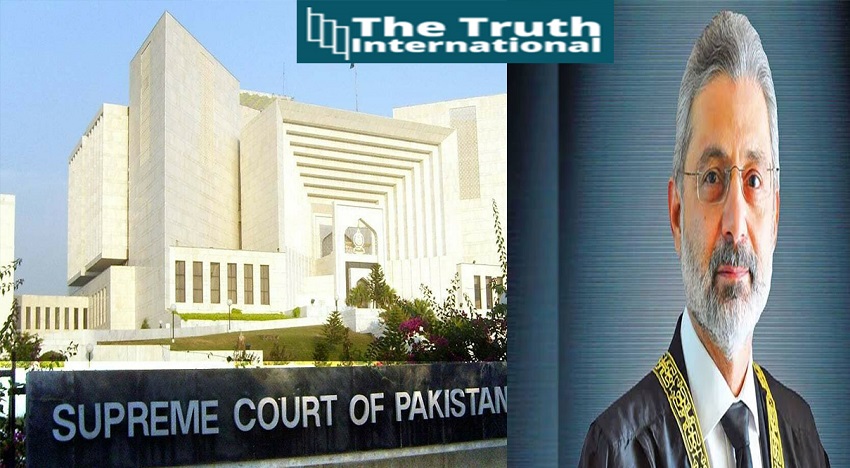

ISLAMABAD: Chief Justice of Pakistan (CJP) Qazi Faez Isa highlighted on Thursday that determining lifetime disqualification under Article 62(1)(F) is based on personal interpretation rather than constitutional clarity.
This observation surfaced during the hearing of a case regarding the permanent disqualification of lawmakers as per the aforementioned article, which sets the standards for contesting elections.
A seven-member bench, chaired by CJP Isa and including Justice Syed Mansoor Ali Shah, Justice Yahya Afridi, Justice Aminuddin Khan, Justice Jamal Khan Mandokhel, Justice Muhammad Ali Mazhar, and Justice Musarrat Hilali, is overseeing the proceedings.
The Attorney General for Pakistan, Mansoor Usman Awan, also appeared before the court. Lawyers Reema Omar, Azir Bhandari, and Faisal Siddiqui have been designated as amici curiae.
During the session, the chief justice cautioned against spreading confusion surrounding the upcoming elections scheduled for February 8. He emphasized that filing cases in multiple courts could impede the electoral process.
Lawyer Khurram Raza, representing petitioners Fayaz Ahmed Ghori and Sajjadul Hasan, faced intense scrutiny from the seven-member bench, led by the chief justice, for advocating lifetime disqualification of parliamentarians.
At one juncture, CJP Isa expressed that the counsel seemed to be aligning with “dictators.”
The lawyer argued that a constitutional amendment was necessary to eliminate lifelong disqualification.
In response, Justice Jamal Khan Mandokhail questioned whether Parliament lacked the authority to legislate. Raza replied, “Parliament legislates, but the Supreme Court interprets it.”
The Case’s Significance: The outcome of this case holds the fate of numerous politicians, including Pakistan Muslim League-Nawaz (PML-N) leader Nawaz Sharif and Istehkam-e-Pakistan Party (IPP) founder Jahangir Tareen, determining their eligibility to contest the impending polls.
The Supreme Court, during its last hearing on January 2, emphasized impartiality and reassured that no specific party was being favored in the case.
Acknowledging contradictions in the Election Act, 2017, and a Supreme Court verdict, the apex court addressed discrepancies highlighted in a petition filed by former PML-N provincial lawmaker Sardar Meer Badshah Khan Qaisrani last month.
The court’s concern stemmed from the contradiction between the Supreme Court’s judgment on lifetime disqualification and the amendments introduced to the Elections Act 2017.
CJP Faez Isa stressed the need to resolve the issue conclusively, prompting the formation of a three-member committee to handle such cases efficiently.
In a 2018 judgment, the Supreme Court established that anyone disqualified under Article 62(1)(f) of the Constitution faced a lifelong disqualification.
However, subsequent amendments made by the former coalition government of Pakistan Democratic Movement (PDM) to the Elections Act 2017 reduced the disqualification period for legislators to five years, retroactively.
Nawaz Sharif and IPP chief Jahangir Tareen are the only two lawmakers disqualified for life in June and December 2017, respectively, under Article 62(1)(f) for being deemed “dishonest.”
