

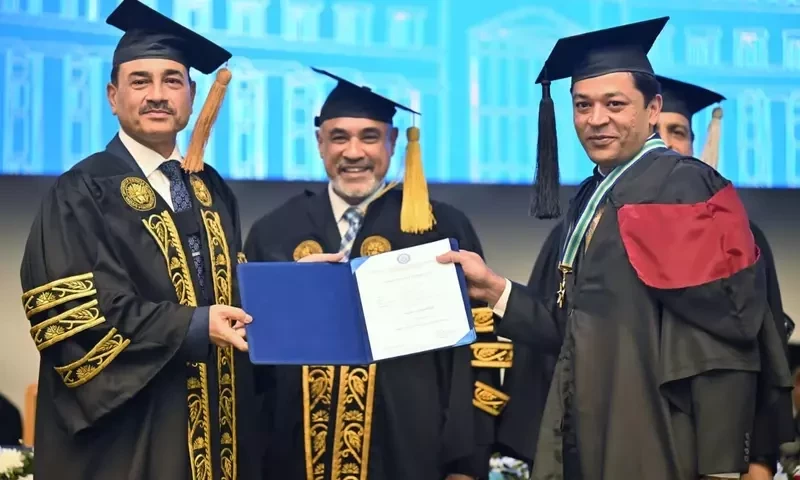

ISLAMABAD: Chief of Army Staff, General Syed Asim Munir, emphasized the necessity of education rather than it being merely an option while addressing the annual convocation week of the National University of Sciences & Technology (NUST). The event took place at the university’s main campus in the federal capital.

During the convocation, which marked the beginning of a new chapter in students’ lives, the army chief, who also serves as the chairman of the NUST board of governors, conferred medals upon distinction holders. This convocation week saw the awarding of degrees to over 3,500 graduates, including those in bachelor’s, master’s, and Ph.D. programs from all NUST schools in seven core disciplines.
COAS Munir extended his congratulations to the graduates, their parents, and faculty members, commending NUST for fostering an environment conducive to teaching and learning, which nurtures bright minds ready to serve the nation. He stressed that the responsibility the graduates now carry should be reflected in their actions and choices as they embark on their journeys.
General Munir urged the graduates to analyze and address the challenges facing the country, utilizing their intellectual resourcefulness to find solutions and contribute positively to their nation.
Aitzaz Ahsan Hails Landmark Supreme Court Decision Declaring Military Trials of Civilians Invalid
In another development, Aitzaz Ahsan, one of the petitioners in the case, expressed his views on the Supreme Court’s verdict declaring military trials of civilians as null and void. He spoke to journalists outside the Supreme Court after the unanimous decision was announced.
A five-member bench, consisting of Justice Ijaz Ul Ahsan, Justice Munib Akhtar, Justice Yahya Afridi, Justice Sayyed Mazahar Ali Akbar Naqvi, and Justice Ayesha Malik, heard the petitions filed by PTI Chairman Imran Khan and others.
The bench’s short verdict ordered that the 102 accused individuals arrested under the Army Act be tried in criminal courts and ruled that any trial of civilians in military courts would now be considered invalid.
Aitzaz Ahsan emphasized that the Supreme Court’s judgment would have a profound and lasting impact. He described it as an important case with a historic verdict, stating that it would strengthen the foundations of the country’s democratic system.
He further highlighted the significance of the ruling, stating that it affirms the supremacy of the Constitution. Ahsan noted that the Supreme Court had rejected the government’s plea to interpret the law in a way that would allow the trial of civilians under military laws.
In his view, the ruling signifies that “the law is above you,” emphasizing the principle that even rulers are subject to the law, and it is the law that defines their authority.
