

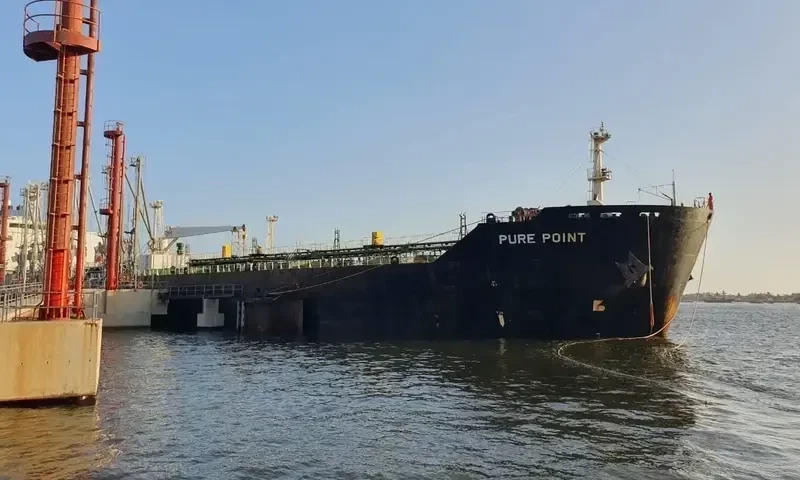

Pakistan has achieved a significant milestone in meeting its energy requirements by officially entering into a long-term agreement to purchase oil from Russia. The sources further indicated that this agreement has been established on a commercial basis, enabling privately owned local refineries to directly procure the oil.
The initial commercial shipment from Russia, anticipated to be 100,000 metric tonnes, is scheduled to reach Pakistan in December. As the supply becomes more consistent, the possibility of formalizing a government-to-government pact exists.
Russia will supply the oil at Pakistani ports, and the pricing structure will be set at $60 per barrel. Reports have indicated that this pricing has been determined in consideration of the rates for Russian oil established by G7 countries.
Despite the application of additional costs and premiums, it is anticipated that Russian oil will be approximately $10 per barrel less expensive than if it were procured from the international market. Furthermore, Pakistan is said to have saved $40 million during the test cargo phase.
Japan Urges Increased Oil Supplies To Offset Global Fuel Price Rise Amid Israel-Hamas Conflict
Meanwhile, the chief cabinet secretary of Japan stated that the country is urging Saudi Arabia and other oil-producing nations to increase supplies in order to stabilize the global oil market. This action is being taken due to the rising fuel prices resulting from the Israel-Hamas conflict, which poses a threat to the global economy.
Japan, as the world’s fourth-largest crude buyer, heavily relies on oil imports, with over 90% coming from the Middle East, particularly from Saudi Arabia, the United Arab Emirates, and Kuwait. The conflict in the Middle East has put Japan, a US ally, in a delicate diplomatic situation due to its dependence on Middle Eastern oil.

Hirokazu Matsuno, the chief cabinet secretary, emphasized that the Japanese government will request oil-producing countries to stabilize the global crude oil market by increasing production and investing in production capacity.
It’s worth noting that benchmark Brent crude oil futures increased by over $5 per barrel since the conflict began but eased on Thursday after the Organization of the Petroleum Exporting Countries (OPEC) indicated it did not plan to immediately act on OPEC member Iran’s call for an oil embargo on Israel.
Japanese Prime Minister Fumio Kishida recently spoke with Saudi Crown Prince Mohammed bin Salman to discuss improving humanitarian conditions in Gaza and helping ease tensions. While they did not discuss the stabilization of the crude oil market, Japan is requesting relevant countries, including Saudi Arabia, to take a leading role in stabilizing the global crude oil market, potentially by increasing production.
Japan is a member of the International Energy Agency and has released oil reserves in the past to address major supply disruptions, most recently in 2022 following the Russian invasion of Ukraine.
