



Good Intentions
ISLAMABAD: Chief Justice of Pakistan (CJP) Qazi Faez Isa has acknowledged that the parliament passed the Supreme Court (Practice and Procedure) Act 2023 with good intentions. It aims to regulate the discretionary powers of the country’s highest judicial authority, with well-intentioned motives.
He also said that the Parliament must not be discouraged from doing something good just because it lacks two-thirds majority.
The CJP Isa remarked this during a session of the full court of the Supreme Court on Monday. The apex court resumed hearing of petitions challenging the aforementioned SC law on Monday.
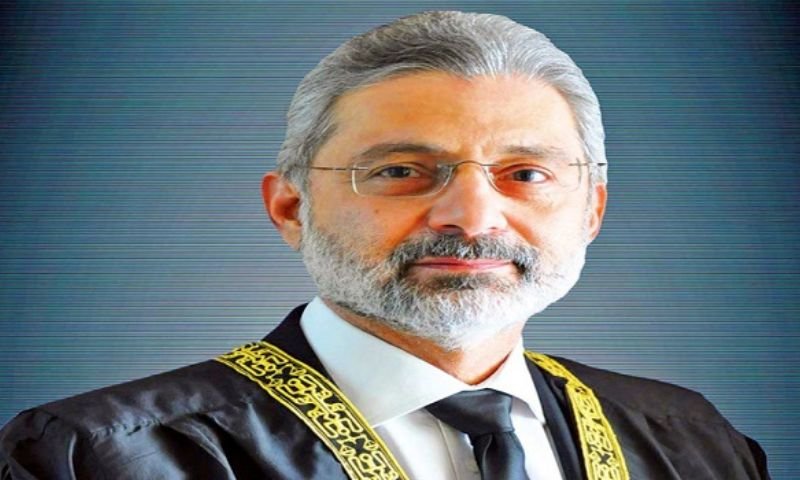
During the proceedings, the CJP expressed his discontent when one of the petitioners cited a decision from a US court as a precedent to challenge the amendments in the SC law.
The CJP Isa-led full-court bench comprises 15 judges from the Supreme Court, including Justice Sardar Tariq Masood, Justice Ijaz Ul Ahsan, Justice Syed Mansoor Ali Shah, Justice Munib Akhtar, Justice Yahya Afridi, Justice Aminuddin Khan, Justice Sayyed Mazahar Ali Akbar Naqvi, Justice Jamal Khan Mandokhel, Justice Muhammad Ali Mazhar, Justice Ayesha A. Malik, Justice Athar Minallah, Justice Syed Hasan Azhar Rizvi, Justice Shahid Waheed, and Justice Musarrat Hilali.
At the commencement of the hearing, the CJP urged the counsel for the petitioners to expedite their arguments.
CJP Isa remarked, “At the very least, provide us with a decision from the US Supreme Court. Our standards have declined to such an extent that we are now referencing a judgment from a New Jersey court,” after Abid Zuberi, President of the Supreme Court Bar Association, cited a verdict in defense of his objections to the law.
CJP Isa further commented, “This doesn’t even qualify as a decision.”
Meanwhile, Chief Justice Qazi Faez Isa said that the Parliament should not be hampered from doing something good merely on the basis that it lacks two-thirds majority.
The Justice Isa cautioned that the Supreme Court should not send out any such message that Constitution and Pakistan’s laws were dependent on the wishes of the top adjudicator.
“The Constitution and laws are not subservient to the wishes of the Chief Justice of Pakistan,” he observed.
This will be destructive to the rule of law, independence of judiciary and everything, he added.
