

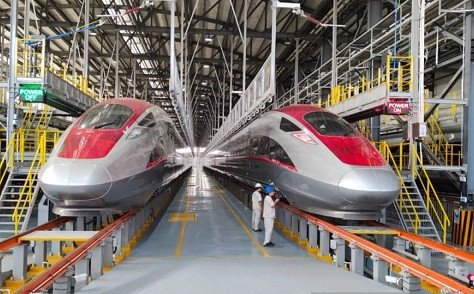

First Bullet Train
Indonesia is unveiling the inaugural high-speed bullet train in Southeast Asia. It marks a significant milestone in China’s Belt and Road Infrastructure (BRI) initiative. This groundbreaking project will dramatically reduce travel time between the capital city and another major urban center.
Named “Whoosh,” this Chinese-made bullet train will establish a vital connection between Jakarta and Bandung. It is the densely populated capital of West Java province. Bullet trains will reduce the current three-hour journey to a mere 40-minute trip. These 209-meter (685-foot) trains boast a passenger capacity of 601.
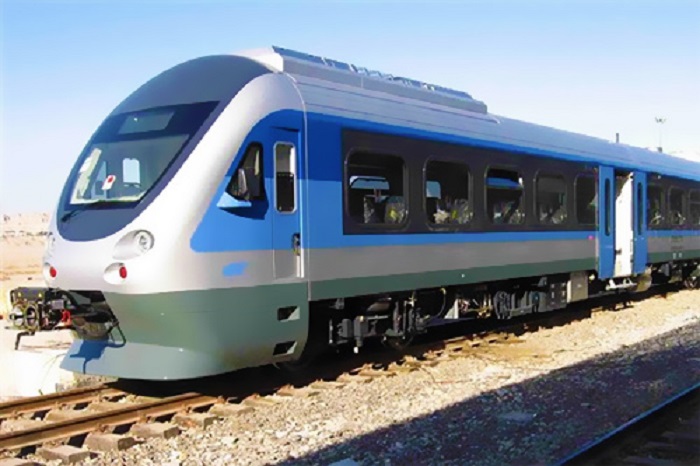
Financed primarily by China, the project carries a price tag of $7.3 billion and was executed by PT Kereta Cepat Indonesia-China (PT KCIC). It is a joint venture comprising an Indonesian consortium of four state-owned enterprises and China Railway International Co. Ltd. These trains are set to be the swiftest in Southeast Asia, boasting speeds of up to 350 kph (217 mph).
Despite facing numerous delays and escalating costs, some skeptics question its commercial viability.
However, President Joko Widodo has been a staunch advocate for the project. Today (Oct 2), he is set to inaugurate the 142.3-kilometer railway service.
President Widodo, accompanied by other high-ranking officials, is embarking on the inaugural Whoosh journey. It will commence at the Halim KCBJ station in eastern Jakarta and conclude at Bandung’s Tegalluar station, the railway’s final stop.
Luhut Binsar Pandjaitan, the coordinating minister for maritime and investment, has confirmed that China Railway will facilitate the transfer of its technology to Indonesia, enabling the nation to manufacture high-speed trains domestically in the future.
During his three-day visit to Jakarta for discussions with leaders of the Association of Southeast Asian Nations and other nations, Chinese Premier Li Qiang conducted a test ride on the Whoosh. His journey spanned from the Halim KCBJ station to Karawang city in West Java, covering 40 kilometers (25 miles) in a mere 11 minutes before his return on the same train.
President Widodo also participated in a 25-minute test ride aboard the train, expressing his comfort even at its top speeds. He encouraged the public to transition from personal vehicles to mass transit systems to alleviate congestion and pollution, noting that congestion in Jakarta and Bandung exacts an annual economic toll of over $6.5 billion.
PT KCIC conducted a two-week, complimentary public trial ahead of the official inauguration.
Initiated in 2016, Indonesia’s high-speed railway project was originally slated for operation in 2019 but encountered setbacks due to land acquisition disputes, environmental concerns, and the COVID-19 pandemic. The initial budget projection of 66.7 trillion rupiah ($4.3 billion) swelled to 113 trillion rupiah ($7.3 billion).
To suit Indonesia’s tropical climate, the trains have undergone modifications and incorporate a safety system capable of responding to earthquakes, floods, and other emergency scenarios.
