



In a recent public opinion survey conducted in July, the military has received the highest approval rating of 88 percent. This survey, conducted by Gallup on behalf of a political organization, also revealed that people’s trust in the media and the courts stood at 56 percent approval for each. However, approval ratings for politicians in general were at 39 percent, for parliament at 47 percent, for the Election Commission at 42 percent, and for the police at 54 percent.
The survey asked respondents to what extent they approved or disapproved of the performance of various institutions. The Army received the highest approval rating at 88 percent, followed by the media and the courts at 56 percent each. The Election Commission received a 42 percent approval rating, Local Government at 51 percent, police at 54 percent, parliament at 47 percent, and politicians in general at 39 percent.
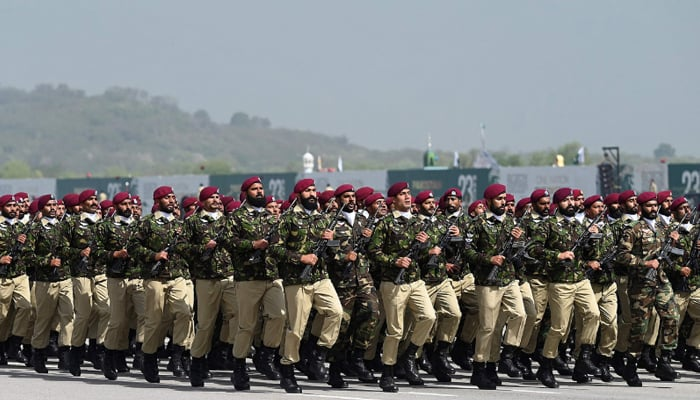
When broken down by province, Punjab had the approval rating for the military at 90 percent, followed by Sindh at 88 percent, KP at 91 percent, and Balochistan at 66 percent. On the other hand, approval ratings for politicians were lower, with 43 percent in Punjab, 34 percent in Sindh, 29 percent in KP, and 34 percent in Balochistan. The survey noted that the Army received positive approval across all provinces, except for Balochistan, where 66 percent approved. Politicians, on the other hand, received negative ratings, particularly among women, those with higher education, and those living in KP.
Among individual politicians, Imran Khan had the highest positive approval rating at 60 percent, followed by Saad Rizvi and Pervaiz Elahi at 38 percent each, Shah Mehmood Qureshi at 37 percent, Nawaz Sharif at 36 percent, Shehbaz Sharif at 35 percent, Maryam Nawaz at 30 percent, Shahid Khaqan Abbasi at 28 percent, and others.
Strong PTI Lead
Regarding political parties, the PTI received the highest positive approval rating for its economic performance at 64 percent. Among political parties, 38 percent strongly favored PTI, 16 percent strongly liked PMLN, 10 percent strongly liked PPP, 15 percent strongly liked TLP, 9 percent strongly liked JI, and 6 percent strongly liked MQM. The survey also found that 44 percent of respondents said they voted for PTI in the 2018 election, while 23 percent voted for PMLN, and 16 percent for PPP.
In terms of upcoming elections, twice as many respondents indicated they would vote for PTI if elections were held next week compared to those who would vote for PMLN. Additionally, 37 percent of respondents said they would still vote for PTI if Imran Khan were not the party’s president. If PTI did not participate in the election, nearly a quarter of respondents would vote for PML-N. The survey also revealed that half of the respondents considered themselves strong supporters of their respective political parties.
When asked about their preferences in the National Assembly election, 41 percent in Punjab said they would vote for PTI, 28 percent for PMLN, 4 percent for PPP, 6 percent for TLP, and so on. In the province of Sindh, PTI secured 36 percent of the vote, while 35 percent opted for PPP, with PMLN receiving 3 percent, MQM gaining 2 percent, and the remaining percentage going to other parties. Moving to Khyber Pakhtunkhwa (KP), PTI emerged as the dominant choice with 69 percent support, while PMLN garnered 12 percent and PPP received 2 percent. In Balochistan, PTI took the lead with 36 percent, followed by PPP at 18 percent, ANP at 11 percent, and PMLN also at 11 percent.
