

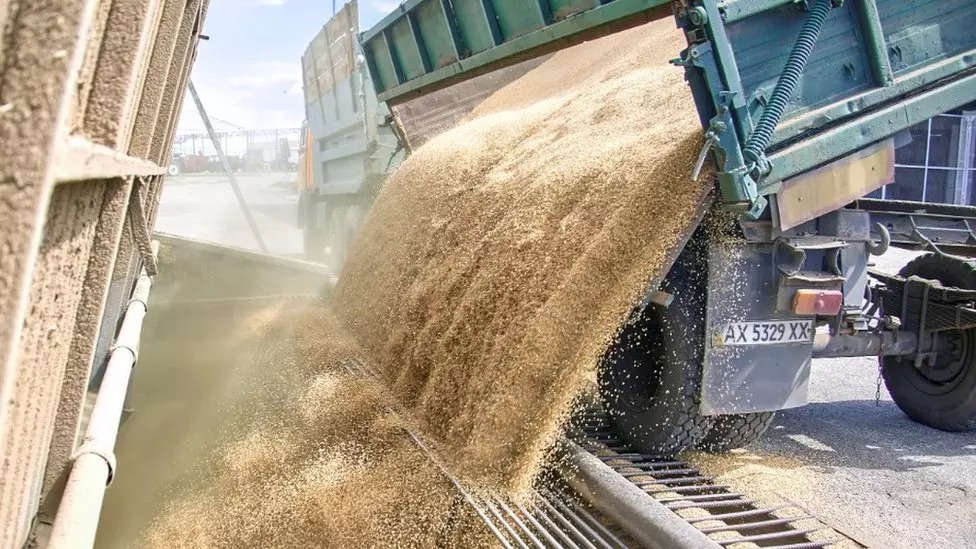

On November 2, Russia re-joined an agreement that would have permitted Ukrainian grain exports over the Black Sea, but President Vladimir Putin issued a warning that Moscow may still withdraw from the accord.
Washington declared it was “increasingly concerned” that Russia could use nuclear weapons in its war in Ukraine, which coincided with the renewal of a deal meant to allay concerns about the global food crisis.
Moscow announced its temporary withdrawal from the grain pact on Saturday, blaming Ukraine for utilising the safe maritime lane created by the agreement to launch a drone attack on its Black Sea fleet.
According to the Russian defence ministry, Kyiv has now provided sufficient assurances that it won’t conduct attacks using the maritime corridor.
Russia’s decision to rejoin the accord, which allowed for joint ship inspections and was mediated by the UN and Turkey in July, was welcomed by UN Secretary-General Antonio Guterres.
On Twitter, President Volodymyr Zelenskyy expressed gratitude to Turkish President Recep Tayyip Erdogan for helping to keep the grain deal intact. Later, the president of Ukraine praised the restart of negotiations as “a big diplomatic result for our nation and the entire world.”
Putin did, however, say that if Ukraine breaks any of its promises, Russia may withdraw from the agreement once more. However, even in that case, Moscow would not obstruct grain shipments.
Despite Moscow’s warning that the route was hazardous for supplies without its involvement in the arrangement, some deliveries from Ukraine continued on it.
Although no departures from Ukraine were scheduled for Wednesday, a Turkish security source reported that the passage was reopened as of 0900 GMT.
Russian Vice Foreign Minister Andrei Rudenko stated that Moscow has not yet decided whether it would continue to be a part of the agreement after November 18.
The agreement is due for renewal on November 19, but the decision to extend it is a separate matter, and it will be decided “taking into account all the associated variables,” he told the state news agency RIA Novosti.
Ned Price, a spokesperson for the US State Department, advocated for the agreement to be extended on Wednesday, claiming that doing so “would ultimately infuse even more consistency and stability in this marketplace and, most critically, put downward pressure to the costs” of international foods.
More than 9.7 million metric tonnes of grain and other foodstuffs have been able to leave Ukrainian ports because to the agreement, which is being supervised by the Joint Coordination Centre in Istanbul.
This has alleviated a critical food crisis that was brought on by the conflict between Russia and Ukraine, two of the world’s largest exporters of grains.
In contrast to Zelenskyy’s Tuesday call for “reliable and long-term protection” of the corridor, Putin had requested “concrete guarantees.”
According to the Russian Ministry of Defense, Kiev provided written commitments.
Ukraine, according to the statement, “assured the non-use of the humanitarian corridor and Ukrainian ports determined in the interests of the sale of agricultural products for waging military operations against the Russian Federation.”
