

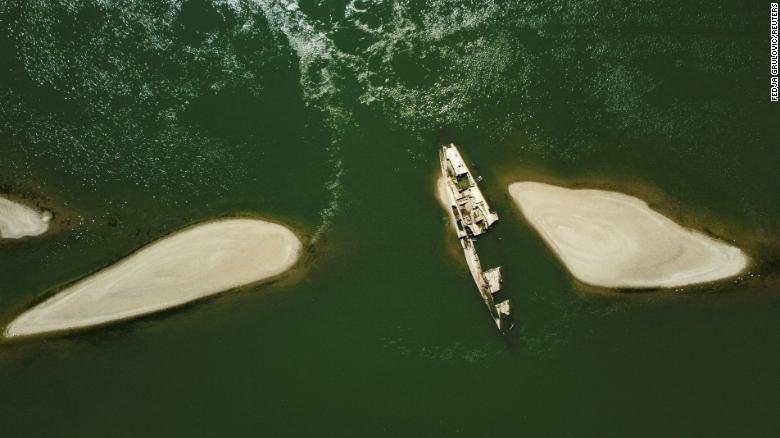

As a result of Europe’s worst drought in years, the mighty Danube has dropped to one of its lowest levels in almost a century, revealing the hulks of dozens of explosives-laden German warships sunk during World War II near Serbia’s river port town of Prahovo.
Hundreds of ships were scuttled along the Danube by Nazi Germany’s Black Sea fleet in 1944 as they fled from advancing Soviet forces; today, they still impede river traffic during low water levels.
More than 20 sunken ships have been exposed on a stretch of the Danube near Prahovo in eastern Serbia due to this year’s drought, which scientists attribute to human-caused global warming.
Velimir Trajilovic, a 74-year-old pensioner from Prahovo who wrote a book about the German ships, said, “The German flotilla has left behind a big ecological disaster that threatens us, people of Prahovo.” Workers in the local fishing industry, including those from neighbouring Romania, are also at risk.
River traffic on vital arteries in other parts of Europe, such as Germany, Italy, and France, has been snarled due to months of drought and record-high temperatures. Dredging is being used by the Serbian government to maintain open Danube shipping channels. The Serbian government put out a request for proposals in March to remove the explosives and ammunition from the wrecks. The estimated price of the operation was 30 million dollars, or 29 million euros.
