

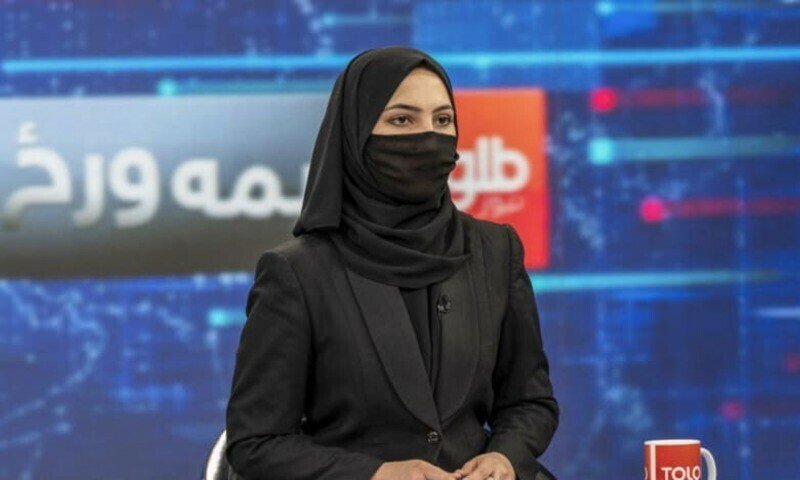

KABUL: Sunday’s broadcast of Afghanistan’s biggest news networks saw female presenters hide their faces, a day after rejecting a Taliban order to do so.
A number of limitations on civil society have been implemented since the Taliban’s takeover of power last year, many of which focus on reigning in women’s rights to adhere to the stringent interpretations of Islam that they preach.
In a recent decree, Afghanistan’s supreme commander Hibatullah Akhundzada ordered women to wear the traditional burqa or similar head covering when out in public.
TV presenters were required to follow suit starting Saturday by the Ministry for the Promotion of Virtue and Prevention of Vice.
They disregarded the injunction and went on broadcast with their faces showing, only to return to the directive on Sunday.
Women presenters and reporters presented morning news bulletins on popular stations including TOLOnews, Ariana Television, Shamshad TV, and 1TV while wearing complete hijabs and face-covering veils.
In an interview with AFP, TOLOnews anchor Sonia Niazi said that she and her colleagues “resisted and were against donning a mask.”
ToLOnews was forced and informed that “any female presenter who appeared on TV without covering her face had to be offered another position or dismissed,” she added.
“We had to wear it since it was required of us and forced on us.”
A headscarf was originally the only requirement for female presenters.
Khpolwak Sapai, the director of TOLOnews, stated that the channel was “forced” to implement the order.
“It was explained to us that it’s your obligation. There is no other way’,” Sapai told AFP.
“I was summoned on the telephone yesterday and was ordered in strong terms to do it. So, we’re not doing it because we want to, but because we have no other alternative.”
To show their support for TOLOnews’ female presenters, male journalists and staff donned face masks on Sunday, according to an AFP report.
Some of the channel’s female staffers continued to work while keeping their faces out in the open.
Mohammed Akif Sadeq Mohajir, a Ministry of Information spokesperson, stated that officials welcomed the media’s adherence to the clothing code.
In an interview with AFP, he said, “We are pleased with the media outlets for how they have handled this obligation.”
Also, according to Mohajir, the authorities do not have a problem with female presenters working in media outlets.
“They will not be removed from public view or sidelined, and they will not have their right to work taken away”, he said.
Those who do not adhere to the clothing code mandated by Akhundzada’s proclamation will face dismissal from the government.
The spouses and daughters of government employees might also be suspended if they do npt abide by the rules.
According to officials, media managers and guardians of recalcitrant female presenters might face fines if the directive is ignored.
Women and girls in Afghanistan have achieved only a little progress under the United States’ two-decade-long military engagement.
Taliban leaders quickly pledged to soften the strict Islamist rule that characterised them during their first tenure in office, which lasted from 1996 to 2001.
However, since the takeover, women have been prohibited from travelling alone and adolescent females have been prevented from secondary education.
Many women in the conservative countryside continued to wear a burqa for the next 20 years after the Taliban were driven from power in 2001.
In contrast, most Afghan women, including TV presenters, choose to cover their hair with the Islamic headscarf.
On the orders of Taliban officials, television networks have already ceased airing dramas and soap operas that include women.
